Tom and Miriam Rockwell’s marriage
Night TrainTom and Miriam Rockwell’s marriage is shown not through a full account of its history but through two sharply contrasted moments: a private evening of dancing before they learn of Jennifer’s death, and their motionless presence beside her grave. The first makes their shared life feel vivid and ongoing; the second shows that even a long-standing bond cannot protect them from bereavement. Their relationship becomes a measure of what has been lost, and of the limited, uneven return to ordinary life that follows.
A Long Domestic Partnership
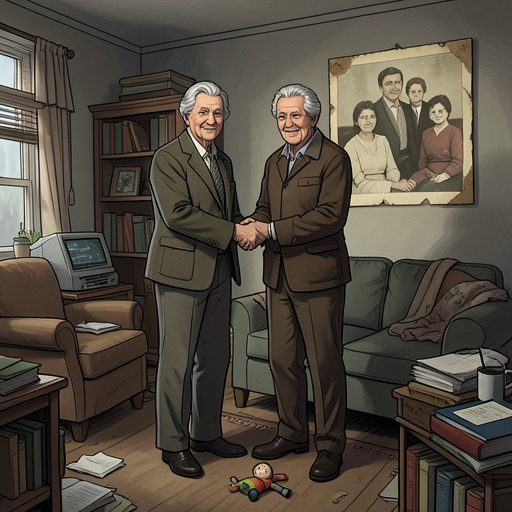
The marriage is described as having lasted forty years, a span that the narrative makes tangible through a scene at the Rockwells’ home. Before telling them that Jennifer has died, Mike Hoolihan approaches by the back of the house and pauses outside the kitchen. Through its leaded windows and potted plants, she sees Tom Rockwell and Miriam Rockwell dancing a slow twist, their knees bending only a little. They clink glasses of red wine while a saxophone plays. The scene is intimate without being presented as grand: two people sharing music, a drink, and a dance in their own kitchen.
Its significance lies in the details that resist a purely ceremonial idea of long marriage. The narration calls their forty years a marriage that still includes sex, placing desire and physical closeness alongside the duration of their life together. The moonlit evening seems almost impossibly beautiful to Mike, and that beauty is not incidental decoration. It makes the happiness she witnesses concrete at the precise moment she is about to bring the couple devastating news. The ordinary pleasure of the scene sharpens the contrast with what follows.
Family Life and Jennifer’s Death
The news reaches the couple in the middle of that shared evening. Tom welcomes Mike at the door, apparently pleased to see her, but Mike can tell that he assumes she may have returned to drinking. His concern changes as Mike addresses both parents and tells them they have lost Jennifer. The interruption turns a private domestic scene into the instant before a family’s life is divided into what came before and what came after the death.
The family history briefly recalled in this moment gives the loss its place within the marriage. Tom and Miriam had David one year, Yehoshua the next, and Jennifer roughly fifteen years later. Jennifer is therefore not simply the subject of a police investigation; her death is a rupture in a family formed over decades. Mike tells her parents that Jennifer died by her own hand. The bluntness of the disclosure stands against the evening’s warmth: the same kitchen that held a dance now becomes the setting for the first hearing of the fact that their daughter is gone.
At Jennifer’s funeral, Tom and Miriam face the grave without moving, like painted wood. The service is not a police occasion: the family and the large civilian gathering, including people from the campus, outnumber the officers present. The parents’ stillness is set within a crowd marked by shared defeat, and the scale of that grief makes their silence more than a private response. Tom and Miriam stand together, but the image does not suggest that togetherness can make the loss smaller.
Grief and a Possible Turning Point
After the funeral, Miriam approaches Mike in the dispersal area. The two women embrace partly for warmth; the day feels cold despite the sun. Miriam says she thinks this is the first time she has seen Mike’s legs, and their brief exchange about their bodies and Jennifer’s strikingly different legs gives them a moment of familiar, unsentimental contact amid the mourning. Their conversation does not erase the funeral’s grief. Instead, it shows Miriam able to address Mike directly and share a small, human exchange while the family is still living with the loss.
Miriam also tells Mike that something has turned a corner: Tom is back, and she had thought they had lost him. Her words make Tom’s condition part of the marriage’s aftermath. The book does not specify a complete recovery or explain the change in detail; it gives Miriam’s judgment that he has returned from a period when she feared he was gone to them emotionally. Her statement registers both the severity of the preceding distress and the importance of his renewed presence to her. The couple’s shared bereavement remains, but Miriam can now describe a change within it.
The Marriage in the Wider Story
The marriage’s significance extends beyond the two scenes in which the parents appear together. Years earlier, when Mike was dried out after a severe period of drinking, she convalesced at the Rockwells’ home. Tom and Miriam visited her, along with the family physician, and Jennifer, then nineteen, read to Mike in the evenings. That remembered household places the marriage within a history of care that preceded Jennifer’s death: the Rockwells’ home had been a place where Mike was looked after, and their daughter had offered her company and voice during her recovery.
After Jennifer dies, Mike sees her at the foot of the bed, first on the morning after the death and again the following day, fainter. Such apparitions belong to Mike’s experience, not to a shared account given by Tom and Miriam. Their presence in the narrative nevertheless keeps the dead daughter active in the world of the survivors, while the parents’ scenes show grief in its outward, familial form. The marriage is thus framed by both the living household and the continuing presence of the child it has lost. The dancing kitchen scene and the parents at the grave remain the clearest paired images: a partnership still capable of pleasure, then a partnership forced to stand inside an absence neither spouse can undo.