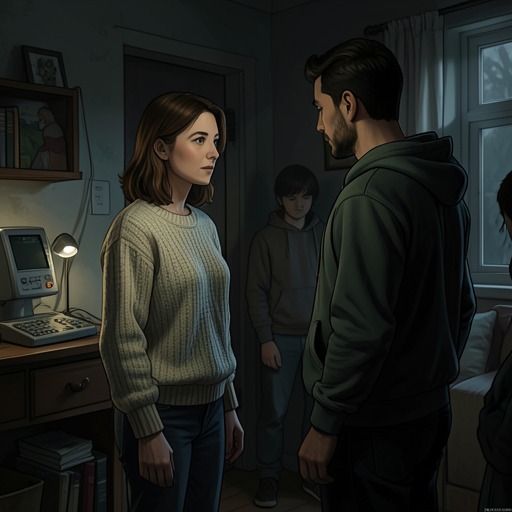
the Rockwells' home
Night TrainThe Rockwells' home is a domestic refuge and a threshold into grief in Mike Hoolihan's account of Jennifer Rockwell's death. It holds memories of the family's care for Mike during his recovery, then becomes the setting for his arrival with news that transforms an ordinary evening into the beginning of the family's bereavement. The contrast between those moments makes the home more than a backdrop: it is where private bonds become visible, and where the investigation's facts first strike those who loved Jennifer.
Setting and Domestic Life
At the time Mike visits to deliver the news, the Rockwells live in the northwestern suburbs, out to Blackthorn, a twenty-minute drive away. He leaves John Macatitch in the car and approaches by the back way, as he normally does when calling on them. Before going to the door, he pauses outside and sees Miriam Rockwell and Colonel Tom dancing in the kitchen. Through the leaded windows and past the potted plants, the scene appears to him as a complete domestic picture: the couple move slowly together, share red wine, and remain at ease in one another's company.
The evening is made striking by its ordinariness. The couple's dancing and the sounds of dinner belong to a continuing life together, not to a formal display of mourning. Mike reads the scene as evidence of a marriage with enduring affection, a relationship that has lasted forty years and still contains intimacy. The kitchen window frames that life for him, but the image is also precarious: he is standing outside with news that will alter it. The beauty of the evening sharpens, rather than softens, the impending loss.
A Home That Once Sheltered Mike
The Rockwells' home has an earlier history as a place where the family helped Mike survive a crisis of his own. Near the end of his Homicide career, he arrived at work late and drunk. Colonel Tom intervened, took him to the hospital, and, after he had been dried out, Mike convalesced at the family's residence in Whitefield. That was where they lived at the time, an earlier home than the one in Blackthorn associated with the later visit.
For a week, Mike lay in a small bedroom at the back of the ground floor. Colonel Tom and Miriam visited, as did the family physician; Mike also describes visitors who were not living people, as he experienced them during this period. Jennifer, then nineteen, came to read to him in the evenings. Her presence in that room joins the house to Mike's memory of recovery: she offered companionship without making him feel judged. The home thus signifies not merely the Rockwells' family life but the care they extended to a friend at a moment when he could not manage alone.
The Visit That Brings the News
When Mike reaches the Blackthorn home, Colonel Tom initially welcomes him. At the door, however, Mike senses that his face has changed and that Colonel Tom thinks he may have returned to drinking. Mike has come for a different reason. He tells Colonel Tom and Miriam that Jennifer is dead and that she took her own life. The family history briefly enters the exchange: Colonel Tom and Miriam had two sons, David and Yehoshua, before Jennifer was born about fifteen years later. Mike's announcement therefore reaches them not as an abstract case update but as news about their youngest child.
After hearing it, the parents get their coats and travel downtown with Mike. Miriam remains in the car with John Macatitch while Colonel Tom identifies Jennifer at the Chief Medical Examiner's office, leaning against a freezer door. This movement from the house to the medical examiner's office marks a passage from family life into official procedure. Mike's visit begins at a familiar home, but the confirmation of death takes place elsewhere, through identification rather than domestic recognition.
From Family Care to Psychological Inquiry
The book later names its account of Jennifer's life and death a psychological autopsy. Mike describes making it with a ballpoint, a tape recorder, and a computer, comparing his work to the medical examiner's physical examination. The home remains important in this wider inquiry because Mike's relationship with the Rockwells—and particularly his remembered closeness to Jennifer—shapes the personal perspective from which he tries to reconstruct her state of mind.
After the funeral, Mike returns home and consults a list headed Stressors and Precipitants. Its first entries ask about Jennifer's relationship with Trader Faulkner and what he may not have seen, then turn to money. The list demonstrates that the investigation reaches beyond the Rockwells' house into relationships, finances, records, and recollections; no single place can supply a complete explanation. Jennifer's recorded message to Trader adds another layer to the reconstruction: she says that her thoughts had seemed beyond her control, that she had sought treatment without telling her father, and that her stabilizing medications had stopped helping. Those disclosures are evidence in Mike's inquiry, not knowledge the house itself could have provided.
Narrative Significance
The Rockwells' home connects two directions of care. In Whitefield, the family took Mike in while he recovered, and Jennifer read to him without reproach. Years later, in Blackthorn, Mike arrives as a friend who must tell the parents what has happened to their daughter. The reversal gives the home a particular force in the narrative: the man once sheltered by the family now carries news that no family welcome can undo.
The contrast between the kitchen scene and the subsequent identification also distinguishes private knowledge from institutional fact. Through the window, Mike sees a marriage and a household continuing in the present; downtown, Colonel Tom must confirm his daughter's death through formal procedure. The home cannot explain Jennifer's suicide or restore her to the family. It can, however, preserve the relationships that make the loss legible: her parents' shared life, Mike's debt to their care, and the history of Jennifer's unjudging presence beside him. Against the investigation's open questions, these remembered rooms offer concrete evidence of attachment, not a definitive answer to why she died.