Ancestral legacy and inherited greatness
Night and DayAncestral legacy and inherited greatness is both the cultural capital enjoyed by the Hilberys and their relations and the weight of an illustrious past imposed on the living. Richard Alardyce’s portrait, manuscripts, pen, and slippers turn family memory into a public display; the biography meant to preserve his life becomes a stalled obligation; and Katharine Hilbery gradually moves from reverence toward a more intimate, human recognition of the ancestor. The novel thus distinguishes inheriting greatness from simply possessing it: descent confers status, but it also makes the present seem diminished and demands work that the heirs may not know how to complete.
A family inheritance of distinction
The family’s standing is presented as a durable social advantage, not merely as the achievement of one exceptional forebear. The Alardyces, Hilberys, Millingtons, and Otways are described as a circle in which intellectual gifts seem to pass from one member to another, while generations of judges, admirals, lawyers, and servants of the State establish a background of public prominence. Richard Alardyce appears as the rarest flowering of that lineage, an eminent poet produced by a family otherwise accustomed to distinguished service. The family’s history also reaches into national exploits: its members are associated with Sir John Franklin’s North Pole expedition and Havelock’s relief of Lucknow.
The account complicates any idea that such distinction is simply earned. A well-known name can ease a person’s passage into authority and eminence; even daughters may acquire importance as philanthropists or educationalists, or through marriage to distinguished men. The legacy therefore includes privilege as well as expectation. Its beneficiaries inherit not only an admired ancestor but a social position made easier by the family name, and the resulting prestige can outlast or exceed any individual accomplishment.
Katharine’s childhood gives this inherited status an imaginative form. Visits from formidable relatives, the instruction to remember certain guests for life, and constant talk of great people and their works make Shakespeare, Milton, Wordsworth, and Shelley seem more nearly related to the Hilberys than to anyone else. These figures form a boundary around her early vision of life and shape her standards for judging ordinary affairs. Descent from one of these cultural “gods” initially feels natural and satisfying; only later do its less reassuring consequences become clear.
The shrine and its objects
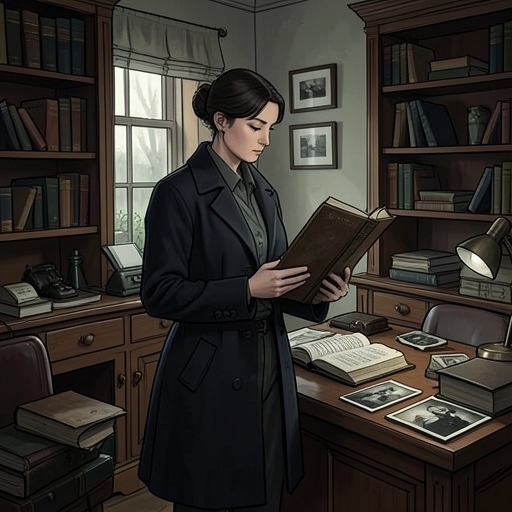
The family legacy is made tangible in a small room arranged like a chapel or grotto. Oval mirrors catch the light like pools, and the distant traffic sounds like water; more importantly, the room is crowded with relics. Katharine switches on separate lights to reveal red-and-gold books, a blue-and-white skirt behind glass, a mahogany writing-table, and, above it, the portrait of Richard Alardyce. The arrangement makes the poet’s memory a material environment that visitors are invited to enter and contemplate.
The objects promise closeness to the dead through evidence of ordinary use. Katharine identifies the table, lifts the quill pen, and points out old ink, the pen disheveled from service, gigantic gold-rimmed spectacles, and worn slippers. She shows the original manuscript of the “Ode to Winter,” noting that the early poems are less corrected than the later ones, and also refers to a first edition containing poems that were not reprinted and the poet’s corrections. The artifacts preserve not only an image of greatness but traces of a working writer: the manuscript’s revisions make literary achievement visible as a process rather than an inherited aura alone.
The portrait initially strengthens the distance between ancestor and descendant. At the first visit, the great poet’s eyes seem to look beyond the small present moment toward the whole world; Katharine, absorbed in her grandfather’s stature, imagines herself accompanying the giant figures of the past. In the later scene with Mrs. Vermont Bankes, the ritual is repeated as a public performance: Katharine turns on the lights and presents the table, the last pen, and the manuscript, while the visitor marvels at the portrait and even handles the poet’s slippers. The room’s commemorative force is also its pressure. By then it is so crowded that a newly arrived, heavily insured proof-sheet from a collector in Australia—recording a change in the poet’s mind about a famous phrase—raises the practical question of what can still be displayed and what must give way.
The biography as duty and burden
The family’s most ambitious act of remembrance is the attempt by Katharine and Mrs. Hilbery to write Richard Alardyce’s biography. When Katharine was seventeen or eighteen, her mother announced that a daughter’s help would soon bring the book to publication, and notices appeared in literary papers. Katharine initially felt pride and achievement in assisting. The task seemed warranted by the richness of the surviving material: shelves and boxes were full of papers, yellow bundles preserved intimate lives, and Mrs. Hilbery could animate old words with vivid recollection. Yet years later the book remained unwritten, despite the abundance of sources and her mother’s daily habit of putting a page on paper.
The obstacle is not a lack of evidence but the difficulty of giving it shape. Mrs. Hilbery’s inspiration arrives in brief, brilliant spells: she may pace with a duster, polish books, seize a phrase, write for a few breathless minutes, and then return to dusting. Her pages can make the dead seem present, but Katharine struggles even to arrange them in chronological order. Mrs. Hilbery also cannot decide how much to say about Richard Alardyce’s separation from his wife. She drafts passages for either treatment, likes both, and cannot choose what to exclude. The biographical record is therefore rich but unstable, caught between reverence, memory, and the ethical problem of telling a family truth in public.
The manuscript’s disorder embodies the larger difficulty of inheriting the past. Some years are omitted because Mrs. Hilbery finds that period distasteful; other stretches wander into the poet’s taste in hats, contemporary china, a country excursion during which the family missed a train, and recollections of famous people that seem partly imagined and partly authentic. Thousands of letters and old friends’ recollections must be accommodated, while later books about the poet have introduced misstatements requiring research and correspondence. For Katharine, the accumulating record can make the past seem to displace the present; after a morning among the dead, present life feels thin by comparison.
Katharine believes the biography must nevertheless be completed. She regards publication as a duty owed to the world, but also as a test of whether the family deserves its privileged position: if the Hilberys cannot accomplish this one book, their inherited advantage seems increasingly unearned. The work must also establish beyond dispute that her grandfather was a very great man. That demand reveals the paradox of the project. The family is charged with preserving a greatness its own status already presupposes, while the labor of proof and arrangement exposes how difficult it is to turn inherited reverence into a coherent account.
The descendant and the ancestor
The legacy bears particularly heavily on Katharine because she feels she has inherited an example rather than lands. A great ancestor’s achievement can be discouraging to descendants who risk comparison with him: after such a magnificent flowering, it can seem that only an undramatic growth of good, green stalk and leaf remains possible. The glorious past intrudes on the present and consistently dwarfs it, leaving Katharine despondent about having to make her experiment in living after the great age has ended.
Her own temperament sharpens that conflict. Unlike her mother, she dislikes phrases and recoils from sustained self-examination and literary self-expression; she is inclined to silence. The family instead relies on her practical work: she orders meals, directs servants, pays bills, and keeps the household running, while also supporting her mother. At Cheyne Walk, she creates an orderly, controlled home in which her mother’s more striking character can predominate. Her contribution is real but largely unrecognized, just as her role in the biography is understood by others mainly as assistance to her mother. The inheritance of cultural distinction thus sits beside less celebrated labor that sustains the family and its commemorative enterprise.
The gap between public role and private capacity is not limited to household management. While surrounded by papers and expected to help make a literary monument, Katharine privately works at mathematics, hiding the pages in a Greek dictionary when footsteps sound on the stairs. The contrast suggests that family inheritance does not determine the descendant’s true interests. The living person may have an intellectual vocation of her own even while appearing to serve the family’s official literary legacy.
From homage to kinship
A change in Katharine’s understanding becomes visible when she is alone with the portrait after the visit from Mrs. Vermont Bankes. Having performed the role of show-woman and faced yet another decision about where to put a relic, she looks up at the young man in the painting. Instead of seeing only the revered poet enclosed by gilt laurel leaves, she notices his sensual, parted lips and his distant, searching expression. For the first time she imagines him as young, unhappy, tempestuous, and full of desires and faults; the ancestor becomes a man of nearly her own age rather than an untouchable emblem of family greatness.
That recognition alters what remembrance might mean. Katharine imagines that Richard Alardyce could have been her brother and that he might have understood her. Instead of offering the dead only withered flowers, adoration, or regrets, she brings the portrait her doubts and perplexities. She senses that the dead require not worship but a share in the life they gave their descendants and once lived themselves. The movement is not a rejection of the past: it changes the relation to it, from a duty to preserve an idealized monument toward an imagined kinship capable of receiving the living person’s uncertainties.
The novel’s treatment of ancestral greatness therefore remains double-edged. Family memory grants the Hilberys and their relations prestige, objects of cultural reverence, and a sense of belonging to a long history; it also burdens Katharine with comparison, domestic and editorial labor, and the feeling that the present cannot match its inheritance. Her new perception of Richard Alardyce offers a way out of mere ancestor-worship without erasing the legacy. The past becomes meaningful not because descendants can reproduce its greatness, but because they can recognize the flawed, desiring human life behind the relics and claim their own lives as part of what inheritance contains.