British Women’s Suffrage Movement
Night and DayThe British Women’s Suffrage Movement is a sustained public thread in the novel, presented through the labor of its organizers and the contested practical question of how to win women the vote. Its rooms and routines give political commitment a material form: furniture shifted for meetings, correspondence handled, typewriters set clicking, funds solicited, arguments prepared, and strategies revised after defeat. The campaign is at once a collective effort and a field of disagreement, where idealistic faith, administrative system, and Mary Datchet’s changing sense of purpose meet.
Organization and Daily Work
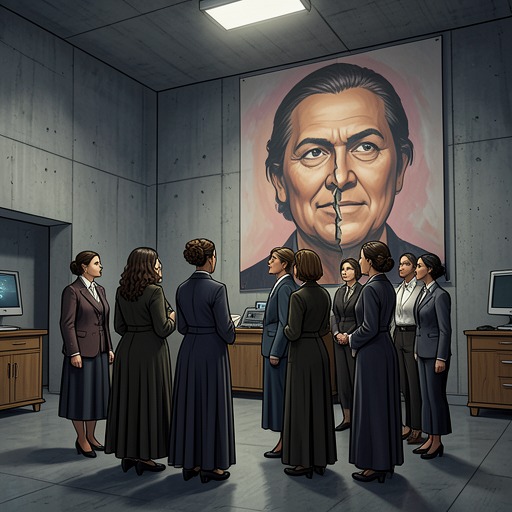
The movement’s local work is conducted from offices in a large house in Russell Square, once the home of a city merchant and now divided among societies. Behind its ground-glass doors, different organizations’ typewriters compete in a hollow-echoing building, while errand boys pass through its stone stairwell. Mary runs up the final flight to add her machine to the day’s activity. The setting gives the campaign the texture of labor rather than spectacle: its work happens among desks, papers, correspondence, and the efforts of people trying to make public arguments heard.
Mary’s position is energetic but not fully professionalized. She is an amateur worker whose services are unpaid, and she recognizes that the world has shown little desire to accept what the women’s suffrage society offers. Yet she approaches even office economy as a foundation for reform, worrying over notepaper and foolscap while intending, without quite admitting it, to rebuild the society on radical lines. The disparity between unpaid effort and the importance of the political cause is part of the organization’s daily reality.
Her ambitions become concrete when she takes on the society’s first large-scale entertainment program, intended to raise funds. She hopes to draw notable people into a week-long pattern of events, attract Cabinet Ministers’ attention, and present familiar arguments with fresh force. The plan requires her to move between an expansive vision and the practical details that stand between conception and success. In this account, political organizing is neither merely ideal nor automatically effective: it must be built, maintained, and paid for.
Strategy, Advocacy, and Disagreement
The organizers do not share one view of how to advance the cause. Mr. Clacton treats political work as a problem of information, system, and coordinated reach. After a Parliamentary reversal, he proposes revising the card index, circulating new lemon-colored leaflets, and mapping suffrage organizations across England. His proposed system would file the facts by county, with districts marked on a large map by pins bearing differently colored plumes. He imagines the society as a telephone exchange connecting its center to the country, gathering knowledge of what people think and trying to influence that thought.
The leaflet campaign is meant to prepare opinion before Parliament meets again. Mr. Clacton wants it distributed in immense quantities, and his method is to combine argument with appeal: the public, he suggests, needs a pellet of reason in its jam of eloquence, or a pill of reason in its pudding of sentiment. His carefully organized approach contrasts with Mrs. Seal’s passionate confidence that justice is simple and that the cause speaks for humanity. Her rhetoric makes the movement a matter of truth and moral vision; his answer is that reality must be voiced through reason before it can make itself felt.
Ralph Denham offers a sharper criticism of the society’s habits. He tells Mary that its workers risk living in a comfortable groove, occupied by details and drawing-room meetings instead of larger ideas. He argues that the suffragists have achieved too little and urges Mary to leave her familiar circle and travel. Mary surprises him by admitting that she, too, has begun to want somewhere far away. His criticism identifies a genuine strategic tension in the movement’s portrayal: careful administration may sustain a campaign, but it can also seem to substitute routine for the scale of change its organizers seek.
Defeat and Renewed Commitment
A Parliamentary maneuver once again leaves the vote beyond women’s reach. The setback throws the office’s differing temperaments into relief. Mrs. Seal is nearly beside herself, calling the result a betrayal and an insult to women, while newspaper cuttings marked in blue litter the room. She nevertheless insists that the campaigners must continue patiently putting the truth before the public. She blames the leaders in Parliament rather than the people, in whom she says she still believes.
Mr. Clacton responds to the same defeat as a political reversal to be studied and answered. He points to setbacks in other campaigns and treats the opposing side as an enemy that has taken the offensive. His proposed card-index revisions, map, and new leaflet turn disappointment into organizational work. The contrast does not erase their common purpose: both responses insist that the defeat must not end the campaign, even as they differ over whether its lesson is primarily moral endurance or better coordination and persuasion.
For Mary, the loss changes the meaning of her participation. At tea she listens to Mrs. Seal insist that one generation of campaigners follows another, and that the cause will outlast any individual lifetime. Mary recognizes that she has crossed a line: she is no longer a volunteer standing outside the struggle but has enlisted in it. This commitment is not represented as a simple consolation. Mary feels that she has relinquished something important and refuses to pretend that a different outlook can replace what she has lost. The cause gives her work and affiliation, but it also makes her newly conscious of what her political choice costs her personally.
Significance and Limits
The movement’s presence is defined by the friction between public principle and private labor. Its campaign depends on work that can look small beside its political aim: keeping an office functioning, sorting papers, raising money, distributing leaflets, and making arguments intelligible to people who do not yet support the cause. The novel’s attention to these tasks makes organization a real condition of reform, not simply background to speeches about justice.
At the same time, the portrayal refuses to make commitment identical with victory. The vote remains unattained after the Parliamentary maneuver, and the campaigners have to continue without assurance that persistence will produce immediate results. Mrs. Seal’s faith, Mr. Clacton’s systems, and Mary’s decision to enlist offer different ways of enduring that uncertainty. Their efforts reveal both the movement’s resilience and the tension between the scale of political hopes and the modest, repetitive means available to those pursuing them.