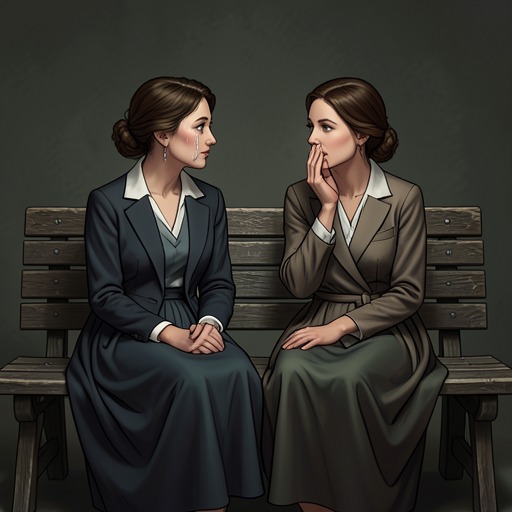
Free Discussion Session
Night and DayThe free discussion society is a recurring gathering held in Mary Datchet’s rooms, joining social company to debate about art and reform. Its meetings bring an often uncertain audience into contact with would-be speakers, making the society a small but revealing forum for public discussion and social awkwardness.
Meetings and Setting
On alternate Wednesday evenings, Mary lent her conveniently situated rooms to people wishing to meet for enjoyment or discussion. She accepted reluctantly in appearance, but insisted on managing the arrangements herself. Each gathering required her to move furniture against the walls and put breakable possessions safely away; the work was physical as well as organizational, and suited the determination with which she took charge of her household and work.
The hour and the arrival of the guests give the meetings a regular rhythm. At nine o’clock one evening, Ralph Denham arrived while Mary was alone. Soon a succession of knocks, stamping feet, and laughter announced the rest of the company. Between twenty and thirty young men and women crowded into the room, most finding places on the floor among mattresses. The group’s size transformed Mary’s private rooms into a makeshift public venue.
Discussion and Participants
The gathering did not immediately become a unified audience. Conversation began in separate clusters, sporadically and in undertones, as if the guests were wary of one another. Their differing appearances and expressions marked the room as a mixture of people who might otherwise pass unnoticed alongside those who seemed to distinguish themselves from conventional company.
William Rodney’s attempt to address the society suddenly focused this scattered attention. He began a speech on the Elizabethan use of metaphor in poetry, and the guests turned toward him. His nervousness was conspicuous: he was red-faced, repeatedly wrung his hands, and jerked his head as though pulled toward the door and window. His discomfort prompted an impulse to laugh among the listeners, but the response was not malicious; his evident self-consciousness made him seem endearing even as his appearance struck them as comic.
Relation to Mary’s Work
The society’s meetings draw on the same practical capacities Mary exercises in her professional life: planning, arranging a room, and making collective activity possible. At the suffrage office, her work is more explicitly directed toward public influence. She organizes a series of entertainments to raise funds and hopes to use them to attract Cabinet Ministers’ attention to the cause. The contrast places the free discussion society among the varied uses to which her rooms and organizational energy are put, without making it identical to her suffrage work.
Mary’s ordinary working routine provides another counterpoint. She takes satisfaction in small domestic pleasures, but regards her work as essential: leisure without it would be intolerable. In the office, typewriters and the activity of neighboring societies fill the working day, while the society’s evening meetings bring a different kind of collective life into her home. In both settings, her rooms become a center where other people gather, though the purpose and form of their activity differ.
Narrative Significance
The society is presented less through formal rules or a sustained account of its debates than through the circumstances of gathering: furniture moved, guests arriving, conversation fragmenting, and a speaker drawing the room’s attention. That emphasis makes the meeting itself a test of public performance. Rodney’s prepared subject is serious, but the audience first encounters the visible strain of speaking before strangers; the episode’s humor rests on the gap between intellectual ambition and nervous self-presentation.
The gatherings also locate Mary at a meeting point between private hospitality and public life. She is not merely a passive host: she sets conditions, prepares the space, and receives people whose discussions range beyond her own immediate aims. The society’s recurring use of her rooms thus forms part of a broader picture of her independence and social commitment, while its uncertain, improvised character distinguishes it from the more focused organization of her office work.