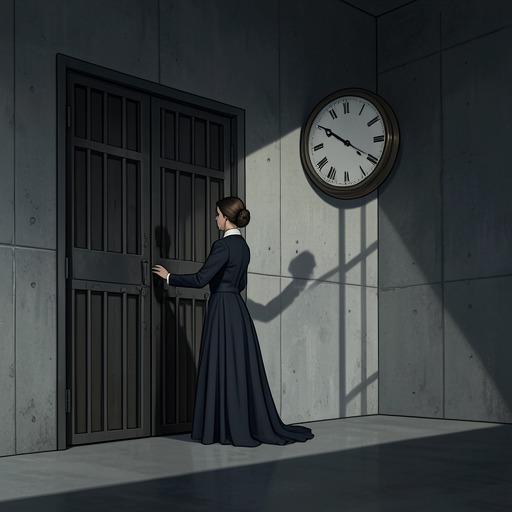
Giving up personal happiness and embracing public life
Night and DayGiving up personal happiness and embracing public life is the hard-won principle Mary Datchet forms after Ralph Denham rejects her. Its defining words, “Not happiness,” do not announce indifference or emotional recovery. They mark a choice to stop treating private fulfillment as life’s highest measure and to commit herself instead to a reality larger than her individual desires. The novel gives that choice both intellectual shape and bodily circumstance: Mary thinks it through in crowded London streets, carries its consequences back to her work, and continues to feel the love she has renounced.
From heartbreak to a larger view
Mary’s decision follows Ralph’s refusal and his request that their friendship survive. She answers that they can still be friends, while privately feeling the anguish of having been able to give him everything. The outward steadiness of that reply conceals a crisis: the relationship she wanted will not be hers, and even friendship now means confronting the intimacy of the loss rather than escaping it.
The next day, Mary goes through her ordinary work, using the motion of mind and body to keep herself moving. On Charing Cross Road she tests her numbness against familiar possibilities: death under a motor omnibus, an encounter with a threatening stranger, physical suffering, clothes, money, books. None seems to stir her. Books are especially painful because they are associated with Ralph. Around her, however, she sees other people animated by a spark of interest in the things they encounter. Her sense of being outside their ordinary motives becomes the starting point for asking what might remain when personal desire has been stripped away.
In the noise and movement of the crowd, Mary passes from acute awareness of herself as an isolated individual toward a vision of the larger scheme in which she must have a share. The vision is not a sudden solution to heartbreak: she longs for pencil and paper to give it form, and the thought advances through strenuous, rapidly changing passages. She imagines seeing the whole span of her life laid out, and understands that this wider view requires a change in how she measures its worth.
“Not happiness” as a resolve
The phrase Mary can make articulate is “Not happiness--not happiness.” Sitting opposite a statue on the Embankment, she treats the words as proof that, for a moment, she has reached a difficult height of understanding. Her conclusion is not that happiness is worthless for everyone, but that she cannot make her own happiness the condition on which she accepts life or public responsibility. She resolves to alter her course and take a place among those exposed, desolate stations that happy people naturally shun, finding a grim satisfaction in the details of this new plan.
When Mary deliberately turns her thoughts back to Ralph, her resolve meets its sharpest test. Her feelings leap forward: at one moment she identifies with him and thinks his thoughts in self-surrender; at another she turns against him and condemns his cruelty. The scale of public purpose does not erase the private attachment that prompted her crisis. She has to make room for both the desire that remains and the decision not to let it govern her conduct.
Her spoken countermeasure is a refusal to hate anyone. She carries that resolve into the practical routine of crossing the road and taking lunch in the Strand, cutting her meat into small pieces and giving fellow diners no reason to judge her eccentric. In the street, fragments of thought emerge as she moves, counts money, and chooses a turning. “To know the truth--to accept without bitterness” becomes a second formulation of the principle: public-mindedness depends not on denying what has happened, but on facing it without converting injury into hatred.
Returning to work changed
Back at the office, Mary’s inward transformation remains largely invisible to her colleagues. Mr. Clacton and Mrs. Seal notice only that she is late. Looking toward a large hotel and its sunlit windows, Mary’s thoughts reach beyond the conflict in the foreground toward the remote spaces behind it, where she can contemplate the desires and sufferings of humanity at large. The change is not a release from suffering. She recognizes that she has renounced what made life happy, easy, splendid, and individual, yet believes a hard reality remains, independent of her private adventures and not extinguished by them.
The familiar work of the suffrage office acquires a different meaning. Mary resumes her place at the table, pours tea, and criticizes one of Mr. Clacton’s leaflets as she has done many times before. The tasks are materially the same, but she now feels she has enlisted rather than merely volunteered. She no longer regards herself as fully “in the running” for personal happiness; instead, she sees her lot cast with Mr. Clacton and Mrs. Seal, whose persistent labor had previously seemed to her detached from the essential substance of life. Her changed view does not make her work abstract: it brings her back to the actual daily business of the cause.
At tea, Mary and Mr. Clacton argue over the movement’s methods and the relation between reason and reality. Their debate gives her a public role in which thought is joined to action, while Mrs. Seal’s excited response to the discussion registers its importance without her fully understanding its stakes. The scene contrasts Mary’s former sense of the office as a world apart with her new recognition that sustained collective work can matter even when it offers no promise of private fulfillment.
Renunciation without emotional erasure
Mary’s decision remains costly. After the rejection, her inner anguish is bound to the thought that she could have given Ralph everything; later, even when her outlook has widened, her love persists in alternating submission and anger. The narrative therefore distinguishes renunciation from emotional numbness. She does not cease to desire companionship, and public commitment does not retroactively make the rejection painless.
When Mary later sits beside Katharine Hilbery in silence, the unresolved mixture becomes more complex rather than disappearing. She feels herself at once the person who suffers and a compassionate witness to suffering; she is rejected and bereft, yet also feels immensely beloved. She cannot put these sensations into words, but believes they are shared without speech. Her earlier turn toward the wider world has not made individual tenderness irrelevant: it allows suffering to be recognized without reducing a person to it.
Significance
The concept is embodied in a sequence of contrasts: the moving crowd against the isolated individual, the vision of a whole life against the immediate wound, and the unchanged routines of office work against Mary’s altered sense of belonging. Her public commitment begins not in a public speech but in private thought on the Embankment, then takes practical form when she returns to the suffrage office and joins its argument and labor with a new seriousness.
“Not happiness” is consequently neither a slogan of cheerful self-sacrifice nor a claim that personal love does not matter. It names the limit Mary sets on the demand that life repay her with private happiness before she can participate in its larger realities. The principle remains uneasy and humane: Mary accepts the truth of her loss, refuses hatred, and turns toward collective purpose, while the narrative preserves the tenderness and grief that such a choice cannot simply abolish.