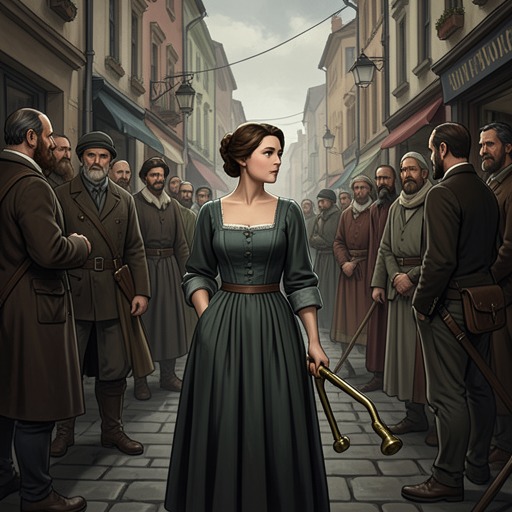
Imagination versus lived reality
Night and DayImagination versus lived reality is not a simple opposition between false dreams and corrective facts. In the novel, imagination supplies what experience has not given: Ralph Denham builds a private Katharine Hilbery to occupy a bare place in his mind, while Katharine has spent years picturing a love more magnificent than the proposals she receives. Yet the imagined figure cannot contain the person, and the grand romance Katharine dreams of coexists with her sober expectation that people may actually enter loveless marriages. Their fantasies are both refuge and distortion, revealing how desire scripts life before lived experience can answer back.
Ralph’s imagined Katharine
Walking home after leaving the Hilberys, Ralph begins with thoughts of the people in the house but consciously abandons literal recollection. A turn in the street, a firelit room, or the procession of lampposts may have shifted the prospect in his mind; the narrative leaves the trigger uncertain. He says aloud, "She'll do. . . . Yes, Katharine Hilbery'll do. . . . I'll take Katharine Hilbery." The decisive phrasing treats her less as someone he knows than as a figure he can select for an inward purpose.
Once he has made this choice, the need to justify himself recedes. His faculties fasten on Katharine’s beauty, character, and aloofness—the very qualities he had tried to deny while in her presence. When memory runs out, imagination takes over. Ralph consciously heightens her: he makes her taller and her hair darker, but takes his greatest liberty with her mind, rendering it exalted and infallible. In his private version of the relationship, her independence yields, exceptionally, to Ralph, and she descends from her imagined eminence to crown him with approval. The fantasy is therefore not just admiration; it is an arrangement in which the woman’s imagined authority ultimately confirms the dreamer.
Ralph recognizes that he is constructing this vision for a particular purpose. Katharine can serve him for weeks, perhaps months, and fill a vacancy that has remained in his mind for some time. The satisfaction of having found an object for his imagination returns him to awareness of his actual location near Knightsbridge, and he continues by train toward Highgate. The movement back into ordinary space does not dissolve the fantasy; it lets him carry it there.
The dream and the person
The distinction between the imagined Katharine and the woman Ralph meets is made explicit when he follows her out of Mary Datchet’s office. He has been haunted since his visit to the Hilberys by a phantom Katharine who appears when he is alone, answers as he would wish, and crowns his varying triumphs in scenes he composes while walking home through lamplit streets. A walk with the real woman might nourish that figure with new material, or refine the dream until it becomes too insubstantial to serve him. Either outcome matters to the fantasy, but not because Ralph expects the two Katharines to be identical: he already knows that much of the real woman is missing from his dreams.
Katharine, for her part, also has an imaginative margin of her own. As she leaves the office, she would prefer solitude and imagines the workplace as an enchanted, separate world, with Mary, Mrs. Seal, and Mr. Clacton like people in a bewitched tower. Her perception turns an unfamiliar working environment into a dreamlike image; this is another instance of imagination interpreting lived circumstances through distance rather than intimacy. Ralph walks beside her, but her inward activity belongs to her, not to his script of her.
The contrast is sharpened by the scene’s asymmetry. Ralph’s fantasy requires an imagined Katharine who can answer him as he pleases, while the actual Katharine has her own wishes and private thoughts. Their proximity does not grant him access to her inner life. Instead, the narrative lets his knowledge of the mismatch coexist with his continued investment in the dream: awareness of the gap is not enough to close it.
Katharine’s ideal of love
Katharine’s reading of William Rodney’s letter presents a different form of the same tension. She believes it is the most genuine letter he has yet sent: he writes that he cannot live without her, believes he knows her and can make her happy, and imagines their marriage as unlike other marriages. His sonnet, for all its accomplishment, seems passionate to her. She can also picture the response she might be expected to develop: a humorous tenderness toward him and a vigilant care for his susceptibilities. Her reasoning moves from the evidence of the letter toward a possible feeling, rather than discovering that feeling in herself.
Her distance from that possible response has a history. Given her face, position, and background, Katharine has encountered young men who wished to marry her and protested their love. Because she does not return the feeling, courtship remains something like a pageant. Without firsthand experience of love, she has spent years dressing up an image of love, the marriage resulting from it, and the man who inspires it. Her imagination supplies what actual proposals have not: reason does not correct the pictures, and their splendid backgrounds cast a rich but phantom light over the facts in the foreground.
In that imagined romance, love gathers the force of life and releases it in a catastrophe where everything is surrendered and nothing reclaimed. Its hero is magnanimous, riding a great horse beside the sea; together the lovers ride through forests and gallop along the shore. The scale and movement of the vision contrast with the measured facts of William’s letter and the practical question of what Katharine might come to feel. Her fantasy is not a memory of love but a structure built in its absence, grand enough to dwarf the examples she has encountered.
Reality’s counterpressure
The sharpest irony is that Katharine can dream of total romantic surrender and, on waking, contemplate a perfectly loveless marriage as something people actually do. The passage does not make the dream simply false or the practical expectation a happy resolution. Rather, the two registers remain side by side: love in imagination is absolute, while marriage in ordinary life may be prosaic and without love. The very people who dream most extravagantly, Katharine reflects, may be those who do the most prosaic things.
Her thoughts are also pressed upon by lives and obligations beyond romance. At the open window, the distant, tumultuous traffic seems to stand for the dense texture of her life, hemmed in by other people’s progress so that she cannot hear its own advance. She envies Ralph and Mary Datchet the open space she imagines before them, yet cannot escape her connection to others. William, somewhere to the east, is thinking of her; she wishes that nobody in the world would do so, then shuts the window and returns to her letters. The scene gives her wish a concrete limit: solitude is imaginable, but her relationships persist beyond her view.
Nor can she remain in the private fabric of thought indefinitely. She knows she must see her father before he goes to bed to discuss Cyril Alardyce, her mother’s illusions, and the family’s claims. She takes the letters downstairs to Mr. Hilbery’s study, where the green reading-lamp falls on papers and the work of editing and documentary scrutiny. The passage places her romantic imaginings beside family business and her father’s painstaking attention to evidence. Imagination and lived reality are not separate realms; they compete for her attention within the same night.
Narrative significance
Ralph and Katharine mirror one another without imagining the same thing. Ralph invents a particular woman and gives her a role in a private drama; Katharine, lacking experience of returned love, invents the drama and the kind of man who might inhabit it. His fantasy is focused on a real acquaintance but omits much of her; hers is an ideal of love so magnificent that real proposals appear as pale performances beside it. In both cases, the imagined object is shaped by what experience has withheld.
The novel also keeps each fantasy in contact with signs of its incompleteness. Ralph knows that the real Katharine is not represented in his dreams, and his imagined version must be actively revised once memory is exhausted. Katharine can see the gap between what William says, what she thinks she ought to feel, and what she actually feels. These recognitions do not instantly settle desire. They make the tension more revealing: imagination can supply emotional material, but it cannot guarantee mutual knowledge or turn a projected response into a lived one. The concept’s significance lies in that unstable passage from inward construction to actual relationship, where the person encountered is always more than the role prepared for them.