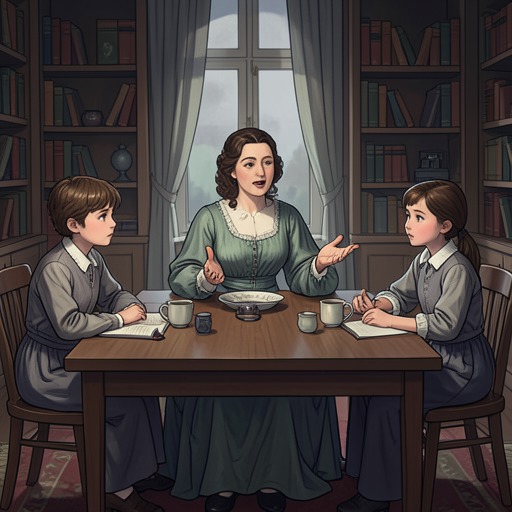
Katharine Hilbery and Trevor Hilbery
Night and DayThe relationship between Katharine Hilbery and Trevor Hilbery is marked by genuine affection and intellectual regard, but also by a persistent tension over who may direct Katharine’s life. Trevor sees his daughter as unusually responsible and mature, and his love for her is unmistakable; still, when her choices unsettle him, he falls back on paternal authority and social convention. Katharine’s answers grow more direct as she resists that authority, until her announcement of a new engagement forces him to confront both her independence and his own attachment to her.
A close bond shaped by family life
Trevor’s affection appears in the ordinary texture of family life as well as in moments of crisis. At home, the family’s rooms are crowded with books, pictures, china, manuscripts, and inherited objects. His household is a place where Katharine is expected to move between family duties and her own affairs, while her mother’s talk and domestic hospitality help set the scene. These details locate their bond within an intimate, cultivated family world, one shaped by its history and habits rather than by formal declarations of feeling.
Trevor’s confidence in Katharine is initially so settled that he takes her beauty for granted and congratulates himself on having a daughter with a profound understanding of life. When he summons her to the study, he expects that a private conversation will confirm his picture of her as sensible and responsible. The scene exposes a gap between his admiration for her and his assumption that he can ultimately supervise her decisions: he values her maturity, yet has not fully reckoned with what that maturity means when she disagrees with him.
Paternal concern and romantic scrutiny
That gap becomes visible when Trevor raises a report from his sister about Katharine and Cassandra Otway. He asks whether Cassandra has been left too much in the company of Ralph Denham, presenting the matter as a possible misunderstanding rather than as a question of Katharine’s right to choose her own companions. Katharine refuses to answer her aunt’s questions, and Trevor’s inquiry brings the family’s concern with propriety into direct contact with her resistance to being examined.
The conversation changes direction when Katharine says she is not going to marry William Rodney. Trevor is taken aback and asks why and when she reached the decision. He hopes at first to treat the break as a misunderstanding that might pass; Katharine insists there has been no misunderstanding. Her matter-of-fact refusal unsettles his confidence in her stability, and he feels, for the first time in many years, that he is responsible for her rather than able to leave her affairs to her after a superficial show of guidance.
When Trevor sees Katharine with Ralph, his concern sharpens into another attempt to establish the facts. He tells her that she is no longer engaged to Rodney and appears to be on intimate terms with Denham, then asks whether she is engaged to Ralph. She says no. The answer relieves him, but does not resolve the tension: he is still annoyed by her behavior and still wants an explanation that she is unwilling to provide. To Trevor, romantic appearances call for interpretation; to Katharine, the meaning of her private life is not automatically his to extract.
Refusal, misunderstanding, and anger
The study becomes the setting for a more explicit contest over privacy. Asked to explain what is happening, Katharine says that she will not explain herself to a third person and then refuses outright. When the front door bangs, she tells Trevor that Ralph has gone. Her anger makes plain that she feels pressed by his demands, while his response—telling her to control herself and making her sit—shows how quickly paternal concern can become an assertion of household authority. Their closeness does not prevent conflict; it gives the conflict its force.
Trevor’s interpretation of what he sees is also complicated by his feelings. Katharine’s presence beside Ralph, even without conversation or touch, transforms Ralph’s sense of the world, while Trevor enters and draws his own conclusions from their apparent intimacy. He calls Katharine back into the study and asks directly whether she and Ralph are engaged. Her answer is no, and his relief is immediate. But the sequence underscores the limits of what he knows: he is trying to turn visible gestures into a settled account of her private commitments, while Katharine declines to supply the explanation he wants.
Engagement and a changed understanding
The decisive change comes when Katharine finally announces to her father that she and Ralph are engaged. Trevor is caught off guard by the directness of the statement. His reaction is not simply disapproval: he experiences the announcement as a painful loss of his daughter, as though an uncontrollable force were carrying her away from him and leaving him helpless. The intensity of his response reveals the love that had been present beneath his earlier questions and attempts to manage events.
He nods curtly to Ralph and says that he hopes Ralph will deserve Katharine, then leaves without looking at her. His departure registers wounded feeling, but it does not cancel his acceptance of the engagement. Afterward, he returns to the family table, pours wine, and presides over a meal whose atmosphere becomes cheerful and promising. The movement from abrupt withdrawal to hospitality does not erase the strain; it shows Trevor beginning to make room for a choice he did not control.
Affection and the limits of authority
Their relationship is neither a simple idyll nor a straightforward struggle between father and daughter. Trevor’s pride in Katharine and his apprehension about losing her coexist with a conventional instinct to question and direct her. Katharine, for her part, remains connected to him but claims the right to withhold explanations and make consequential decisions on her own terms. The contrast between his questions and her refusals gives their bond a particular shape: affection remains real, but intimacy does not grant him complete access to her thoughts.
Trevor’s response to the engagement completes that tension without pretending to settle it. He cannot prevent Katharine from choosing Ralph, and his first reaction is to experience that independence as separation. Yet he offers Ralph a guarded welcome and resumes the work of family hospitality. In this transition, the novel presents paternal love as both attachment and adjustment: Trevor must recognize that caring for Katharine does not mean determining the course of her life.