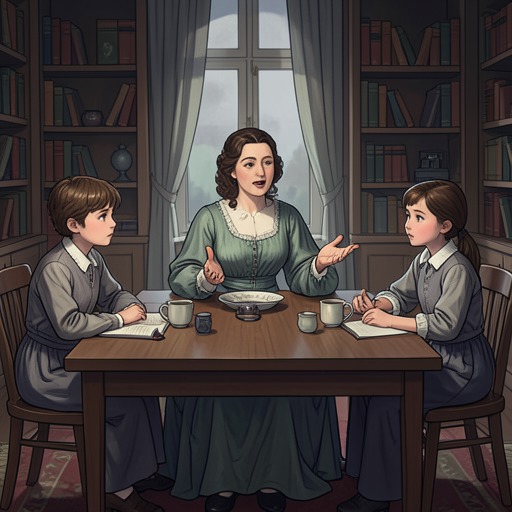
Katharine and Ralph become engaged
Night and DayKatharine and Ralph become engaged when Katharine answers her mother’s tentative suggestion that she and Ralph might speak privately by announcing their engagement to her father, Trevor. The declaration turns a relationship long marked by hesitation into a public fact, while Trevor’s startled hurt reveals that the change is not merely romantic: it also means his beloved daughter is choosing a life beyond his control.
Background and Setting
The engagement takes shape in the Hilberys’ drawing room, amid the family’s familiar rituals of tea, literary conversation, and social ease. Earlier, Katharine had imagined a visitor judging the household by the lively noise of one of her mother’s tea parties; when Ralph first entered, she was pouring tea and managing the conventions of welcome. The later announcement occurs in that same domestic world, but its stakes have changed: the drawing room has become the setting for a choice that cannot be absorbed into polite conversation.
The family’s literary habits help frame the moment. After Trevor enters, he finds Cassandra’s lost engagement ring on the carpet and returns it with a courtly bow. His gesture softens his resentment, and a question about the first performance of Hamlet draws him back into the authority and comfort of scholarship. Literature briefly gives him a composed language for human feeling; beneath that decorum, however, he is already registering the force of Katharine’s attachment to Ralph.
The Announcement
Trevor notices the silence that falls over the room and sees Katharine sitting at the head of the tea table, still and distant. Ralph, under Trevor’s gaze, appears equally composed, but the narration distinguishes his restraint from passivity: beneath it lies a tenacious resolution. Trevor understands that Katharine loves Ralph and recognizes that she might have married William without provoking the same jealousy. His uncertainty about the exact state of affairs between them gives way when Mrs. Hilbery offers Katharine the little room, tentatively suggesting that she and Ralph might go there together.
Katharine instead looks straight at her father and says, “We're engaged,” waking from her stillness with a start. The brief declaration is both disclosure and action: it names the bond and makes it known to the family. Trevor receives it like an unexpected blow. His response registers the abruptness with which his daughter’s choice seems to carry her away from him, even though the engagement is also the culmination of her own decision.
Family Response and Aftermath
Trevor offers Ralph a curt acknowledgment and says, “I gathered something of the kind last night,” followed by the hope that Ralph will deserve Katharine. He does not look at his daughter before striding out, his departure leaving the women with a mixture of awe and amusement at his conspicuously wounded, unpolished display of feeling. Katharine watches the shut door and then lowers her eyes to hide her tears. Her announcement is firm, but the scene does not present the family transition as emotionally effortless.
The tension does not endure unchanged. At the later dinner, civilization has returned in the form of a cheerful, dignified family meal, with Trevor presiding and inviting Ralph to help himself to wine. The movement from his angry exit to this renewed hospitality gives the engagement a domestic aftermath: the new relationship is not simply declared against the family, but gradually admitted into its shared life.
Significance
The scene makes the engagement’s meaning visible through contrast. In a household that can turn to Shakespeare and formal manners to contain difficult feeling, Katharine’s plain announcement cuts through the literary and social circumlocutions. Trevor’s jealousy exposes the possessive ache beneath paternal affection, while his eventual place at the dinner table shows that his first resistance can coexist with recognition and welcome. The engagement therefore closes the gap between private attachment and family knowledge without erasing the cost of that passage.