Marriage and Women's Autonomy
Night and DayMarriage and Women's Autonomy is presented not as a simple choice between marriage and freedom, but as a struggle over what a woman may want, what work she is permitted to do, and whose account of her future counts. Katharine Hilbery can imagine marriage as a route out of the demands of her family home, yet privately longs for the exacting, self-directed study of mathematics. The contrast exposes a gap between the life others recognize for her and the life she wants to make her own.
Work Hidden Inside the Household
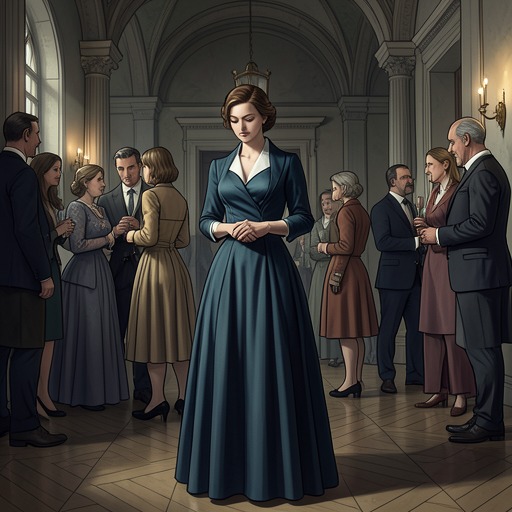
Katharine has been trained to be useful at home. She dislikes literary self-expression, while her family is absorbed in phrases and in the unfinished biography of her grandfather. Because her quietness seems to promise practical ability, she is entrusted with household affairs from childhood: ordering meals, directing servants, paying bills, keeping the clocks approximately in time, and making sure the vases hold fresh flowers. These tasks are treated as natural gifts rather than labor. Her mother calls the arrangement poetry turned inside out, while the orderly household at Cheyne Walk makes Katharine’s work nearly invisible by presenting family life as harmonious.
The household role is not limited to domestic management. Katharine also counsels and sustains her mother, whose insight and imagination do not protect her from the everyday demands of life. The family’s literary work likewise occupies Katharine, although she feels ill-suited to it: she is surrounded by faded papers, correspondence, and recollections while feeling that the past has displaced the present. Her practical competence serves her family, but it does not define the full extent of her capacities or desires.
Against this public image, Katharine secretly works at mathematics. She rises early or stays up late, and at the sound of footsteps hides her paper between the leaves of a large Greek dictionary taken from her father’s room. Night is the only time she feels safe enough to concentrate. She prefers the exactness and impersonal clarity of figures to the vagueness and agitation of prose; that preference makes mathematics more than a pastime. It is a form of intellectual life chosen for herself, and one she conceals partly because it appears unwomanly and partly because it contradicts her family’s literary inheritance.
Marriage as Escape and Compromise
When Katharine accepts William Rodney, the decision comes in a subdued, complicated moment rather than a declaration of joyful certainty. While William is nearby, she imagines herself a few years later, married and returning from a lecture with books on mathematics and astronomy that she has mastered. The picture preserves a future for study within marriage, but the fact that she must imagine it privately already marks the uncertainty of that future. She eventually tells William that she will marry him if he still wants her to. His immediate response turns to the practical question of buying oysters, and Katharine feels relief.
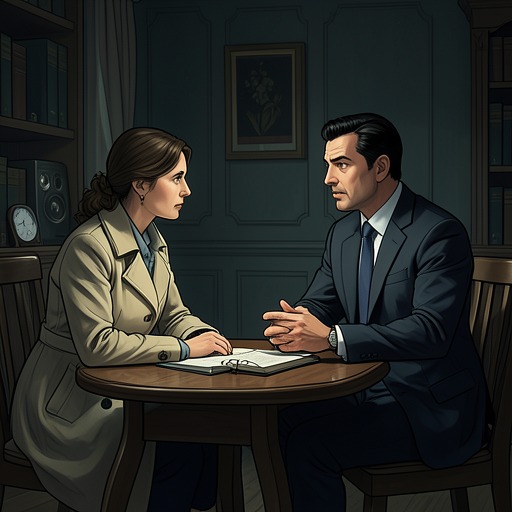
At Christmas, the engagement is viewed from outside. Her cousins watch for evidence of affection between her and William, and their silent scrutiny makes Katharine newly conscious of what may be missing. She has grown used to giving satisfaction, and their reserve unsettles her; she wants to justify her engagement to someone whose opinion matters. In an imagined explanation to her cousin Henry, she admits that she is fond of William, but also that she wants to marry because she wants a house of her own. She cannot pursue her own way at home, where the family’s atmosphere and her constant presence make independent work difficult.
That imagined confession reaches the ambition she has difficulty speaking aloud. Katharine wants to study mathematics and learn about the stars—not necessarily to become accomplished, but to work through figures, use a telescope, and know precisely where an error lies. She distrusts the household identity others assign her: she says she is not truly domestic, practical, or sensible. At the same time, she imagines that fulfilling this intellectual desire might allow her to give William what he wants. The thought reveals both possibility and compromise: marriage might provide space for her vocation, but she still measures that possibility against a husband’s expectations.
The Social Lessons of Marriage
The older women around Katharine offer conflicting counsel, though each speaks from a world in which women’s choices are constrained by marriage. Lady Otway’s principle is that a woman who wants her own way should hesitate to marry. She also says that if a woman can yield to her husband, a happy marriage may be the happiest life. Later she states the condition more plainly: a woman should know beforehand whether she can give way; if she cannot, she should not marry. Her advice makes submission not an incidental difficulty but a term on which marriage may depend.
Mrs. Hilbery answers from a more imaginative and less systematic faith. She calls marriage a school, at first describes it as the happiest life for a woman, then corrects herself: it is the most interesting. Her correction matters. It leaves room for complexity and curiosity, but does not resolve Katharine’s fear that the institution may demand obedience. When Katharine asks whether a wife must give way to her husband in an ordinary marriage, Lady Otway answers yes, and Katharine concludes that a woman ought to decide this before marrying. Her question is practical and prospective: what sort of self will marriage permit her to remain?
Katharine’s mother and aunt cannot simply supply an answer that fits her. The novel distinguishes the shared wisdom of older generations from the particular truth an individual must discover. Mrs. Hilbery’s romantic and associative imagination does not make her an accurate reader of her daughter’s private conflict, while Lady Otway comes closer to sensing it. Marriage is thus discussed not only as a social arrangement but as a test of whether inherited rules and family experience can speak for a woman whose desires do not fit them neatly.
Public Work and the Limits of Independence
Mary Datchet’s working life provides a contrasting example of female purpose beyond the household. She devotes herself to a suffrage society, although her position is unpaid and the wider world has shown little appetite for the benefits it offers. Her office occupies the top of a large house in Russell Square, shared with other organizations whose typewriters sound through the day. Mary arrives determined to make her own machine join that chorus. She organizes fundraising entertainments for a society short of money, hoping to attract notable people and catch the attention of Cabinet Ministers.
Her work is purposeful, but the novel also shows how easily reforming ambition becomes entangled with routine and under-recognized labor. Mary worries about the use of notepaper and seeks to rebuild the organization, while Ralph Denham accuses her of settling into a comfortable groove and becoming absorbed in details. He urges her to seek larger ideas and to travel rather than remain among a small circle. Mary surprises him by agreeing that she has begun to think similarly about herself and would like to go somewhere far away. Their exchange places women’s autonomy in a public as well as a domestic frame: earning or intending to earn a living and doing political work do not automatically free a woman from limited means, repetitive duties, or other people’s judgments.
Katharine’s visit to the suffrage office prompts her to tell her father that she wishes her mother were not famous, because people at tea assume that she must be poetical and talk to her about poetry. The complaint links public identity to inherited expectation: being the daughter of a famous family becomes another role imposed on her, even though literature is not the vocation she desires. Mary’s activism and Katharine’s mathematical ambition are different forms of female independence, but both sit uneasily beside the assumption that women’s lives should be organized around familiar social roles.
Choice Against Prescribed Answers
When Katharine tries to settle moral questions about her conduct by consulting convention, the answers seem ready-made. A traditional rulebook appears to offer clear directions to an unmarried woman, and other people’s agreement can seem brighter than the uncertain evidence of her own feelings. Yet once she seriously tests these answers against her particular circumstances, they become useless. Her own sense of what she feels is a frail guide beside the authority of custom, but she has no other guide that is truly hers.
This conflict gives the subject its lasting force. The novel neither treats household competence as proof that Katharine has found her vocation nor assumes that marriage will automatically extinguish her intellectual life. Instead it keeps the pressure visible: her work at home sustains a family whose literary world does not accommodate her; her secret mathematics gives her an independent object of attention; and marriage promises a home while bringing expectations of obedience and emotional adjustment. The crucial question is not simply whether Katharine will marry, but whether she can recognize and protect a self that family duty, social convention, and romantic expectation each threaten to define for her.