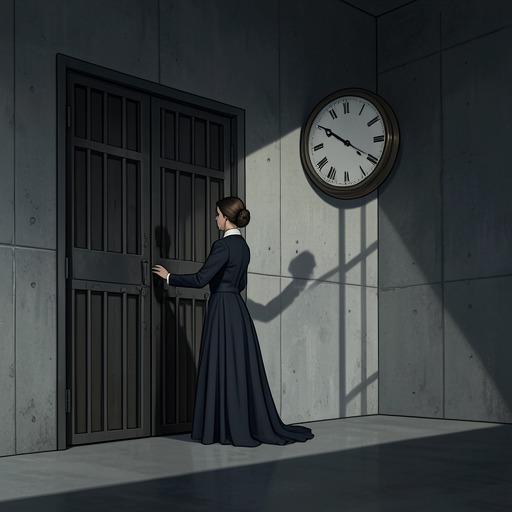
Mary Datchet’s society for woman’s suffrage
Night and DayMary Datchet’s society for woman’s suffrage turns the campaign for women’s votes into the daily work of an office: rooms to arrange, letters to answer, funds to raise, and a case to make across the country. Its modest resources and repeated disappointments do not diminish its members’ commitment; instead, they expose the labor and strategic disagreements beneath political reform.
Organization and Setting
The society is one of several organizations housed in a large former merchant’s residence in Russell Square, now divided among groups identified by initials on ground-glass doors. A stone staircase carries the hollow sound of typewriters and errand-boys from ten until six. The suffrage office occupies the top floor, where Mary races up the last flight to set her typewriter clicking alongside those of neighboring societies.
Its work also spills into the rooms Mary lends for a fortnightly free-discussion meeting. She initially resolves, every other Wednesday, never to lend them again; then she yields, on the condition that she controls the arrangements. She and the others move furniture against the walls, protect breakable objects, and turn the room into a meeting place. The organization’s public life therefore rests on the use of private space and on the practical effort required to make that space available.
The society is short of money. Mary’s first major office project is a series of entertainments whose profits are meant to sustain it. Funding is not incidental to the campaign: the shortage shapes what the members can attempt and makes organization itself a central part of their political work.
Aims, Methods, and Internal Tensions
Mary treats the office as a place where small administrative decisions can support larger reforms. She thinks about economizing on notepaper and foolscap, while planning to rebuild the society on more radical lines. Her ambition is to become a great organizer, and she imagines a large-scale program of entertainments that will draw interesting people together, attract Cabinet Ministers’ attention, and present familiar arguments with new force.
That vision meets the friction of ordinary office life. Mr. Clacton searches for a leaflet buried under other leaflets and jokes about keeping papers in order; Mrs. Seal arrives with an unclear request that can multiply into several. Their interruptions show how reform depends on paperwork and coordination as well as conviction. They also distinguish Mary’s desire for bold organization from the untidy, sometimes comic conditions in which the society operates.
The organization’s public case is expressed most directly by Mrs. Seal, who has left other committees and civic duties to devote herself to this work. She regards women’s votes as the root question and the cause of humanity, not merely a cause for women. Mary, however, cuts across her appeal with impatient irony, insisting that the group is tired of hearing about women and their votes. The exchange makes the office more than a unified platform: it is a workplace in which earnest advocacy and skepticism about familiar methods coexist.
Political Setback and Organizational Response
A Parliamentary maneuver once again prevents women from obtaining the vote. The reversal throws Mrs. Seal into near frenzy. She condemns the Ministers’ duplicity and the insult to women, then describes the society as pioneering in a wilderness: its members must continue patiently putting their case before the public. She blames the leaders in Parliament rather than the people, whom she still believes would grant justice if directly asked.
Mr. Clacton responds in a cooler, more procedural register. Historical examples lead him to treat the defeat as a familiar reverse in a political campaign, and he argues that the society must outwit its opponents. His proposed answer is an overhaul of the card index, new lemon-colored leaflets arranging the facts persuasively, and a large map of England marked with pins whose colored tufts indicate districts. Under the scheme, each district would have a flag, ink bottle, and filed documents, so that information about county suffrage organizations could be retrieved by consulting the relevant drawer.
Clacton describes the society as a telephone exchange for ideas, a center connected by wires to every district and able to discover what people across England are thinking. The image gives administrative machinery a political purpose: the office would gather local knowledge, connect organizations, and help shape public opinion. Yet the proposal remains a rough plan, sketched during the Christmas holidays, and would require a great deal of work. The episode holds its optimism and limits together: defeat inspires a more ambitious system, but the system itself is still only an outline.
Commitment and Significance
Mrs. Seal answers the prospect of more work by insisting that it will occupy all their lifetimes, as each generation replaces the one before it. She recalls her father as a pioneer and sees the younger women as the future of the cause. Her idealism is sincere, but the scene’s domestic detail—the kettle and teapot she handles while speaking—keeps political conviction grounded in the everyday labor through which it is sustained.
The society’s significance lies in this conjunction of principle and routine. It seeks a fundamental political change, yet its practical existence depends on Mary’s unpaid organizing, fundraising plans, files, leaflets, meetings, and borrowed rooms. Its members differ over how to address defeat and how much weight to give administrative detail, but the setbacks do not end their effort. The office becomes a portrait of reform as persistent collective work: necessary, under-resourced, and never guaranteed a quick result.