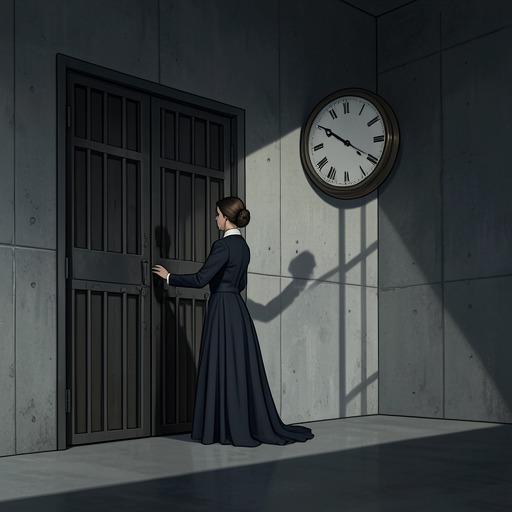
Mary gives up personal happiness and returns to the suffrage movement
Night and DayMary Datchet’s renunciation of personal happiness is not a simple retreat from love into work. It is a hard-won reorientation: after confronting her attachment to Ralph Denham and the emptiness she fears in a life organized around private feeling, she chooses the women’s suffrage cause as a continuing obligation. The choice leads not away from the office but back into its daily labor, now understood as a more deliberate commitment rather than a volunteer’s experiment.
Causes and Background
Mary’s decision takes shape against the routine of the suffrage office and the political setback that brings its purpose sharply into view. The office occupies the top floor of a large Russell Square house divided among societies. Typewriters compete along its echoing stone staircase, while Mary works among letters, leaflets, colleagues, and plans. Though she has ambitions to become an organizer, the society’s services have so far attracted little public demand; funding is short, and she is trying to devise entertainments to support its work and bring its arguments before influential people.
The personal crisis behind her resolve is bound up with Ralph. In the crowded streets she recognizes that books have become painful because they are associated with him. When she allows herself to think of him, her feeling surges between identification with him and anger at what she takes to be his cruelty. She refuses to let that anger settle into hatred, but neither can she simply turn the attachment into the basis of a happy private future. Her walk becomes an attempt to understand what remains when individual desire is no longer treated as life’s measure.
The political situation gives that inward questioning a concrete setting. Mary returns to the office after a parliamentary maneuver has once again put the vote beyond women’s reach. The failure is not abstract: the suffrage workers must respond to defeat, reconsider their methods, and continue the campaign despite the renewed delay. Mary’s personal decision therefore occurs in a workplace already confronting the difference between hoped-for progress and the sustained labor that political organizing demands.
The Walk and the Decision
As Mary walks down Charing Cross Road, she tests her state of mind against ordinary dangers and desires. She asks whether being run over by a motor omnibus would matter to her and finds that she feels neither fear nor excitement. Suffering, in that moment, seems to her neither good nor bad. Looking at other Londoners, she perceives in them a motivating spark—in people studying shop windows and in men examining second-hand books—while she feels herself alienated from the impulses that appear to animate them. The questions do not produce a tidy answer; they expose how far she feels removed from the appetite and emotional responsiveness of everyday life.
The crowd and noise nevertheless help her move from private distress toward a larger conception of existence. She imagines her life laid out to its end and feels that she has seen beyond the suffering of the individual self. Only a few words emerge from this complicated inward process: “Not happiness--not happiness.” The phrase is not a general condemnation of happiness but the brief, hard-won formulation of what she believes her own course must become. She repeats it aloud while seated on the Embankment, opposite a statue of one of London’s heroes, treating the words as evidence of having reached a higher vantage point.
From that vantage, she decides that her place should be among those who accept difficult and desolate work rather than seek a personally rewarding path. She does not imagine that the decision makes her free of feeling. Once she permits herself to consider Ralph, her passions leap forward again: at one moment she gives herself over to his thoughts; at another she denounces him. Her resolve consists in refusing to let either renewed attachment or bitterness dictate her entire life. The effort is captured in the phrases she mutters to herself about knowing the truth and accepting it without bitterness.
From Private Renunciation to Public Commitment
Mary’s altered outlook follows her back to the office. Mr. Clacton and Mrs. Seal notice no extraordinary change in her behavior, apart from her returning nearly half an hour late. For a time she sits by the window, her pen resting on the paper, while her thoughts move beyond the immediate disputes of the organization toward the larger sufferings and desires of humanity. Renunciation brings no easy consolation: what she discovers is a reality she considers enduring even after personal happiness has been relinquished.
When she resumes discussion with her colleagues, familiar office actions acquire a different weight. She pours tea and criticizes one of Mr. Clacton’s yellow leaflets, as she has done many times before, but now she experiences herself as having enlisted rather than merely volunteered. Her position has changed inwardly even though the work remains recognizable. The leaflet, the discussion, and the ordinary responsibilities of the organization become occasions for participation in a cause from which she no longer expects personal fulfillment.
The colleagues’ contrasting responses clarify the public stakes. Mrs. Seal speaks of the cause as a labor carried forward across generations, from her father’s pioneering efforts to her own, and then entrusted to younger women such as Mary. For her, it is not merely the cause of women but of humanity. Mr. Clacton, meanwhile, answers the setback with a plan for more systematic organization: revised card indexes, new leaflets, and detailed county records designed to coordinate the movement’s information. Their different emphases—fervent moral certainty and administrative method—surround Mary’s own decision to keep working without pretending that effort guarantees immediate success.
Return to Work and Significance
Mary’s choice becomes practical when she puts on her hat and gives the office its next instructions. She tells Mrs. Seal that letters need copying and that the question of a new census must be examined carefully, then says she is going home. The departure is not an abandonment of the organization: she leaves its tasks in view, naming work that still needs to be done and assigning responsibility before she goes. Mr. Clacton is impressed by the authority in her manner, though he interprets her new ideas as possibly suggested by the clever young men around her. The scene lets the difference between Mary’s inward transformation and other people’s limited understanding remain unresolved.
The episode also places her return to public work within the movement’s repeated cycle of anticipation and disappointment. On the day she comes back, Mrs. Seal is furious that the vote has again slipped beyond women’s reach, while Mr. Clacton treats the reverse as a challenge requiring tactical adaptation. Mary’s decision does not reverse that parliamentary defeat, and the evidence does not present it as a victory over political obstacles. Instead, her answer is persistence: she resumes the work of an underfunded organization whose cause has again been denied, and does so with a stronger sense that the labor matters even when it cannot promise happiness or quick success.
Her turn is thus both personal and political, but the two dimensions do not collapse into one another. Love for Ralph remains an active source of pain, not a feeling she has simply erased; the suffrage work supplies a direction for life without becoming a substitute romance or a guarantee of emotional recovery. By returning to the office’s letters, leaflets, discussions, and organizational plans, Mary accepts a demanding public role while refusing to call that acceptance happiness. The force of her decision lies in that distinction: she gives up happiness as the condition of action, not the capacity to care about what the action serves.