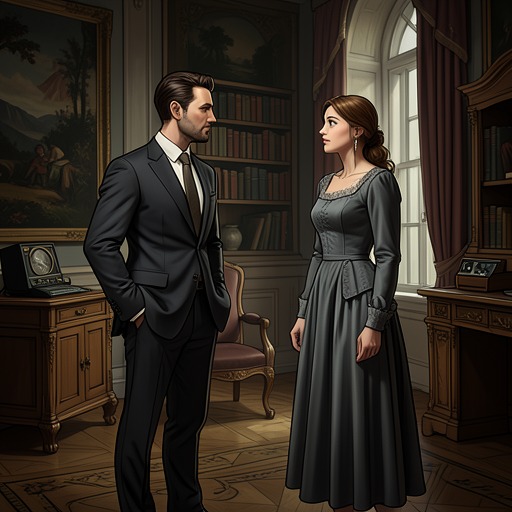
Ralph decides to leave law, move to the country, and write
Night and DayRalph Denham’s decision to leave law, move to the country, and write turns professional dissatisfaction into a concrete break with his former life. The choice has two inseparable sources: his growing conviction that office work is meaningless, and his love for Katharine Hilbery, which he eventually admits has prompted him to change course. A cottage and a history of the English village give that break a practical shape, while his conversations with Mary Datchet reveal the personal cost of the decision and the uncertain motives beneath it.
The decision takes shape
Ralph announces his intention to Mary while they are walking in the country. He has made up his mind to give up his work and live there, and asks her about a cottage she had mentioned. His breezy manner suggests that he expects her to dissuade him, but he insists that he cannot endure the office any longer. He does not yet present the plan as a proposal of marriage: Mary waits for him to approach that subject, only to hear him describe a solitary life, perhaps with an old woman to look after him.
His anger is directed not simply at a particular job, but at the pattern of days it represents. He says that eight years of working at tasks that matter to nobody have brought him to a point of “utter destruction.” The force of the decision lies in its refusal to treat endurance as a virtue in itself: he is no longer willing to continue merely because he has continued so long. Mary recognizes his unhappiness and does not dismiss the plan as madness, although her silence also registers that he has not offered her the shared future she had imagined.
From disillusionment to a new vocation
Ralph tries to explain the deeper crisis behind his resolve. Money-making and ten-hour office days, he asks, have become difficult to justify; the dreams of boyhood no longer supply a reason for going on, and ambition has ceased to satisfy him. He looks back on his desire to rescue his family and help them advance, and judges that motive to have been a lie mixed with self-glorification. Having discovered that he had lived among delusions, he admits that he wants another one to sustain him. His account is not a clean declaration of certainty: it presents the new life as a response to the collapse of old explanations, and leaves open how much of the replacement is conviction and how much is another needed illusion.
The decision quickly acquires a constructive purpose. Ralph tells Mary that one room in the cottage will be his study and that he intends to write a book: a history of the English village from Saxon times to the present. The project is not wholly improvised; it has been a seed in his mind for years. Yet once he resolves to leave his profession, the idea grows rapidly into a full plan, spoken with a confidence that surprises even him.
His imagined cottage is deliberately ordinary rather than romantic: a square white house just off the high road, with a neighbor who keeps a pig and a dozen noisy children. That plainness matters. Ralph takes pleasure in the plan, but restrains it before it becomes an extravagant fantasy, as though testing whether a life can be made supportable within modest, actual limits. The book gives his withdrawal from legal work an intellectual destination, while the unadorned house makes the destination materially imaginable.
Mary’s part in the conversation
Mary’s response is shaped by her love for Ralph and by what she believes his announcement may mean. She initially waits for him to continue because she is convinced that he is approaching the question of marriage. Instead, he describes leaving work and living alone. Her disappointment is registered in her silence, but she listens as he explains the crisis and helps him discuss the cottage in practical terms. When he reveals the book he plans to write, they walk on in a companionship more complete than any they have previously attained.
That intimacy does not turn the decision into a courtship. Later, when Ralph proposes marriage and then recognizes the selfishness and half-heartedness of his reasons, Mary’s private anguish is sharpened by the contrast: she could have given him everything, but he asks her instead to preserve their friendship. She agrees as firmly as she can, and he asks to see her often and to rely on her help. The country plan has therefore brought them close without resolving their unequal feelings; Mary becomes a trusted companion in a transition that does not give her the relationship she wants.
Love, departure, and the plan’s limits
Ralph’s departure is not only a general repudiation of office routine. When he later tells Katharine about the cottage, he says he is giving up his profession, and, when she asks whether he is doing so on her account, answers yes without explaining further. His frankness connects the vocational change directly to his idealized love for her, even though he has already described broader dissatisfaction with work and with the motives that once sustained him. The decision is thus neither reducible to romance nor independent of it: the personal attachment gives urgency to a change whose intellectual and practical outline has its own history.
Katharine encounters the announcement amid the movement of London and the pressures of her divided social world. Seeking Ralph, she buys a large-scale map of Norfolk in Great Queen Street and waits near Lincoln’s Inn Fields, trying to locate his office. The map makes his projected move tangible even before she meets him: the country he has chosen is no longer only an idea discussed with Mary, but a place toward which his life is being redirected. Later, Ralph tells Katharine that he is leaving London for good and has taken the cottage. The resolve has advanced from speculation to commitment, though the evidence does not establish whether he completes the village history or how long he remains in the country.
Significance
The episode sets vocation against routine without presenting retreat as a simple triumph. Ralph rejects the office after eight years because its work appears meaningless, but his explanation also exposes how little certainty he has about what should replace it. Writing offers a chosen task where law had become merely habitual; the village history promises sustained attention to a long span of English life, while the cottage supplies a modest setting for that work. Yet his admission that he wants another delusion prevents the plan from reading as a final cure for disillusionment.
The decision also makes visible the difference between what Ralph tells Mary and what he later tells Katharine. With Mary, he frames the change as an escape from purposeless labor and speaks of solitary country life; to Katharine, he acknowledges that his feelings for her are a reason for giving up his profession. That difference complicates the apparent clarity of his resolve. The new life is at once a work plan, an escape from a discredited ambition, and an action taken under the pressure of love. Its consequences fall unequally: Ralph gains a possible new direction, while Mary is left to support him as a friend despite her unreturned hope of marriage.