Richard Alardyce biography papers
Night and DayThe Richard Alardyce biography papers are the sprawling archive from which the Hilbery family hopes to make a life of the great poet Richard Alardyce. They include private manuscripts, letters, family memories, and corrective research, yet the biography remains unwritten: the papers embody a literary legacy that the family reveres, struggles to shape, and cannot simply convert into a finished book.
Contents and Material Form
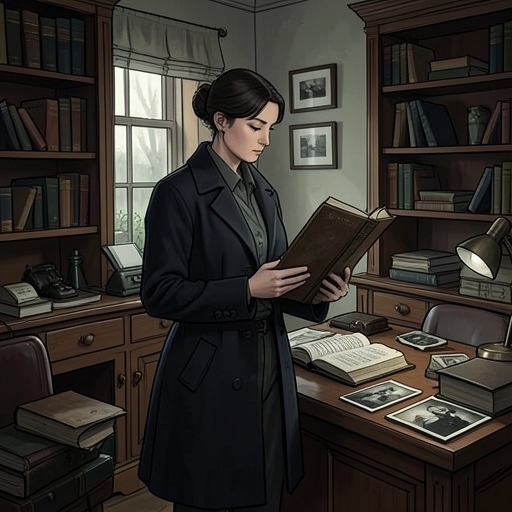
The archive is at once documentary and intimate. Shelves and boxes bulge with precious material, much of it kept in yellow bundles of closely written manuscript. The Hilberys also possess the first edition of Alardyce’s poems, including poems omitted from later reprints and corrections, and the original manuscript of the “Ode to Winter.” The papers are not merely a record of published work: they hold evidence of revisions, private lives, and the changing decisions behind the poetry.
The family’s relics give the archive a physical setting and a public face. In the small, chapel-like room devoted to Alardyce, books, paintings, and personal objects are revealed by lights Katharine switches on one by one. His writing table bears old ink; his quill is disheveled from use; enormous gold-rimmed spectacles and worn slippers remain close at hand. The original “Ode to Winter” manuscript is displayed among these things. What might have been working papers has become part of a family shrine, where the materials invite both historical inquiry and reverent contemplation.
The archive continues to grow as new evidence arrives. A heavily insured proof-sheet sent from a collector in Australia records a change Alardyce made to a famous phrase. Its importance is clear enough to demand preservation and framing, but its arrival creates a practical question: where can it be displayed, and which existing relic, if any, should make room? The problem captures the papers’ double condition as evidence to be studied and heirlooms to be honored.
The Biography Project and Its Stalled Progress
Mrs. Hilbery announced the biography when Katharine was seventeen or eighteen, promising that a daughter’s help would soon bring the book to publication. Notices reached the literary papers, and Katharine initially worked with pride and a sense of achievement. By the time she was twenty-seven, however, years had passed without a finished biography. The archive has grown more imposing, but possession of abundant evidence has not produced a narrative.
The difficulty is not a shortage of materials or intention. Mrs. Hilbery can write readily, filling a page each morning, and she holds a vivid imaginative picture of the period and its people. Yet her work proceeds in brilliant, short-lived bursts: while polishing already gleaming books with a duster, she may suddenly discover a phrase or a point of view, write ecstatically for a few moments, and then return to polishing. Her paragraphs can be luminous, but their inspiration flickers unpredictably across the vast subject. Katharine can keep the pages in order; she cannot make the biography’s account of Alardyce’s life progress steadily from one year to the next.
The manuscripts reveal the consequences. They contain numerous grand openings, many unfinished, and a beautifully written account of the Alardyce home—or, more precisely, of spring in Suffolk—that may not be essential to the story. A chain of names and dates carries the poet through his birth and ninth year, after which the organization becomes less secure. Mrs. Hilbery wants to include memories from an old woman raised in Alardyce’s village, while Katharine decides they must be left out. Mr. Hilbery’s learned sketch of contemporary poetry is set aside as too bare and out of keeping with the rest. The papers thus record not only what the family knows but their unresolved disagreements about what belongs in a biography.
The later materials are more dispersed still: twenty pages on Alardyce’s taste in hats, an essay on contemporary china, an account of a country outing during which the family missed its train, and fragments of famous men and women whose basis in fact is sometimes uncertain. Thousands of letters and recollections from old friends await a place, partly because discarding them could hurt the contributors’ feelings. Several years of Alardyce’s life are omitted altogether because Mrs. Hilbery finds something distasteful in that period and prefers to dwell on memories of her own childhood. The result is not simply a large archive, but a draft that veers between genres, periods, and standards of relevance without acquiring continuity.
Editing, Truth, and the Burden of Inheritance
The most consequential editorial impasse concerns how much to disclose about Alardyce’s separation from his wife. Mrs. Hilbery drafts alternative passages suited to either account, then likes both versions too well to reject one. The family’s devotion to the poet therefore meets a test of biographical truth: the papers preserve material that could complicate the idealized image, while the editor’s affection makes selection difficult. Later, Katharine also has to confront published misstatements about Alardyce. Correcting them requires minute research and extensive correspondence, adding a further task to an already unmanageable project.
For Katharine, publication is a duty owed to the world, not merely an exercise in family commemoration. She believes the family’s privileged position is increasingly unearned if they cannot complete this one book, and she wants Alardyce’s greatness established beyond dispute. Shortly before Ralph Denham visits, she proposes strict rules: she and her mother are to sit at their desks at ten each morning, work through secluded hours, and speak only during a ten-minute break at the hour. Her timetable predicts completion after a year of observance. Mrs. Hilbery warmly praises Katharine’s business sense and imagines how they might celebrate, but the enthusiasm itself does not resolve the archive’s difficulties.
The project also exposes a mismatch between the labor it requires and Katharine’s abilities and desires. She dislikes literary phrasing and recoils from the repeated self-examination that writing demands. Her practical work—keeping household affairs running, managing servants and bills, and sustaining her mother—helps make the Hilbery home orderly, but it is treated as a natural capacity rather than recognized as labor. At the biography table, she is left to maintain the papers’ order without sharing her mother’s gift for producing prose or possessing a clear method for turning fragments into a life.
Legacy, Memory, and the Living Present
The papers shape Katharine’s sense of her own place in time. Raised amid constant talk of great writers and their works, she grows up feeling that the celebrated dead belong almost more closely to the Hilberys than to anyone else. Her descent from Alardyce is a source of satisfaction, but inherited intellectual and spiritual greatness also invites comparison. The past seems to have flowered so fully that the present can offer only lesser growth; in working on the biography, Katharine repeatedly feels that the dead displace the living and make contemporary life seem thin.
The archive’s power changes when Katharine encounters the portrait and relics as more than objects of worship. During a visit by Mrs. Vermont Bankes, Katharine performs her familiar role as guide to the family’s things: she identifies Alardyce’s writing table and last pen and presents the original “Ode to Winter” manuscript. After the visitor leaves, the accumulated ceremony feels oppressive. Looking at the portrait, Katharine imagines her grandfather not as a perfected literary monument but as a young man, nearly her own age, unhappy, tempestuous, and full of desires and faults. She turns from the customary offering of flowers to the possibility of sharing her own doubts and achievements with him. The papers and relics remain evidence of a great inheritance, but they can also connect the dead to the unresolved experience of the living.