Romance
Night and DayRomance is the novel’s name for the charged, unstable distance between a person and the idea another person makes of them. It can turn marriage into a mere passage toward an inward ambition, make an imagined beloved the center of a life, or help expose an engagement in which neither party feels much romantic attachment. The novel does not resolve the tension by simply dismissing romance as illusion: its characters question the stories they tell themselves, yet also discover that an imperfect, partly imagined feeling may still be real and consequential.
Romance as an Ideal and a Social Arrangement
Katharine Hilbery’s first sustained encounter with this problem comes as she considers marriage through the example of women who have learned to accommodate themselves to their husbands. Lady Otway recalls wanting a diamond ring but receiving an emerald bought at Simla; Katharine turns the ring and silently imagines that she, too, could pretend to like emeralds when she preferred diamonds. The small object gives a practical shape to the larger bargain she believes engagement may require: suppressing one preference, performing contentment, and making a social arrangement work without love.
Her conclusion is more radical than mere resignation. Katharine begins to believe that an engagement to someone one does not love may be inevitable in a world where passion sounds like a travellers’ tale, too rarely heard to be trusted by sensible people. At the same time, marriage appears to her as an archway she must pass through to reach what she wants. Her thoughts range between forest paths and starry blossoms and the exact order of mathematical signs; the force of her inward pursuit makes other people’s feelings seem, at moments, secondary. Romance here is not yet a shared relation. It is an uncertain story about passion set against the expected form of marriage, and a private desire that may use that form instrumentally.
Ralph’s Proposal to Mary and the Illusion of Love
The novel tests another account of romance when Ralph Denham suddenly decides to ask Mary Datchet to marry him. His decision emerges not from a declaration of passion but from a ramshackle train of thought: talk of duck shooting and legal history, the Roman occupation of Lincoln, country gentlemen and their wives, and fragments of his own mind gather until the idea seems to appear of its own accord. The spontaneity of the proposal matters. Ralph experiences it as a thought that has formed itself, rather than as the culmination of a deliberate romantic narrative.
Mary refuses the idea that marriage without love is worth having. Ralph says he will not press her, but then disputes the importance of romantic feeling. He claims that he cares for her more genuinely than many men care for the women they call beloved, and describes love as a story invented about another person, sustained by keeping enough distance not to discover whether it is true. In his account, lovers protect their illusion by avoiding too much knowledge and too much time alone together; marriage to someone one loves may therefore be a perilous gamble.
Mary rejects both his theory and his attempt to make it sound convincing. She says that she does not believe him, and that he does not believe himself either. Her response identifies the instability in Ralph’s reasoning: he presents romantic illusion as nonsense, but his insistence on explaining it cannot make the feeling disappear. The disagreement also establishes a contrast between two kinds of intimacy. Ralph offers practical care and a conception of marriage grounded in genuine regard; Mary insists that such regard does not substitute for love.
Mary’s Love Changes Katharine’s Understanding
Mary’s response to rejection does not take the form of a speech. In silence beside Katharine, she fingers the fur on her old dress and experiences herself at once as the person suffering and as a compassionate observer of suffering. She feels rejected and bereft, but also immensely beloved, and believes that what she cannot put into words is shared. The scene gives romance a bodily, relational presence that exceeds an argument about whether love is an illusion: Mary’s feeling is not made less real by her refusal to dramatize it or by Ralph’s failure to return it.
The encounter becomes a revelation for Katharine. Hurrying along the Strand to keep an engagement with William Rodney, she wants the open air to fan the glow kindled by Mary’s words. Mary’s composed declaration of love makes Katharine see how far her own feelings have fallen short of what she had called love. She thinks back to the moment when she yielded to William, now unable to recover why she did so, and resolves to speak to him. In the light of Mary’s example, romance becomes not a decorative ideal but a standard by which Katharine can recognize the fictitiousness of her own supposed attachment.
William and Katharine Question Their Engagement
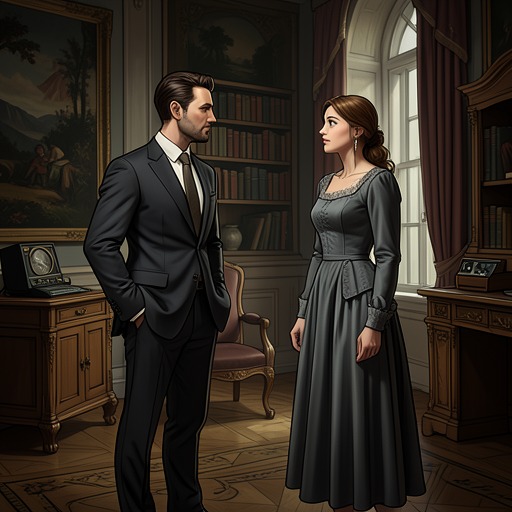
When William and Katharine discuss the prospect that their marriage may be delayed by about six months, William notices that neither is seriously upset. He treats their calm as a psychological problem and suggests that they are not romantic about each other. He attributes this partly to their long familiarity and partly to temperament, describing himself as self-absorbed and Katharine as somewhat cold. His measured self-analysis contrasts with the expectation that an engagement should produce distress when postponed; the absence of such distress becomes evidence that their relation may have been organized without romantic attachment.
Their conversation turns from their particular engagement to the meaning of romance itself. Katharine tentatively suggests that romance may depend not on knowing another person but on ignorance. William distinguishes romance in literature, which may depend on distance, from the feelings people have for one another. Neither offers a final definition. Their exchange makes uncertainty part of the concept: romance may be sustained by incomplete knowledge, but the characters cannot settle whether greater knowledge would extinguish it, refine it, or reveal a different feeling beneath the illusion.
Ralph’s Idealization and the Limits of Dreaming
Ralph’s confession to Katharine makes the imaginative construction of romance explicit. He says that since first seeing her four or five months earlier, he has made her his ideal, though he knows how absurd that may sound. Without knowing her beyond her beauty, he has imagined that they share a purpose and see something together. He habitually supplies her imagined words and actions, talks to her in his mind as he walks, and dreams of her. Romance has become the most important thing in his life, but its intensity rests on a version of Katharine he has created without the ordinary knowledge of a relationship.
Ralph does not simply retract his confession when Katharine points out that they do not know one another and have always been interrupted. He grants that greater knowledge would make his feeling more reasonable and less nonsensical, yet insists that what he has said is true and important. He also recognizes that feelings are partly illusion, including the best ones. The distinction he reaches is not between a wholly real love and a wholly false dream, but between an idealized feeling and a feeling strong enough to alter a life. He tells her that he is taking a cottage and giving up his profession, making the cost of his attachment concrete even as its object remains partly imagined.
After speaking, Ralph confronts the gap between the Katharine of his dreams and the real woman beside him. In the empty street, the revelation brings a sense of loss: her skirt, feather, and voice belong to a living person, but the pauses between imagined speech and actual speech expose how little fantasy can prepare him for practice. He recalls their commonplace words and judges how small they seemed when they emerged from the cloud of thought that had surrounded them. Yet repeating Katharine’s words soon restores her presence to him, and he finds himself worshipping her more than before. The scene refuses a clean conversion from illusion to knowledge: contact unsettles the ideal, but recollection renews it.
The immediate consequence is another surge of frustration. Ralph remembers that Katharine is engaged to William Rodney and reacts with bitterness to the prospect of their marriage. At home, he writes her a long, impassioned letter begging her to break with William, then ends by saying that he will accept whatever she decides as best. The letter’s movement—from pleading to deference—reveals the conflict between Ralph’s desire to make his ideal real and his recognition that Katharine’s choice cannot properly be dictated by it.
The Novel’s Unsettled Account of Romance
Across these episodes, romance is both a story people invent and a force that can expose the inadequacy of the lives they have arranged. Katharine’s emerald-ring thought connects the performance of contentment to the social pressure of marriage; Mary’s love makes the difference between companionship and romantic attachment newly legible; William and Katharine use their untroubled response to delay as evidence of their emotional distance; and Ralph discovers that idealization may be at once a distortion of the beloved and the strongest feeling he has experienced.
The novel’s recurring contrast is therefore not simply romance versus reality. Reality does puncture fantasy: Ralph encounters the commonplace words and interruptions that his imagined communion had bypassed. But reality does not abolish the feeling. His recollection intensifies his attachment, while Katharine’s encounter with Mary’s love changes her understanding of what she herself feels. Romance remains uncertain because it depends on imagination without being reducible to imagination. Its danger lies in mistaking an ideal for another person; its force lies in making that ideal, and the life built around it, impossible to ignore.