The Hilberys’ attempt to write Richard Alardyce’s biography
Night and DayThe Hilberys’ attempt to write Richard Alardyce’s biography is an inherited literary undertaking that becomes a daily test of whether the family can turn privilege, memory, and a mass of papers into a finished public work. For Katharine Hilbery, the project is at once a duty owed to the world and a burden that makes the grandeur of the past difficult to escape. Its failure to reach completion comes not from a lack of evidence or intention, but from the family’s inability to select, order, and finally give up material.
Origins and family obligation
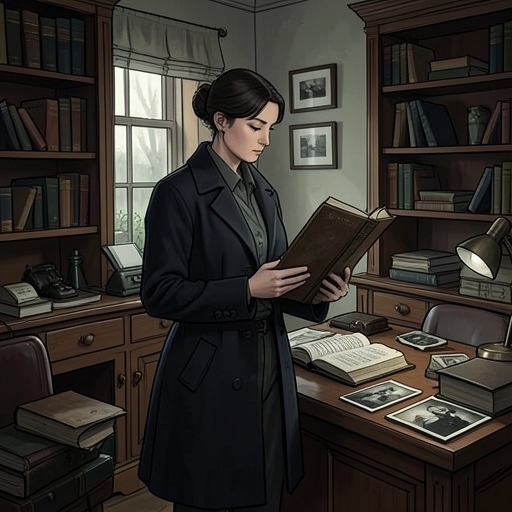
When Katharine was seventeen or eighteen, Mrs. Hilbery announced that, with her daughter’s help, the biography would soon be published. Literary papers carried notices to that effect, and Katharine initially worked with pride and a sense of achievement. By the time she was twenty-seven, however, the book was still unfinished. Its delay mattered to her beyond the ordinary frustration of a stalled project: if the family could not complete this one book, she felt they had no right to their privileged position. The biography was meant to establish beyond dispute that her grandfather had been a great man, and to give the family’s inherited standing a work that might justify it.
The project also shapes Katharine’s sense of time and ancestry. She has grown up hearing about great writers and thinking of the past as an august company closely connected to the Hilberys. Her family’s task places her in unusually sustained contact with the dead: for much of her time she is handling old documents and helping to assemble the life of a poet. That inheritance offers an example of intellectual and spiritual distinction, but it also makes the present seem diminished by comparison. The biography’s importance therefore carries a personal cost: the family must honor the past without allowing it to displace the life Katharine is trying to lead.
Abundant material, no finished narrative
The obstacle is not a shortage of sources. Shelves and boxes are crowded with what Mrs. Hilbery regards as precious material, including close-written manuscripts and papers bearing on the private lives of interesting people. Mrs. Hilbery also has an unusually vivid sense of the period she is writing about. She can make old words seem almost embodied, and she writes easily, often filling a page in the morning. Yet her work comes in brief, intermittent bursts rather than a sustained sequence. While walking around the room with a duster, she may suddenly find the right phrase, write ecstatically for a few breathless moments, and then return to polishing the books.
Those flashes yield brilliant passages but not a stable biography. Mrs. Hilbery’s pages illuminate the subject unpredictably, like will-o’-the-wisps flickering over a vast landscape. Katharine can keep the manuscript pages in order, but cannot make the poet’s sixteenth year follow his fifteenth in a continuous account. Reading the paragraphs consecutively gives her a kind of vertigo: the dead seem to crowd the room, while the manuscript offers no clear instruction about how its pieces should be made into a book.
The difficulty is especially acute whenever selection requires a decision that Mrs. Hilbery would rather postpone. She cannot settle how much the public should be told about the poet’s separation from his wife. She drafts passages for either account, likes both, and cannot bring herself to reject one. The question of truth is thus embedded in the practical work of composition: preserving every version avoids an immediate choice, but leaves the biography unable to decide what it can responsibly say.
Katharine’s attempt to impose order
Shortly before Ralph Denham’s visit, Katharine resolves to test whether strict rules will change her mother’s writing habits. She proposes that they sit at their tables every morning at ten, keep their eyes on the page, and refrain from talking except during ten minutes of relaxation at the hour. If they maintain this routine for a year, she calculates, the biography’s completion is certain. The proposal turns an immense and emotionally charged undertaking into a timetable, and Katharine presents it to her mother with the confidence of someone who believes much of the work is already accomplished once the system has been designed.
Mrs. Hilbery receives the scheme enthusiastically, praises Katharine’s business sense, and begins imagining how they might celebrate the eventual finish. Her response is affectionate, but it also exposes the gap between endorsing a plan and carrying it through: even the celebration quickly becomes another occasion for free association. The project’s recurring pattern is already visible. Katharine tries to make time, sequence, and responsibility explicit; Mrs. Hilbery responds through vivid enthusiasm that does not necessarily produce sustained progress.
When Katharine inspects the manuscripts she has arranged, the disorder makes the need for editorial choices unmistakable. The opening material includes several imposing beginnings, some unfinished, which Mrs. Hilbery thinks could be patched up in ten minutes. A beautifully written account of the Alardyces’ old home—or, more precisely, of spring in Suffolk—is not essential to the story. Katharine has assembled a sequence of names and dates that brings the poet into the world and carries him through his ninth year. After that, the proposed structure begins to break apart: an old woman’s recollections are set aside, while a learned sketch of contemporary poetry by Mr. Hilbery is judged too bare and too much like a lecture-room.
The next section, the poet’s early manhood, brings back the unresolved question of whether to conceal or reveal his affairs of the heart. A thick packet is shelved for later consideration. Other years disappear altogether because Mrs. Hilbery dislikes that period and prefers to dwell on memories of her own childhood. The remaining material veers from twenty pages on the poet’s taste in hats to an essay on contemporary china, an account of a country excursion that ends with a missed train, and fragments of encounters with famous people that seem partly imaginary and partly authentic. Thousands of letters and recollections from old friends must also be placed somewhere, partly because leaving them out might hurt their contributors’ feelings. Later biographies have made errors that the Hilberys feel obliged to correct, demanding detailed research and correspondence as well. The task is therefore not merely to gather memories: it is to distinguish relevance from sentiment, evidence from uncertain recollection, and narrative from accumulation.
The cost of living among the dead
The biography’s disorder becomes a pressure on Katharine’s own life. Sometimes she feels half crushed among the papers; sometimes she believes she must free herself from the past to exist at all. After a morning spent among the dead, the present can appear thin and inferior. The problem is not only that the book remains incomplete, but that its unfinished state allows ancestral memory to occupy the space in which present experience might otherwise take shape.
Katharine’s temperament makes her a capable organizer but an uneasy literary collaborator. She dislikes phrases and shrinks from expressing herself, even in conversation; the continual self-examination and carefully shaped language that form so much of her mother’s life do not come naturally to her. The family treats her silence as practical competence. From childhood she has managed meals, servants, bills, clocks, and flowers, and she has also counselled and sustained her mother. These responsibilities make her indispensable to the household, but they do not give her an authorial voice in the biography. Her work consists largely of preserving order around a manuscript whose underlying disorder she cannot cure.
That practical labor is itself substantial. Katharine is not simply an assistant sorting documents: she helps maintain the conditions in which her mother can write and makes the family home appear orderly and harmonious. Her skill supports the visible work of composition while remaining easy to misread as an innate domestic gift. The book’s failure consequently reveals a contradiction at the center of the undertaking: a family that believes it owes the world a major biography relies on Katharine’s disciplined, largely unacknowledged labor, yet the manuscript remains governed by the less orderly habits of the person writing it.
Significance and unresolved outcome
The biography stands at the meeting point of inherited greatness and present-day responsibility. Its completion is treated as proof that the Hilberys deserve the advantages attached to their position, while the abundance of family documents seems to promise that a definitive account is within reach. But the papers do not arrange themselves into a life. Every addition creates another editorial burden, and every difficult truth can be deferred by keeping multiple versions or setting a packet aside.
The project also gives concrete form to the novel’s contrast between remembered lives and lived ones. Mrs. Hilbery’s gifts make the past vivid, while Katharine’s organizing intelligence tries to give that vividness a sequence; neither quality alone produces the finished book. What remains is a history at once overfull and incomplete: rich in letters, recollections, and brilliant passages, but lacking a settled account of what belongs in it and what must be left out. The supplied episodes establish the undertaking’s prolonged failure and its cost to Katharine, but do not show the biography reaching publication.