The past and the present
Night and DayThe past and the present are not separate periods in the Hilberys’ lives but rival claims made upon the same rooms, work, and sense of identity. The family’s reverence for the poet Richard Alardyce gives the past a material presence in manuscripts, portraits, keepsakes, and stories; it also imposes an inheritance so imposing that the younger generation can feel diminished before it has begun. The novel’s central tension is not simply between memory and change, but between treating the past as a finished monument and receiving it as part of an unfinished life.
Inheritance and Its Burden
The Hilbery family’s prominence derives from Richard Alardyce, whose literary fame lends his descendants a social and spiritual distinction. His daughter, Mrs. Hilbery, stands at the family’s center as the poet’s only child, and Katharine Hilbery, herself an only child, inherits a special place among the extended relations. The family’s history is thus more than private recollection: it shapes rank, custom, and the expectations attached to the present generation.
Katharine’s sense of that inheritance begins in childhood. A photograph of her grandfather’s tomb in Poets’ Corner hangs above the nursery fireplace; on an anniversary, she is taken to lay flowers at the tomb. Distinguished elderly visitors bless her and search her face for a likeness to Richard as a boy. In the stories and rituals around her, the great writers of the past seem almost kin to the Hilberys, forming a boundary around her earliest understanding of what counts as good or great.
That lineage brings pride, but it also makes comparison difficult to escape. Katharine feels that a great ancestor’s intellectual and spiritual example can be more discouraging than an inheritance of land: after such a splendid flowering, the next generation seems condemned to produce only modest growth. The past repeatedly intrudes upon the present and dwarfs it, leaving her despondent about having to make her own experiment in living after the age of greatness has ended.
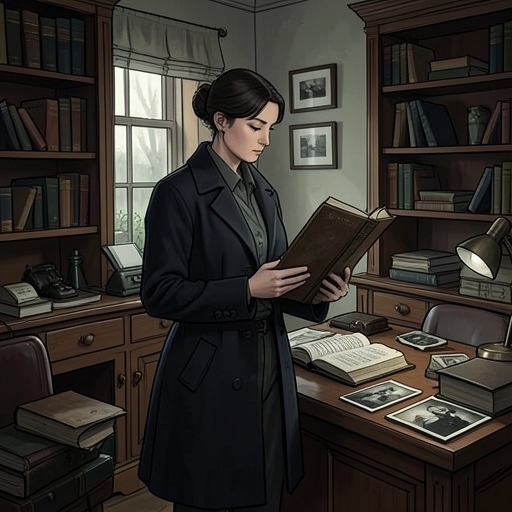
This pressure sharpens into a practical question of what the family owes the world. Mrs. Hilbery and Katharine have spent years attempting to write Richard’s biography, surrounded by boxes and shelves of private papers. Katharine believes their privileged position is unearned if they cannot complete the book, and feels that its publication must establish beyond dispute that her grandfather was great. The obligation to preserve his memory therefore binds intellectual work to family status and public reputation.
The Biography: Memory Against Completion
The biography’s failure to take shape exposes the difference between possessing the past and organizing it. Mrs. Hilbery writes in brief, inspired bursts, often while walking about with a duster; her brilliant pages illuminate separate moments but do not settle into a continuous account. Katharine can keep the manuscript pages in order, but cannot make one year of Richard’s life follow another. Their archive is abundant, yet abundance itself becomes an obstacle when the material has not been selected, arranged, and shaped.
The difficulty is also ethical. Mrs. Hilbery cannot decide how much the public should be told about the poet’s separation from his wife. She drafts versions for either choice, then likes both too well to discard either. The family’s duty to make the past public thus collides with its impulse to protect, romanticize, or preserve competing accounts. Their reverence does not guarantee clarity; it can make judgment harder.
Katharine tries to answer this impasse with a schedule. Shortly before Ralph Denham’s visit, she proposes that she and her mother sit down to work every morning at ten, keep their attention on the page, and allow only ten minutes of conversation each hour. She calculates that, if they follow the rules for a year, completion is certain. The scheme turns the inherited past into a problem of present labor, but Mrs. Hilbery’s habits of inspiration and reverie resist the discipline Katharine hopes will bring the book to completion.
The living past is most palpable in Mrs. Hilbery’s study. When she begins a fresh sentence after reflecting that she is three years and six months older than Richard was when he died, Katharine reads the movement of her pen as an act of reconstruction: her mother is raising the old world around herself, summoning its skies, trees, and voices. The room seems to become a pool of past time, while the clock continues to mint the seconds of an ordinary Thursday. The present is neither absent nor defeated; its passing sounds—the motor-car, wheels, and street vendors—persist at the edge of the remembered world.
Rooms, Relics, and the Work of Remembrance
The Hilbery home gives memory a physical setting. When Katharine leads Denham into the small room of family treasures, the distant traffic sounds like water, and the oval mirrors resemble pools under starlight. The space feels less like an ordinary display room than a chapel or grotto, crowded with relics. Lights reveal the red-and-gold books, a painted skirt behind glass, Richard’s writing-table, and finally his portrait. The arrangement makes the act of looking a kind of ceremony: the visitor is guided from object to object until the poet’s eyes become the room’s focus.
The relics make cultural inheritance visible, but repeated display can also blunt perception. Years later, while showing Mrs. Vermont Bankes the writing-table, Richard’s last pen, and the original manuscript of “Ode to Winter,” Katharine performs her accustomed role as custodian and guide. An American visitor handles the manuscript with awe and grasps the poet’s slippers; meanwhile, the room is so crowded that the family cannot decide where to put a newly acquired, heavily insured proof-sheet recording a change to a famous phrase. Each additional object demands honor, until commemoration threatens to become a problem of space and arrangement.
Left alone after the visit, Katharine looks again at the portrait. The painter has fallen out of fashion, and the picture has become, through repeated presentation, little more than a glow of pink and brown inside a gilt laurel frame. But now she sees the young man behind the celebrated name: someone nearly her own age, unhappy, tempestuous, and full of desires and faults. The change is not in the relic but in her way of looking. Instead of encountering only the family’s public emblem, she recognizes a person whose life might be approached with sympathy rather than worship.
Living With the Dead
Katharine’s imaginative relation to earlier generations is intimate enough to unsettle her sense of the present. In her mother’s room, the books, pictures, chairs, and tables connect her to people who have vanished; she imagines their voices and clothing, and moves among them as an invisible presence who knows their secrets and foresees their destinies. She sees how unhappy, confused, and wrong-headed they were, and thinks she could have advised them. Yet their follies do not free her to judge them from a distance. The more closely she imagines their lives, the more attached she feels, until she nearly loses awareness of herself as a separate person with a future of her own.
Mrs. Hilbery’s reminiscences offer a different, though related, account of what the past can teach. Turning old photographs, she praises women who were called upon in sorrow or difficulty and remembers them as majestic ships, neither pushing nor fretting, but simply being. She recalls Janie Mannering cooking an entire dinner when the cook was drunk, and Queenie Colquhoun taking a coffin to Jamaica because she feared being buried without one there. Such stories make the past vivid through particular actions rather than abstract greatness. Mrs. Hilbery contrasts this remembered vitality with a present generation that is virtuous and earnest, attends meetings, and pays workers, yet seems less fully alive.
Her stories are not a reliable substitute for the biography. Mrs. Hilbery openly weaves romances around the younger generation that often bear little resemblance to the truth, and her affectionate accounts can turn complicated lives into memorable family legend. In one recollection, an imperious older woman arranges a marriage and a young girl’s submission, then claims that three perfect months were all anyone had a right to. Mrs. Hilbery finds a sincerity in such earlier relations that she believes her own generation lacks, but the episode also reveals the cost that may lie behind the romance. Remembering the past entails both receiving its stories and noticing what their charm can conceal.
The inheritance is not confined to the family archive. When Katharine returns from tea and says she wishes her mother were not famous because people expect her to be poetical, Richard’s legacy appears as a present-day social burden. Her father asks whether she is poetical, while the household’s identity makes poetry an expectation attached to her name. Elsewhere, she dismisses the idea that the young are singular in failing to produce great work, and Denham answers that he is glad there are no great men: in his view, the worship of greatness helped make the nineteenth century worthless. Their exchange challenges the very standard by which the Hilberys measure the present. To inherit the past need not mean repeating its cult of greatness.
From Commemoration to Kinship
The novel keeps the past and present in tension through its treatment of inheritance: the dead can supply the living with memory and continuity, but they can also become standards and images that prevent the living from seeing their own time clearly. Mrs. Hilbery mourns the disappearance of great figures, while Katharine feels the pressure of being judged against one. The biography promises to make that inheritance publicly legible, yet its stalled manuscripts show that reverence alone cannot turn memory into a finished account.
Katharine’s encounter with the portrait marks a more personal possibility. Looking at Richard as a young man, she wonders whether he too saw waves and heroes, and thinks that he might have been her brother. She brings the image not flowers or incense but her own doubts, questions, and despondency. In doing so, she imagines a relationship with the dead based not on homage alone but on a shared participation in the life they have handed down. The past remains powerful, but it becomes less a shrine to bow before than a human experience with which the present can enter into conversation.