Truth, honesty, and self-deception
Night and DayTruth, honesty, and self-deception are not merely moral abstractions in the novel: they determine whether intimacy can be trusted, whether love is being honestly named, and how a person may act when custom supplies no convincing answer. Through Ralph Denham’s admissions and evasions, Mary Datchet’s insistence on the difference between small lies and consequential ones, and Katharine Hilbery’s effort to follow what she actually feels, the idea of truth becomes both a demand between people and a fragile guide within a confused social world.
Truth as a Test of Intimacy
At lunch with Mary, Ralph begins by calling himself a liar. He asks whether she recognized his lies on two earlier occasions, in Lincoln’s Inn Fields and on their walk that day, and presses the accusation even when Mary says she thinks she knows him. His confession is less a clean disclosure than an attempt to hold open a moment of intimacy: he admits that he does not want her to go to America and describes his feelings toward her as selfish, while acknowledging that, in a more decent community, she ought not to have anything to do with him. His language makes honesty difficult to separate from self-condemnation; confessing his faults does not undo the way he has treated her.
Mary refuses to accept Ralph’s sweeping account of himself as the whole truth. She admits that she is worldly and likes to direct things, but distinguishes these ordinary faults from the kind of lying that matters between people. She believes Ralph is not false in the essential sense he fears, and says that she could not care for someone who was a liar in that deeper way. Her admission that she loves truth, though not with Ralph’s intensity, turns their discussion into a measure of unequal but serious commitments: he treats truth as an uncompromising principle, while she judges it by whether a person’s conduct betrays what matters.
That difference sharpens when Mary understands that Ralph’s proposal of marriage did not express love. She recalls that he had always spoken truthfully before, and his answer confirms the limit of what he offered: he says that he never told her he loved her. Mary is hurt, yet respects his refusal to claim a feeling he did not profess. For her, marriage without love is not worth entering. Ralph, by contrast, argues that romantic love may be an illusion people protect by avoiding too much familiarity, and that marrying someone one loves could be a colossal risk. Mary rejects the argument as something neither of them believes. Their disagreement exposes self-deception not as a simple failure to know facts, but as a story a person tells to make a desired choice seem reasonable.
Confession and Its Consequences
Ralph’s candor does not make him innocent. At a later reckoning, he explains that he had meant to ask Mary to marry him, but saw Katharine through a window in Lincoln and afterward no longer wanted to ask anyone. He proposed to Mary anyway; she recognized that he was lying and refused him. Ralph says he behaved very badly and offers no defence. Katharine answers that people are bound to be honest and that there is no excuse for such conduct. The remembered expression on Mary’s face makes the principle immediate: Ralph’s self-accusation may be sincere, but its sincerity cannot erase the harm caused by acting against what he knew.
Mary’s own judgment is likewise complicated by what she feels. After refusing Ralph, she recognizes that the silence between them has been built on a mistaken understanding. She had read his depression as pain over seeing Katharine with William Rodney, and the discovery that Ralph had asked her to marry him while loving someone else makes their old friendship seem false to her. She cannot recover the reassuring phrase about truth she had tried to remember; instead, she vividly recalls Ralph paying the luncheon bill. That concrete memory displaces a maxim with the visible fact of their shared history, now altered by what she has learned.
Even so, Mary does not treat truth as a licence to punish. She tells Ralph that he need not suffer merely because she is keeping her resolve, and later says that he need not press her to marry him. She remains firm that his proposal did not mean what marriage should mean to her, but recognizes that her own habits of judging right and wrong may narrow her understanding. Ralph accuses her of measuring people by a rigid standard, and she sees herself in the suffrage office delivering judgment. The insight complicates her position without overturning it: she can question her moral posture while still refusing a marriage she does not believe in.
Love, Illusion, and Self-Knowledge
Ralph’s account of love as a pleasant illusion sits uneasily beside his own admissions. He claims that people knowingly preserve romantic illusions by limiting how often they meet or how long they are alone together, yet the novel sets this theory against his concrete actions: he saw Katharine, changed his mind about marrying Mary, and nevertheless proposed. The gap between his general argument and his conduct reveals how abstract reasoning can protect a person from the truth of a particular choice. Mary’s answer—that he does not believe his own argument—cuts through the theory without pretending that love itself is easy to define.
The difficulty of understanding another person remains part of the same problem. Ralph says that one human being may never understand another, given how thoroughly people lie, but insists that they can try. His statement is not a resolution; it acknowledges the limits of knowledge while retaining the obligation to seek it. In the novel, truth between people is partial and exposed to misreading, yet that uncertainty makes honest attempts more necessary, not less.
Mary later tells Katharine plainly that she is in love with Ralph. She had thought herself too reasonable to feel this without a corresponding feeling in him, and recognizes that she had allowed herself to pretend. Naming her love is therefore both a confession and a correction to her self-image. She also tells Katharine that Ralph loves her, though she has no authority from him to say so. Truth passes between the women as difficult knowledge: Mary gives up the protection of pretending to be unaffected, and Katharine must reckon with what Mary’s disclosure implies.
Personal Truth Against Convention
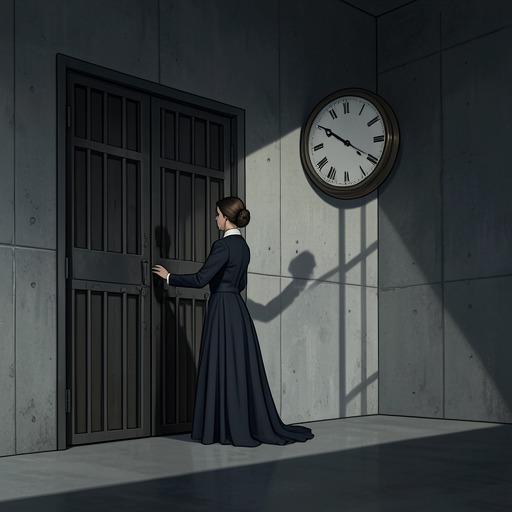
Katharine’s search for truth takes place amid the inherited rules governing an unmarried woman. Traditional authority appears readily available, as though relatives and social convention could furnish an answer for every moral difficulty. Yet when Katharine tries to apply those answers to her own life, the questions become phantoms; what has served others cannot decide what she herself feels. Her reflection contrasts the broad illumination of people who agree with one another against the frail beam of individual conviction. She has rejected the ready-made voices, but has no guide other than that uncertain light.
Following that beam does not bring simple clarity. As Katharine considers William, Ralph, and Mary, the word love seems to mean something different in each case while remaining unmistakably important. Her earlier blindness about William—trying to match his real feeling with a feeling of her own that was false—stands as a landmark she cannot excuse or bury. The image gives error a lasting place in self-knowledge: honesty does not mean never having misread oneself, but recognizing the misreading and accepting the consequences of what it has revealed.
The novel therefore presents truth neither as a flawless possession nor as a rule that automatically settles conduct. Ralph’s confessions expose the distance between knowing and doing; Mary’s refusal shows that compassion need not require surrendering a standard; and Katharine’s inward beam offers a difficult alternative to social consensus. Their encounters make self-deception visible precisely where people try to defend desire with moral language, romantic theory, or inherited convention. What remains is a demanding practice: to name what is felt, admit the harm done when action contradicts it, and proceed without pretending that private certainty illuminates the whole way.