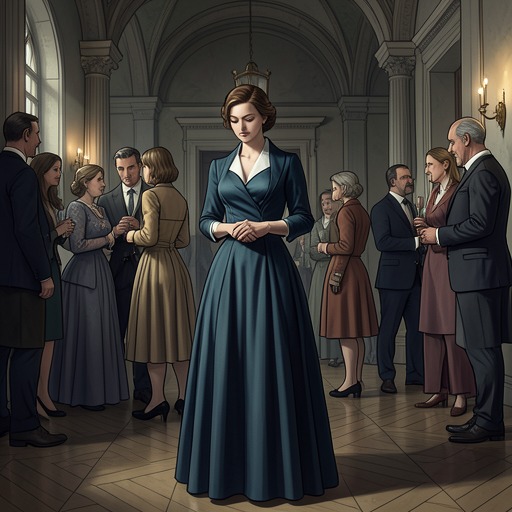
William Rodney
Night and DayWilliam Rodney is an aspiring playwright and a conspicuously self-conscious suitor whose changing attachments expose the difference between romantic language and lived intimacy. He courts Katharine Hilbery as both the woman he loves and the reader whose approval he most desires; their engagement briefly gives that idealized pursuit a conventional form, but neither can make it a loving partnership. His eventual recognition that he loves Cassandra Otway releases him from the role he has tried to inhabit beside Katharine and redirects his affections toward someone whose response to his writing has reached him more directly.
Identity and First Impressions
Rodney enters the social world around the Hilberys under a cloud of anticipated ridicule: people remark that Katharine is to marry “that queer creature Rodney.” His first appearance makes the gossip seem to have a visible object. Very red in the face, meticulously dressed, and acutely uncomfortable under the family’s collective gaze, he wrings his hands and jerks his head between door and window as if searching for an escape. His pearl tie-pin and careful clothes signal cultivation and care about appearance, while his movements betray how little ease he possesses in the social scene he has entered.
His literary ambitions are central to his identity, but they do not make him the confident artist he would like to be. He offers a guest a Baskerville Congreve, explaining that he could not read the playwright in a cheap edition; the preference suggests a cultivated concern with books and presentation. Yet Rodney is painfully conscious of the work he cannot produce. Under the moon’s iridescence, he tells Katharine how beautiful the world seems and how condemned he feels to experience what he cannot express. He imagines that if he could write, he would no longer need to ask her to marry him. Art, in his account, might have given form to feeling; its absence leaves him trying to make romantic eloquence do the work of a poem.
That gap between literary aspiration and actual achievement is also visible in his response to other people’s manuscripts. Mary Datchet recounts that when she shows him her society’s papers, he grows angry and tells her she has no business calling herself a middle-class woman; she describes his manner as moving abruptly from a visit at which he sits scowling to a parting in a huff. The episode presents his critical authority as a source of friction rather than a settled professional standing. His judgment is forceful, but his social conduct can make the encounter more memorable than the argument.
Courtship of Katharine
Rodney’s pursuit of Katharine is built around the conviction that she is the person whose response matters most. He tells her that he is not asking for a scholar’s criticism of his writing: only a handful of men in England could judge it for him. What he wants from her is a verdict of feeling. He says that he thought of her while writing, repeatedly asking himself whether she would like a scene, and that he would rather have her approval than anyone else’s. In making her his imagined audience, Rodney joins his literary hopes to his courtship: her attention promises to validate not only his work but the person he hopes to be.
The arrangement is emotionally uneven. Katharine eventually tells another person that she is going to marry William Rodney, yet her assent does not mean that she has found the passionate attachment he seeks. Rodney, for his part, treats marriage as the answer to an emotional lack he has just described. In the moonlit conversation he moves from the beauty he cannot express to the hope that marrying Katharine might somehow make that inability bearable. His declaration is earnest, but it also shows how readily he imagines marriage as a solution to his own frustrated sensibility.
Rodney believes that Katharine’s life has been difficult and that marriage will be good for her because she has great powers. The judgment is sympathetic, but it makes her future legible to him through a familiar social outcome: her capacities and difficulties seem to point toward marriage. His confidence in what marriage will do for her stands in contrast to the uncertainty he later discovers in his own engagement. The proposal can feel to him like care for Katharine even as their relationship has not established the mutual feeling that would make the promised future secure.
The Engagement and Its Failure
After becoming engaged, Rodney is acutely alert to the public signs of Katharine’s indifference. At a country house, he confronts her with the incidents that have humiliated him: she did not join him in the garden after he waited ten minutes, the stable boys saw him waiting, and she barely spoke to him on a drive. He adds that Henry noticed her ease in talking to him. Rodney understands these moments as evidence that Katharine’s conduct makes him ridiculous before other people. His complaint is not simply that she has withheld affection; he fears that the social performance of being engaged has exposed how little intimacy the engagement contains.
The conflict comes to a head when Rodney tells Katharine that he was wrong to become engaged to her, that he will never make her happy, and that he has never loved her. The admission is painful partly because it reverses the pursuit that led to their engagement: the man who had made her the desired judge of his work now recognizes that the promised marriage cannot deliver happiness. Their estrangement is not reduced to one quarrel. It is the consequence of a relationship in which public expectation and romantic language have outrun the feeling required to sustain them.
Later, the pair can look at the prospect of postponing marriage without the distress that convention would predict. Rodney observes that most people would be seriously upset if their marriage were put off for six months, whereas neither of them is; he asks how to explain their lack of alarm. Katharine gently raises the possibility that he is, or might be, in love with Cassandra. The question helps expose the emotional truth beneath their outward arrangement. The engagement has continued to carry a social name, but its delay does not feel like the loss of a future either of them ardently wants.
Cassandra and the Change of Attachment
Cassandra’s attention to Rodney’s writing becomes decisive because it answers the artistic vulnerability he had previously brought to Katharine. After reading his play, she writes to him that she had sat up all night over it and gives an enthusiastic response, although she has crossed out portions of her praise. Rodney receives the letter at work. He had intended to treat the previous night’s turmoil as a temporary madness and to speak to Katharine as if they remained indissolubly engaged; Cassandra’s letter unsettles that resolve by showing him that the woman he admires has taken his work seriously.
The recognition is not simple triumph. Rodney realizes that Cassandra loves him, but the certainty brings resentment as well as gratification. He feels her love as a fetter and an encumbrance, and sees their situation as potentially ridiculous; he imagines himself no longer her slave or dupe, but her future master. At the same time, Katharine is holding Cassandra’s letter and silently confronting the temptation to say what might keep Rodney with her. The scene places the three characters’ feelings in sharp contrast: Cassandra’s written praise has changed Rodney’s sense of what is possible, while Katharine’s desire to retain him surfaces at the moment when she sees the cost of doing so.
Rodney does not return to Katharine simply because he can no longer bear the uncertainty. He does ask whether they might restore their former position, requesting that she forgive his folly and bad temper and take him back “once more and for ever.” But when Katharine asks whether he loves Cassandra, his answer is clear. He stops, raps his knuckles sharply on a small table bearing a slender vase, and says, “I love Cassandra.” The physical interruption and plain declaration replace the earlier performance of poetic longing with a direct acknowledgment of where his attachment lies.
Relationships and Ending
Rodney’s relationship with Katharine moves from pursuit to engagement, from exposed dissatisfaction to separation. He admires her intelligence and powers, wants her emotional approval, and imagines marriage as the form that might unite his love and his literary aspirations. Yet he is also acutely concerned about public embarrassment, and their time together reveals that neither the name of engagement nor his passionate language can manufacture mutual love. Their ability to contemplate a postponed wedding without serious distress makes the failure unmistakable before it is formally resolved.
His bond with Cassandra grows through her response to his play and becomes the alternative to the failed engagement. The evidence does not establish a long history between them; what it does show is the force of her letter, Rodney’s sudden awareness of her love, and his own decisive recognition of his feeling. He tells Ralph Denham that Katharine is not going to marry him after all, and later declares his love for Cassandra again. The movement is not merely from one prospective bride to another: it marks a change from a courtship organized around Rodney’s ideal of Katharine to an attachment made newly legible through Cassandra’s attention.
The ending leaves Rodney candid about the social awkwardness that accompanies the change. He tells Katharine that he feels himself to be in an entirely false position: Mr. Hilbery had told him the day before to leave the house, and he says he had no intention of returning. His words register both the household’s disapproval and his own awareness that he has no proper place in the scene. The aspiring poet who once hoped marriage might compensate for what he could not write ends by naming, without metaphor, the feeling that determines his choice. That directness gives his altered course its force, even as its future remains outside the account presented here.