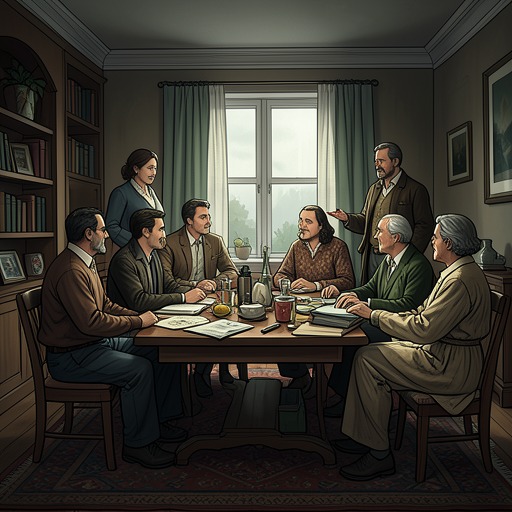
Wyndham Datchet
Night and DayWyndham Datchet, the Reverend and Rector of Disham, is Mary Datchet’s father and the center of the family’s ordered country household. At sixty-eight, he is defined less by intellectual distinction than by punctual duty: he tends his garden, recites Horace, serves the parish, and sustains the routines by which his family understands him. His quiet presence gives the Christmas visit of Ralph Denham a setting at once hospitable and markedly different from London.
Identity and Background
The Rectory stands about half a mile beyond Disham, a large old house grown over centuries around a great kitchen. Its narrow red tiles, thick walls, old ceiling beams, steep staircases, deep-roofed attics, and swallows’ nesting places preserve the accumulated history of successive rectors, though the additions have produced nothing especially beautiful. The grounds, by contrast, bear the unmistakable stamp of Wyndham’s care: a uniformly green lawn, straight paths, and tall flowers arranged along a grassy walk.
Wyndham paces that walk at the same hour each morning, usually carrying a book. He consults it, closes it, and recites the remainder of an ode from memory; he knows most of Horace by heart. As he walks, he inspects the flowers and removes those that have withered or grown overblown. On wet days, he transfers the same timed circuit to his study, where he pauses to straighten a book or adjust the brass crucifixes on the mantelpiece. His children protect these habits because they respect him and credit him with more learning than he possesses.
Duties and Character
The narrative presents Wyndham as methodical rather than original or intellectually powerful. His strength lies in purpose and self-sacrifice: on cold, windy nights he rides out to visit the sick without complaint, and his reliable performance of ordinary duties brings him extensive work on committees, local boards, and councils. At sixty-eight he has become so lean that tender-hearted older women pity him for spending himself on the roads instead of resting beside a comfortable fire.
This distinction between learning and character gives his routine its weight. His recitation of classical verse and care for the garden are not signs of brilliance so much as parts of a disciplined life, while his parish work demonstrates a more practical resolve. The Rector’s established habits organize not only his own day but the household around him: his children defer to his routines, and the house’s work and social occasions unfold within the order they help maintain.
Family and Household
Wyndham’s elder daughter, Elizabeth, lives with him and manages the Rectory. She resembles him in dry sincerity and methodical habits of mind. Since her mother died when Elizabeth was nineteen, the responsibility for the family has rested on her shoulders. She oversees the house and its linen, keeps yellow chickens, sketches, tends particular rose bushes, and attends to the poor; the combination leaves her scarcely a spare moment. Her influence in the family comes chiefly from rectitude rather than any special gift.
The family also includes two sons: Richard, an estate agent, and Christopher, who is studying for the Bar. At Christmas they gather at the Rectory, where mistress and maid spend weeks preparing for the household’s annual gathering. The late Mrs. Datchet’s fine linen cupboard, inherited by Elizabeth, is one concrete sign of the domestic responsibilities and continuities that outlast her mother’s death.
Mary’s return brings a different rhythm into this carefully managed household. She tells Elizabeth that she has invited Ralph Denham to stay, describing him as very nice but rather queer and as someone who has been overworking in London. Ralph’s arrangements are particular: shortly before Christmas he telegraphs Mary to take a room for him in the village, then writes to say that he hopes to eat with the family but needs quiet for his work and must sleep elsewhere. His lodging preserves a measure of independence even while his meals bring him into the Rectory’s family circle.
Ralph’s Visit and the Rector’s Welcome
The country setting makes the contrast between Ralph and the Datchets visible. As Mary and Ralph walk in the dusk, she moves confidently through her native landscape, while he follows her and relies on her direction when they cross a bank into a narrow lane. A light in a neighboring field turns out to be Christopher, who has arrived and gone to feed his chickens. Mary joins her brother among the birds, scattering grain and talking to them; Ralph, in his dark overcoat, remains at the edge of the activity.
At dinner, Wyndham takes the initiative in conversation. Tucking his napkin into his collar, he asks whether Ralph came by the 3.10 train and speaks about the railway’s service. He says he sometimes counts the goods wagons and that at this season there are well over fifty. Ralph’s attentive manner draws the Rector out: Wyndham becomes the principal speaker, and his sons look at him admiringly, relieved that they need not carry the conversation themselves. The store of knowledge he brings forth about this corner of Lincolnshire surprises his children, who had known of it but forgotten its extent.
The episode reveals a hospitable side to Wyndham’s routine. Ralph’s presence rouses him agreeably, and the conversation allows the family to see familiar knowledge newly displayed. After dinner, however, parish business calls the Rector to his study. The household’s welcome is real, but it does not suspend the duties that structure his life.
Character and Narrative Significance
Wyndham’s small domestic gestures convey both the limits and the strength of his character. When Mary presents him with a rose for his buttonhole, he takes it without stopping his walk, examines it at an angle suited to his poor eyesight, and asks whether she had Elizabeth’s permission to pick it. His concern is consistent with the household’s careful habits and Elizabeth’s authority over the garden; even affection passes through an order of permission and care.
The Rectory and its routines offer a counterpoint to the emotional uncertainty carried by Mary and Ralph. London’s offices and streets, and the decisions that unsettle their relationships, give way here to a world of repeated walks, household labor, parish obligations, and seasonal family gathering. Wyndham is not presented as a figure who resolves their conflicts; his narrative function is quieter. Through his disciplined hospitality and ordinary acts of service, the novel gives the Datchet household a distinct moral and temporal texture, one grounded in continuity rather than dramatic change.