
Against the Hysteria Label
NightbitchFollows Nightbitch's struggle to resist the accusation that her transformation is madness, culminating in a vindication that redefines sanity.
increasing Bearing strength in each event
 decreasing
Bearing strength in each eventdecreasingThe Girl Who Feared Hysteria
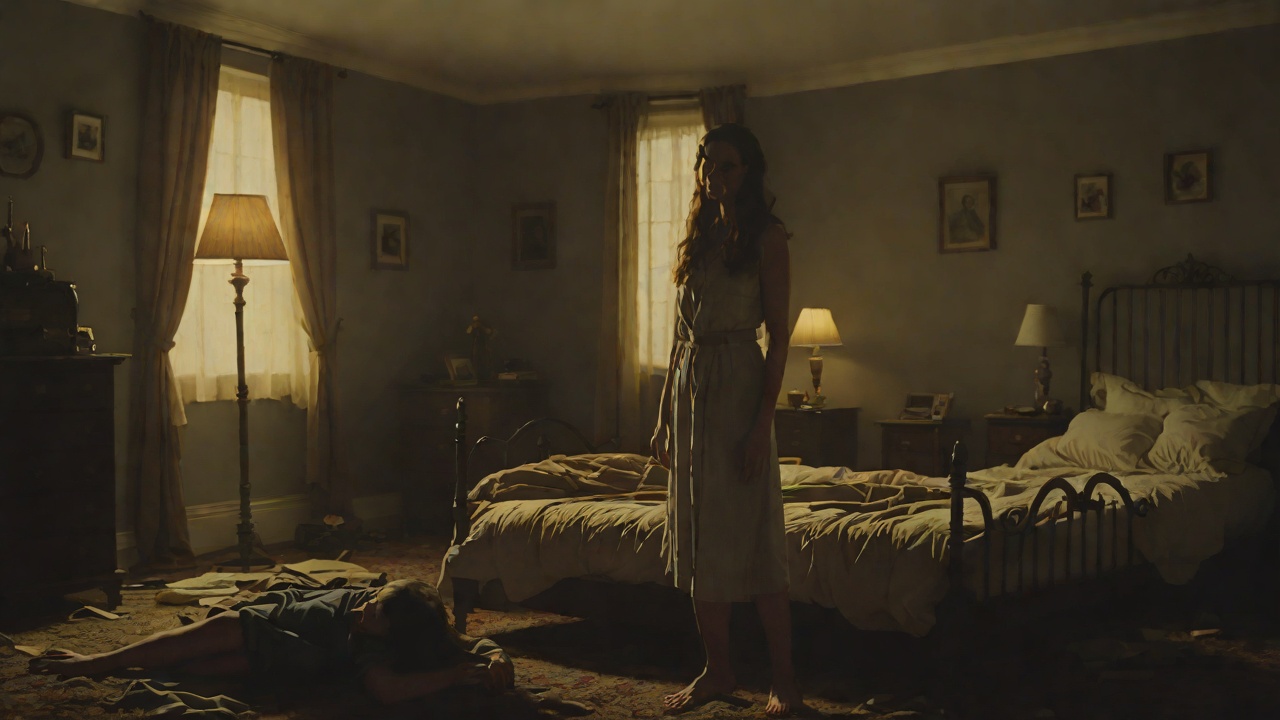
The Girl Who Feared Hysteria
Nightbitch worries she is becoming a “hysterical woman,” a label she has always rejected. She tries to stay cool, reasonable, grateful, but her body keeps betraying her with hair and hunger.
Consequences
The fear of hysteria drives her to suppress and rationalize. She searches the Internet, considers medical explanations, and tells herself to choose happiness.
Significance
The hysteria label is a tool of social control. The novel will identify it as one of the oldest weapons against female knowledge.
The Rational Husband

The Rational Husband
The Husband consistently advises structure, doctors, and positive thinking. He cannot hear her fear as information. His reasonableness becomes another voice telling her she is wrong.
Consequences
Nightbitch internalizes his doubt. She begins to police her own perceptions, calling the dogs hallucinations and the tail a cyst.
Significance
The conflict between reason and intuition is gendered. The novel shows how a woman’s embodied knowledge is routinely pathologized.
The Search for a Medical Cause

The Search for a Medical Cause
Nightbitch searches for diseases, toxins, parasites, and psychiatric conditions to explain her symptoms. She is desperate for a diagnosis that would make her believable.
Consequences
No diagnosis fits. The failure of medicine pushes her toward Wanda White’s alternative epistemology: the unbelievable as another way of knowing.
Significance
The search for a medical cause is a detour. The novel argues that some truths cannot be captured by the diagnostic gaze, especially when the diagnostic gaze belongs to a culture that fears women.
The Vindicated Instinct

The Vindicated Instinct
Nightbitch wakes from her first hunt convinced she has been right about everything. Her feelings were reasonable, precise, and true. The transformation is not a breakdown but a breakthrough.
Consequences
The vindication gives her confidence to trust herself. She stops trying to explain or justify her animal self and begins to accept it as knowledge.
Significance
The conflict shifts: she is no longer defending herself against hysteria; she is reclaiming hysteria as a form of insight.
The Redefined Sanity

The Redefined Sanity
Nightbitch treats her transformation as a performance, not a symptom. The audience’s collective hallucination is studied by psychiatrists, but the artist is never institutionalized. She has taken control of the label.
Consequences
By putting madness onstage, she makes it legible as art. The critics who call her insane are answered by Jen’s statement about the transformative capacities of art.
Significance
The hysteria conflict resolves in redefinition: the “unbelievable” becomes a performance mode, a way of knowing, and finally a successful public career.
early in the transformation, during the grocery store spiral
multiple phone calls and weekends, early summer
the weeks of Internet searching and library research
after the first night hunt, when Nightbitch feels overwhelmingly sane
the final performance and its reception
