Carmel Schneider
Nine Perfect StrangersCarmel Schneider arrives at Tranquillum House as a divorced mother of four who has come for weight loss, but her deeper struggle is with the bodily and emotional aftermath of being left by her husband, Joel. The retreat’s promises of transformation meet a woman who has learned to measure herself through other people’s judgments: first Joel’s, then the cultural demand that a discarded wife remain attractive without seeming bitter. Her arc moves between anxiety about her children, anger at the terms of her divorce, and tentative recognition that weight loss alone cannot repair what has been hurt.
Identity and Introduction
At thirty-nine, Carmel is a mother of young children and divorced. In the guest information file, she has checked every listed concern except couples counselling. Masha reads her photograph and answers with an affectionate but patronizing confidence, deciding that Carmel has low self-esteem and will be an easy guest to help. That early assessment anticipates both the retreat’s focus on her body image and the distance between being treated as a case to solve and being understood as a person.
Carmel is at Tranquillum House alongside eight other guests, each settling into rooms, reading information packs, and encountering the property and its routines. The retreat initially presents her attendance as a weight-loss project; the personal history beneath that stated aim emerges later through her memories of Joel and her efforts to make sense of the end of their marriage.
Divorce, Body Image, and Self-Worth
Carmel remembers Joel telling her, a year earlier, that he still cared for her but was no longer attracted to her. He presented the disclosure as honesty and kindness. In Carmel’s account, however, his apparently ethical manner does not soften the result: he left, went directly onto a dating website, and replaced her with a new partner. His conviction that he had behaved honourably stands in sharp contrast to the lasting injury of being told that her body had made her undesirable.
She understands their divorce as amicable on Joel’s part, while privately experiencing it as a death that nobody acknowledged. She describes the social rules imposed on a wife who has been left: she must keep her dignity, conceal grief except in private, avoid speaking unkindly about the new partner, and remain thin. The pressure is not simply to lose weight but to perform the right kind of pain—contained, agreeable, and never visibly resentful. Carmel’s body becomes the place where those demands converge.
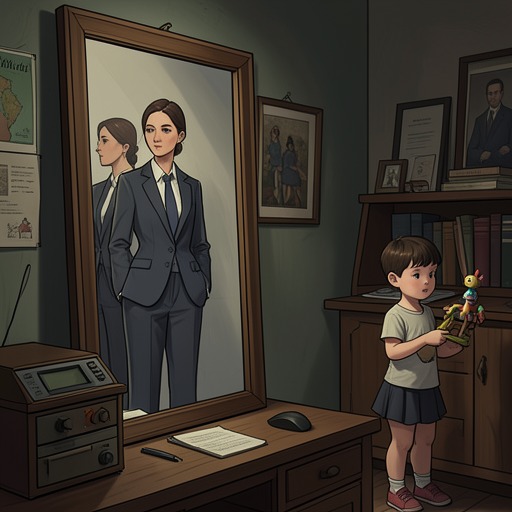
In a private moment, she examines her naked body in a mirror, lifts her breasts to where they used to be, and looks at the stretch marks on her stomach. She recalls a social-media message praising stretch marks as beautiful because they represent new life, but dismisses that reassurance as sentimental when set against the fact that the father of her children no longer loved her body. The scene connects physical change after motherhood with the sharper wound of rejection: an abstract celebration of what bodies have done cannot, by itself, undo the meaning Carmel has attached to Joel’s departure.
Anxiety and Life at the Retreat
During the retreat’s silent period, Carmel’s thoughts turn insistently to her four daughters. She tries to reassure herself that they are safe with their father and Sonia, his new partner, and recalls that the children are in Paris on a trip, staying in a flat Sonia has visited before. Their new jackets and the promise of an educational holiday become details she uses to quiet fears that they might be lost or neglected. The children’s absence gives her freedom from immediate caregiving duties, yet that freedom feels precarious: she imagines recurring dreams in which she loses all four through carelessness and struggles to hold onto rational explanations for where they are.
Her account of the divorce reveals that this anxiety exists beside a carefully maintained civility. Carmel knows that Joel loves the children and that Sonia has been warmly received by them; she can respond pleasantly aloud even when her private thoughts are less generous. Her outward politeness echoes the rules she has absorbed about the discarded wife, who must not appear unkind or difficult. The retreat’s enforced quiet leaves more room for those private contradictions to surface.
At another point, Carmel tries to contain a rising panic by repeating a cheerful affirmation. The attempt fails as her thoughts become more urgent, and she compares the resulting feeling to recurring dreams in which she has somehow forgotten or abandoned her daughters. She slaps herself repeatedly in her room, a stark sign that her efforts to maintain composure have given way to distress. Rather than representing a settled transformation, the retreat exposes how much fear and self-reproach lie beneath her apparent willingness to cooperate.
Encounters and Apparent Breakthrough
During a group drug session, Carmel responds to the prospect of LSD through the framework that has brought her to the retreat. She wonders whether it has calories and whether it might speed up her metabolism, and says she respects Masha’s methods. From Lars’s perspective, her crooked glasses and subdued manner suggest someone who has been hurt; he privately suspects her husband left her for a younger, more glamorous partner and thinks that becoming thin will not solve her underlying problem. His reaction underscores the difference between Carmel’s stated hope of changing her body and the emotional injury others can see in her circumstances.
Later, Masha regards Carmel as having made a breakthrough about her body-image issues after a conversation about body acceptance. Masha also recalls having stopped Carmel when she repeatedly tried to remove her clothes. The scene supports a shift in how Masha interprets the session, but it is Masha who calls it a breakthrough; the evidence does not establish that Carmel’s distress has been permanently resolved. The contrast matters: an apparent therapeutic milestone is also part of Masha’s confidence that her methods are working.
Carmel herself gives a more unresolved account after hallucinating that she had no body. She wonders whether the experience carried a message from her subconscious, but cannot identify what it might mean. She then names the pattern she recognizes in herself: self-loathing. The recognition is candid, not a claim that the cycle has ended. Her own words complicate the triumph Masha sees, distinguishing a moment of insight from a lasting escape from the standards that have shaped her self-image.
Relationships and Narrative Significance
Joel remains central to Carmel’s understanding of herself even though he is absent from the retreat. His decision to leave and his stated loss of attraction become the reference point against which she interprets her body, motherhood, and prospects of being loved. Carmel’s story gives particular weight to the asymmetry between his self-image as honest and ethical and her experience of being replaced. The marriage’s end may be called amicable, but that description does not capture the grief she feels obliged to hide.
Carmel’s relationship with her daughters is presented through both care and fear. She worries about their safety while away with Joel and Sonia, yet can remind herself that they are loved and are having an important trip. The retreat offers her a break from daily obligations, but does not make separation emotionally simple. Her imagined losses and practical reassurances reveal how motherhood remains present even when the children are elsewhere.
As a character, Carmel’s body-image struggle exposes the limits of treating weight loss as a complete answer to distress. Her memories show how a private judgment about attractiveness is reinforced by a wider script requiring women to absorb rejection gracefully and remain thin. Masha’s account of a breakthrough and Carmel’s later description of an ongoing cycle sit uneasily beside each other. That tension keeps Carmel’s development open: she can identify the self-loathing that confines her, but recognition alone does not demonstrate that she has left it behind.