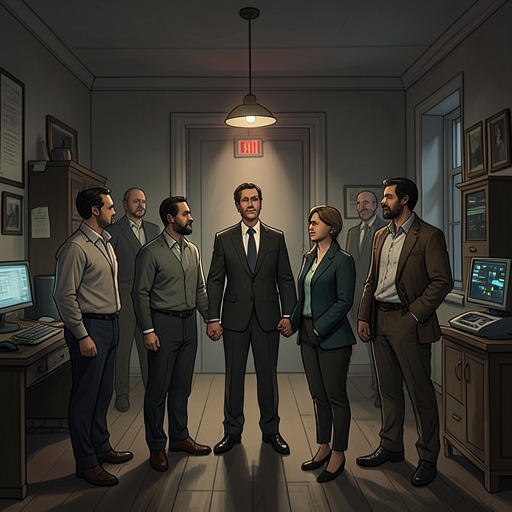
Death Row exercise
Nine Perfect StrangersThe Death Row exercise is a mock capital-sentencing game devised by Masha for the guests at Tranquillum House. Framed as an icebreaker about love and getting to know one another, it assigns each participant another guest to defend and requires a five-minute plea for that person’s life. Its decisive tension lies in the gap between the playful format and the subject it forces into the room: the guests must argue for someone’s right to live while they are confined, frightened, and unsure what is real.
Setting and Introduction
The exercise is introduced during the guests’ confinement in the yoga studio, a room that offers little to support the escape-room interpretation Zoe has proposed. It is virtually empty: towels, yoga mats, stretcher beds, water bottles, headphones, eye masks, and burnt-out candles are among the few objects, with no bookshelves, pictures, or feasible clues. That bare setting matters to the exercise’s design. Rather than giving the guests a puzzle to solve, Masha supplies a new activity in which their own relationships and judgments become the material.
Before announcing the game, Masha tells the guests to listen carefully and calls it a fun icebreaker. Lars answers that the ice is already well and truly broken. Masha nevertheless presents the activity as being about love, passion, and getting to know one another, invoking the idea of radiating boundless love toward the world. The cheerful framing sits uneasily beside the words she chooses next: she first calls the exercise Death Sentence, then revises the name to Death Row. The shift sounds like a naming decision, but it does not make the imagined sentence any less grave.
Rules and Assignments
Masha establishes a courtroom scenario: everyone has been sentenced to death, and each needs someone to argue on their behalf for clemency or a stay of execution. She casts herself as judge and tells the guests they will each have just five minutes to defend their assigned client. The brevity is part of the instruction: they should avoid waffle and make every word count. They are given the night to prepare, with presentations scheduled for dawn, and must ask themselves why their client deserves to live.
The assignments form a chain through the group. Frances defends Lars, and Lars defends Ben; Heather defends Frances, Tony defends Carmel, Carmel defends Zoe, Zoe defends Jessica, and Jessica defends Heather. Ben is assigned Napoleon, while Napoleon must defend Tony. Masha reads the names from a piece of notepaper and stresses that she will say them only once. The linked arrangement makes every guest both advocate and potential subject of another person’s plea, distributing responsibility across the group rather than giving anyone a detached observer’s position.
Reactions and Stakes
The exercise’s language provokes unease even before the arguments begin. Napoleon says he dislikes the name, while Carmel begins to weep softly; Frances responds by putting a hand on Carmel’s arm. These reactions disclose how little distance the game’s premise affords its participants. Masha calls it an icebreaker, but its first effect is to expose distress, and the assignment asks the guests to imagine not simply who they care about but how they would justify another person’s continued life.
Tony answers the central question by saying that everyone deserves to live. That response gives the game an immediate ethical counterpoint: Masha asks each advocate to make an individual case, while Tony’s answer resists the need to establish a person’s worth as a condition of survival. The exercise’s rules turn compassion into a timed performance, yet his reply cuts through the proposed competition of arguments with a universal claim.
Significance and Aftermath
The Death Row exercise belongs to the guests’ larger effort to interpret a confinement they cannot make sense of. They have considered whether the studio might be an escape-room game, but its near-emptiness offers no plausible clues, and their situation continues to carry the threat of real danger. Masha’s exercise does not resolve that uncertainty. Instead, it redirects their attention from finding a way out to articulating why another person should be spared, making judgment and human attachment the focus of the night’s task.
The question of what counts as evidence recurs after the crisis, when the guests give separate, lengthy statements to police about the preceding week. Their accounts are difficult to make logical, and Frances senses the officers’ scepticism. Asked whether they thought they were locked up, she insists that they were; when challenged that they later opened the door and left, she explains that they had stopped trying the handle, which she understands as the point Masha was trying to make: sometimes the answer is already in front of someone. This later explanation resonates with the exercise’s structure. Masha gives the guests a clear rule and a difficult question, but what the game reveals depends on how they respond to one another—not merely on whether they can follow instructions.