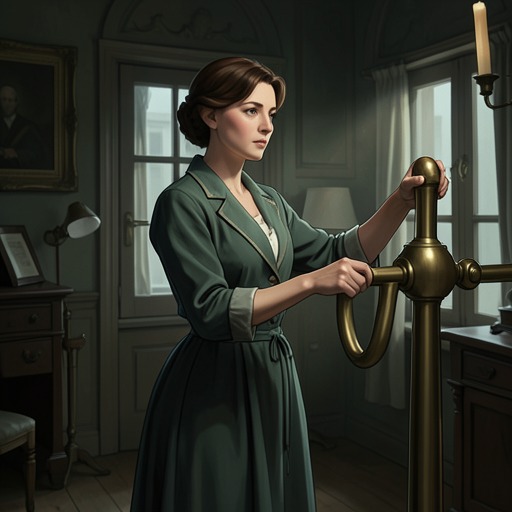
Frances Welty
Nine Perfect StrangersFrances Welty, a formerly bestselling romantic novelist, arrives at Tranquillum House after a professional setback and a romance scam have unsettled two of the stories she had trusted: that her work still had a place in the market, and that an online courtship was leading toward a shared future. Her first response to disappointment is characteristically wry, but her composure is more than a punch line. Books remain indispensable to her, and her early exchanges with Zoe Marconi suggest that humor can make an opening for candor across a sharp difference in age and experience.
Identity and Introduction
Ten years after the narrative’s opening, Frances is driving alone through scrubby bushland on a hot, cloudless January day, six hours north-west of her Sydney home. The highway unrolls ahead while the car’s air-conditioning blasts cold air at her face. The enormous blue sky makes her feel small and isolated; she responds by imagining herself as a disgruntled TripAdvisor reviewer demanding a lower, cloudier, more comfortable sky. The joke captures both her comic imagination and a habit of converting discomfort into a story she can control.
That self-mockery does not mean that Frances feels nothing. It gives her a way to register what she dislikes without surrendering the scene to it. Even before the retreat begins, her voice turns inconvenience into a miniature performance, a comic review of a world that cannot accommodate her preferences. The humor is a defining resource, but the circumstances surrounding her journey show the disappointments it must contain.
Career and the Rejected Novel
Frances is an established novelist whose romantic fiction once made her a bestseller. When her agent, Alain, tells her that publishers do not want her new book, she interrupts the attempt to soften the news and names the rejection plainly. Rather than linger over his reassurances that the book is beautiful and that romance publishing may recover, she immediately asks him to sell it elsewhere, suggesting Timmy as another possibility. The exchange shows a practical, quick-moving response to professional disappointment: she wants a next step before consolation can turn into an account of why failure is temporary.
Her briskness does not make the rejection inconsequential. The new book has been refused in a market where, as Alain explains, romance has been particularly hard hit. Frances later reads a vicious, sarcastic review by Helen Ihnat, a reviewer she does not know. Its insults—calling her work formulaic, trash, drivel, and trite—do not seem to wound her; she tells herself that she is fine and that not everyone can be pleased. Yet the episode places professional criticism alongside the rejected manuscript, making her insistence on resilience part of the portrait rather than proof that the judgment has no stakes.
The timing gives her retreat a practical urgency. Before arriving at Tranquillum House, Frances knows she will have to hand in her device for a digital detox and go off the grid. She checks the review before that disconnection, carrying the public judgment of her work with her into a place organized around withdrawal from ordinary habits and contact. Her ability to dismiss the review with a joke coexists with the sharper fact that she has come at a moment when both her career and private hopes have suffered blows.
The Online Romance and Its Collapse
Frances’s relationship with Paul Drabble begins online through a friend of a friend of a friend. Paul is an American civil engineer; across six months he sends flowers, gift baskets, and handwritten notes, and the two talk for hours by phone. On FaceTime, he claims to have read three of Frances’s books and discusses their characters and passages with enough apparent knowledge to make her feel proud. His praise lands personally: it is not merely attention, but the kind of attentive reading that recognizes the work through which she has made a life.
Paul also sends photographs of his son, Ari, and Frances becomes attached to the child before meeting him in person. Ari is twelve, tall for his age, interested in basketball, and hopes to play professionally. Frances, who had never wanted children of her own, imagines becoming his stepmother. She reads Raising Boys in preparation and has several short, pleasurable phone and Skype conversations with him. His dry chuckle delights her when she manages to make him laugh. The prospective family has begun to feel real to her, even though the relationship is being built at a distance.
The story Paul tells about Ari’s mother is part of what makes the future emotionally persuasive: she supposedly died of cancer when Ari was in preschool. A friend calls the account suspiciously convenient, and Frances slaps her wrist for saying so. That reaction shows how strongly Frances has invested in the romance and how reluctant she is to let another person’s skepticism interrupt it. The later revelation that Paul was not who he claimed to be recasts the details that had seemed to confirm intimacy, from his literary attentiveness to the imagined place Frances might occupy in Ari’s life.
Frances had made concrete plans around the promised future. She had booked flights from Sydney to Santa Barbara. She understood that marriage would be necessary to secure a green card but did not intend to rush it; if the wedding happened, she planned to wear amethyst, a fitting choice in her mind for a third marriage. Paul had sent photographs of a room in his house already set up as her writing room, its empty bookshelves waiting for her books. The room is a particularly tangible emblem of the future she believed she was approaching: a place for her work, and for herself, had apparently been prepared. The romance scam makes these plans evidence not of a settled life together but of how fully Frances had allowed the promise to organize her imagination.
At Tranquillum House
On her first day at Tranquillum House, Frances lies in bed reading while drinking her evening smoothie. Wine and chocolate have been confiscated, but her four packed novels remain, each bearing a slip recommending no reading during the noble silence. The detail brings her attachment to books into direct contact with the retreat’s rules: she is willing to enter the program, yet she does not regard giving up reading as an acceptable price of admission. Her aside that nobody should have to give up wine and books at once makes the refusal playful, but the novels matter enough that their presence reassures her.
Frances meets Zoe after seeing her earlier that day. She introduces herself while Zoe is at a window, adjusting a large tortoiseshell hair clip; Frances’s bright red lipstick and flushed face are part of the young woman’s first impression of her. Their conversation begins with Frances disclosing that she is very single. Zoe says she had thought she was in love with someone recently, only to find that he was not who he claimed to be. Frances names her own experience as an internet romance scam, making quote marks with her fingers around the term. The gesture lets her frame a humiliating experience as something she can identify and even lightly perform, rather than a confession that must remain unspoken.
Zoe privately finds the admission embarrassing and changes the subject by asking what Frances does for a living. The scene therefore establishes an uneven exchange: Frances offers an honest disclosure, while Zoe feels awkward on her behalf and retreats to safer ground. Frances does not press her to remain with the subject. The encounter nevertheless creates an early point of contact between them, since Frances’s willingness to mention deception introduces a painful kind of experience into a conversation that might otherwise have stayed at the level of introductions.
Change, Relationships, and Narrative Role
By the fourth day of the retreat, Frances has settled into its gentle rhythm with surprising ease. She rarely has to decide how to spend her time. That reduced need to choose contrasts with the preceding pressures of work, a romance organized around future plans, and the imminent surrender of her device. The evidence establishes this early adjustment, rather than a complete transformation: Frances remains someone who reads despite the recommendation against it and who can use humor to describe what is wrong, while the retreat’s routine offers a temporary structure in which fewer decisions are demanded of her.
Her relationship with Zoe begins through recognition and disclosure, not a declared closeness. Frances’s confession gives Zoe a glimpse of the discrepancy between romantic hope and a partner’s actual identity, while Zoe’s response reveals embarrassment rather than immediate sympathy. That awkwardness matters: Frances is candid without controlling how the other person receives her story. Their meeting makes the scam part of her social life at Tranquillum House, not just a private history recounted in memory.
Frances’s early trajectory is consequently defined by opposed forms of storytelling. As a novelist, she has built a career from romantic narratives; in her own life, the imagined future with Paul had acquired the props of a novel—a devoted correspondent, a bereaved child, flights, a possible wedding, and a prepared writing room—before its central claim proved false. Her response is not to abandon stories, as her insistence on reading at the retreat makes clear. Instead, the opening material shows her using wit to survive the gap between what had been promised and what is true, while her frank conversation with Zoe turns that gap into a possible basis for human connection.