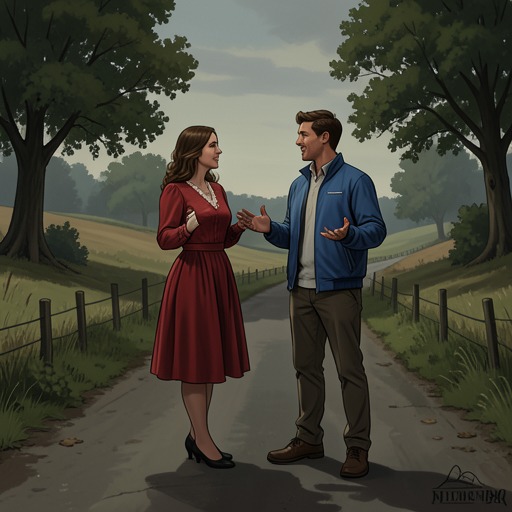
Frances Welty and Tony
Nine Perfect StrangersFrances Welty and Tony’s relationship grows from an attraction neither can dismiss into a marriage built through companionship, deliberate choice, and a willingness to make room for each other’s lives. At Tranquillum House, their apparent differences make the connection seem unlikely; afterward, distance and time test it, but they keep choosing one another. Their eventual wedding gives the relationship a joyful, deliberately extravagant ending, while Frances’s hesitation before their first kiss shows that accepting love means more to her than simply following its excitement.
An Unlikely Attraction
Tony initially sees Frances as a woman whose talk, interests, and life seem remote from his own. He considers her eccentric, notes that she writes romance novels while he has not read one since high school, and believes they have nothing in common. Yet, in a moment when he is frightened and does not want to die, he wants to take her out for a drink. Attraction appears before either has established that they are compatible; the gap between Tony’s dismissal and his wish to see her again is the relationship’s first reversal.
Frances, too, notices the appeal of what is unfamiliar. Tony can pirouette, a physical skill she has never encountered in a partner, but she recognizes that this novelty is not itself a reason to let him kiss her. The thought of being at a party with a man who wants to kiss her, while the kiss has not yet happened, recalls the charged anticipation of her first teenage crush. For Frances, desire briefly makes the present feel heightened and almost hallucinatory, but the memory also carries its later disappointment: that boy eventually told her he preferred smaller breasts. Excitement and caution enter the relationship together.
The First Kiss and Frances’s Choice
After the retreat, Frances and Tony find themselves alone at a long table, sharing a final glass of wine. When Tony offers a refill, Frances declines, joking that she must be transformed because she would normally say yes; Tony says he feels the same. His focused look tells her he has decided to kiss her. The moment invites a familiar romantic script, but Frances pauses over what that script has cost her before.
She remembers her first kiss and its eventual hurt, as well as her late friend Gillian’s warning that she should stop behaving like the heroine of one of her own novels. Tony lives in Melbourne and seems settled there. Frances also recalls how often she has moved for a man, including her readiness to move to America for a man who did not exist, the supposed romantic partner behind her online romance scam. In this pause, the issue is not whether she feels attraction but whether she will again abandon her own judgment and shape her life around a fantasy. Masha’s question about whether she wants to be a different person when she leaves the retreat sharpens the choice. Frances and Tony’s connection advances, but it does not erase the need for her to decide what kind of future she wants.
Distance Becomes Companionship
Two months later, Frances and Tony are walking in different states, nine hundred kilometres apart. They have made a habit of keeping each other company during walks around their respective neighbourhoods. At first they hold their mobile phones to their ears; after Tony’s daughter Mimi suggests using headphones, they can walk longer without their ears aching. The small practical adjustment gives their courtship a durable form: intimacy is no longer confined to the charged atmosphere of the retreat or a single evening over wine, but is sustained through an ordinary, repeated activity across distance.
Their conversations also look toward a life beyond the walks. Frances says she has never been to Holland, and Tony asks whether she would like to go there with him. She agrees. Their first kiss takes place in the Qantas lounge, a detail that links the relationship’s next step to the prospect of travel together. The sequence is characteristically tentative and concrete: a question, an affirmative answer, and then a kiss as their imagined shared future begins to acquire a destination.
Partnership, Marriage, and Family
The relationship becomes a shared life rather than a brief retreat romance. Tony moves to Sydney for Frances, and they live together. He is beside her when her career revives after her first attempt at romantic suspense becomes a surprise success; Jo, her friend, had recognized the manuscript’s strength and called to praise it after Frances delivered the revision. Frances, in turn, becomes close to Tony’s grandchildren in Holland, who call her Grandma Frances. Tony credits her with his family’s eventual move back to Sydney, though the account makes clear that his son Will received a transfer and Frances was not the cause. Her delight in the grandchildren fits a familiar tendency: she skips the hard yards and goes straight to loving and spoiling them, then handing them back.
The narrator initially says that Frances did not marry Tony, distinguishing their enduring partnership from a conventional wedding ending. But the later account revises that expectation: she eventually does marry him, waiting until her sixtieth birthday. She wears turquoise, has eleven bridesmaids, all at least forty-five, thirteen flower girls, and a toddler page boy named Zach who carries a Matchbox car in each fist. Giant white satin bows are tied to the backs of the reception chairs. The wedding is described as beautiful and ridiculous, a celebration whose conspicuous abundance suits Frances’s capacity to embrace the pleasures of family life without pretending they are restrained or conventional.
Significance of the Relationship
Frances and Tony’s arc joins romantic possibility to a more considered form of choice. Frances’s memories of a humiliating first romance and an entirely fabricated overseas lover make her wary of confusing longing with a reason to uproot herself. Her hesitation before Tony’s kiss therefore matters: she does not simply repeat the old pattern but considers the distance, his established life, and her own history before moving forward. The eventual outcome is not an instant transformation but a relationship that develops through continued attention—walks, travel, cohabitation, mutual presence during a career revival, and affection for Tony’s grandchildren.
The contrast between the relationship’s unpromising beginning and its expansive ending gives it its particular shape. Tony first sees difference as evidence that he and Frances have little in common; those differences do not prevent him from wanting her company. Frances experiences the thrill of anticipation but also remembers what romantic fantasy has cost her. Their eventual marriage does not cancel those histories; it follows a slower sequence in which each makes a place for the other. By the time Frances reaches the turquoise-clad, many-attendant wedding at sixty, the connection that began with a wish for a drink has become a shared home, a long-distance courtship, and an extended family role she embraces wholeheartedly.