Grief and remembrance
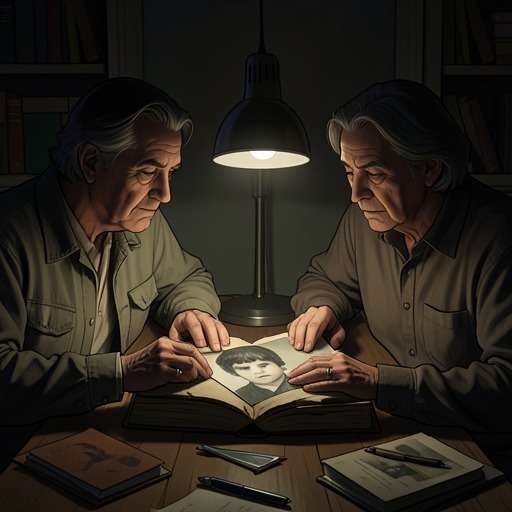
Nine Perfect StrangersGrief and remembrance are presented as an ongoing relationship with the dead, not a clean break from them or a quick return to normal life. In the Marconi family’s mourning of Zach, the story traces how suicide becomes entangled with guilt, fear, and a family’s difficulty speaking together, then makes a crucial distinction between remembering the manner of his death and remembering the full life that preceded it. The change is not forgetting: it is learning to hold painful and joyful memories in the same account, so that love for the dead need not prevent the living from choosing life.
A loss revisited
For Napoleon, Zach’s death remains a scene he repeatedly reconstructs. He examines the morning as though searching evidence, returning to the moment he reached for the phone and pressed snooze, and imagining the alternative in which he got up instead. That counterfactual gives his grief a particular shape: he does not merely miss his son but revisits the possibility that one different action might have changed what happened. The text presents the imagined alternative as part of Napoleon’s mourning, not proof that he could have known or prevented the outcome.
Heather’s memory is anchored in a different moment: she was the one who found Zach. The family’s recollections do not initially converge into a shared account of loss. Heather remembers the shock of discovering what had happened; Napoleon returns to the decision he believes he made that morning; Zoe resists the assumption that being twins meant she and Zach were close. Their distinct memories and silences show how one death can divide a family’s grief into separate, difficult-to-reconcile experiences.
The story also places this family loss beside Masha’s earlier bereavement. Masha remembers opening her infant son’s bedroom door after promising to return in a few minutes and finding that he had died in an accident. Her memory preserves an everyday domestic intention—going to check on her child—against the irreversibility of what she finds. That earlier loss makes grief recur across the novel in different forms, without suggesting that the two deaths or their aftermaths are interchangeable.
Speech, silence, and responsibility
At Tranquillum House, Napoleon tells the group that the next day will mark the third anniversary of Zach’s death. He explains that his family came because January is difficult to face at home, where Zach died. His disclosure follows a recitation of lines about being master of one’s fate; he then confronts the painful contrast between that ideal of self-determination and his son’s suicide. The room’s stillness makes the announcement a turning point in what the other guests understand about the Marconis and why they have come.
Zoe speaks more bluntly. She says the family cannot bear to be at home in January and discloses that Zach died by suicide. She recalls a friend describing his death as brave, a comparison she rejects, and says the family stopped telling people the method because they feared suicide contagion. Her disclosure carries both personal anger and concern about what the family’s account might do to others. When Napoleon and Heather try to stop her, she insists on telling the story in her own terms.
Those terms include an emphatic claim that she and Zach were not close. Zoe recalls that they attended different schools and had different interests and values; she also describes the ordinary morning when Zach took out the recycling bin because it was his turn, then went upstairs. She wonders whether completing the chore was meant as a point, and expresses anger that this small act could not compensate for the hurt his death left behind. The detail of the recycling chore keeps the memory grounded in routine, while Zoe’s interpretation shows how grief can make an ordinary last action seem charged with possible meaning.
Zoe’s claim of distance is not the novel’s final account of the twins’ bond. Heather remembers that they shared a bed when they were frightened by nightmares until they were ten, and believes Zoe adored her brother. That contrast does not simply invalidate Zoe’s words: it exposes a gap between what she can say publicly and what her mother remembers of their childhood. After Zach’s death, Heather also recalls the family grieving separately, each alone in a different room, and searching his belongings for an explanation. The absence of an explanation leaves the survivors with questions, not a settled story of responsibility.
Heather’s guilt becomes especially concentrated around Zach’s asthma medication. She tells her family that a specialist had wanted to prescribe a preventative and that she had said there were no side effects when Napoleon asked. She now believes she should have read the information about the possible side effects, including depression and suicidal thoughts. The confession is an account of Heather’s remorse and her retrospective understanding; it does not establish that the medication caused Zach’s death. Its force lies in how grief fastens on a decision that can be revisited, turning uncertainty into self-accusation.
Remembering the whole life
Heather’s understanding begins to change when she considers how the family might mark the anniversary and the twins’ twenty-first birthday. She wants them to speak about Zach and to recognize Zoe’s birthday as well, rather than allowing the date to become only an occasion for shame and grief. Napoleon has long urged her to separate Zach from the way he died: there was more to his life than its final event. Heather now accepts that one memory has eclipsed the others, and proposes gathering the family’s best memories of his eighteen years. She does not expect grief to become easy; she believes the unbearable can be borne, and distinguishes grieving the suicide from grieving the loss of the boy himself.
The shift is also a revision of how Heather understands Zoe. She had taken her daughter’s insistence that they were not close at face value, but now remembers the twins’ childhood intimacy and recognizes that Zoe may need repeated reassurance that Zach’s death was not her fault. Heather’s thought that the failure was hers alone expresses the severity of her guilt, rather than an objective verdict on the family. The novel lets this self-blame remain painful even as Heather begins to see a different way to remember her son.
For Zoe, the change does not require denying anger. After an intense experience at Tranquillum House, she says that she saw Zach, while recognizing that the group had hallucinated him rather than literally encountered him. She describes having been angry because his death felt like a cruel act that left her responsible for feeling bad forever. Yet the experience seemed to her like a conversation between them renewed. Her response makes the encounter significant as an emotional event without confirming that it was contact with an afterlife.
Zoe asks Frances whether they might really have seen the people who appeared to them. Frances answers cautiously: she does not believe in alternate realities, but believes in the power of love, memory, and imagination, and allows that anything is possible. Zoe says she feels as if she has her brother back in an unusual way, as though she could text him. The imagined possibility matters less as a claim about what exists beyond death than as a change in her felt relationship to Zach: he is no longer present only as the person whose death she cannot forgive.
The continuing bond
The novel makes remembrance active and selective. Zoe begins to imagine remembering not only the times she and Zach fought or stopped speaking, but also the times they laughed together, talked about everything, and shared secrets. Her grief has not disappeared, and she does not describe the loss as acceptable. Instead, the memory of their relationship becomes less one-sided: anger and estrangement remain part of it, but they no longer have to crowd out tenderness and companionship.
That broader memory changes the meaning of moving forward. Zoe recognizes that on occasions when she began to feel better, she had stopped herself because improvement seemed equivalent to forgetting Zach or betraying him. She now sees a way to retain both the difficult and loving parts of their history. The story’s answer to guilt is not a definitive explanation for why Zach died, nor a promise that the family will cease to hurt. It is the possibility of remembering him in a way that leaves room for ordinary life to continue.
At the close of Zoe’s reflection, Zach remains present in her heart and memory as she imagines finishing university, travelling, finding work, marrying, and growing old. His continuing place in her life does not mean that she confuses memory with physical survival: it means that his death does not cancel the relationship they had or dictate that she must refuse her own future. Grief and remembrance thus culminate not in detachment, but in a bond that can accompany the living without preventing them from choosing life.