LSD
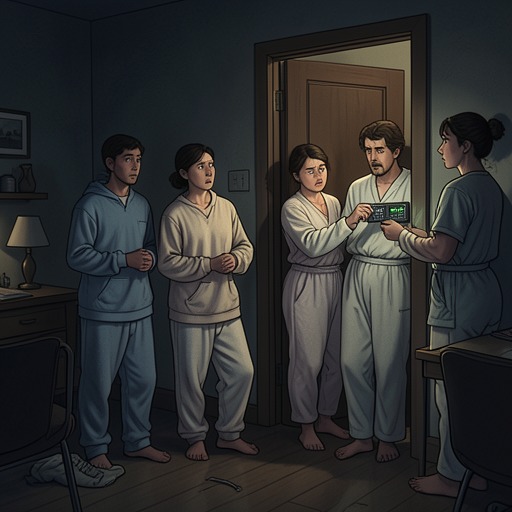
Nine Perfect StrangersLSD is the hidden substance behind Tranquillum House’s smoothies, transforming an advertised wellness retreat into an experiment its guests never knowingly agreed to join. Introduced as micro-dosing and later increased to produce a powerful psychedelic experience, it shapes vivid perceptions and emotional disclosures while exposing the gap between Masha’s promise of therapeutic transformation and the guests’ right to choose what enters their bodies.
From micro-dosing to covert administration
Masha describes micro-dosing as safe and beneficial: the doses, she says, are about one-tenth of a normal LSD dose, and the practice can increase creativity, focus, and spiritual awareness, as well as improve relationships. She presents it as a way for guests to function a little better, not as an intoxicating drug experience. The guests, however, had not been told that LSD was in their drinks. Frances reacts with uncertain laughter and asks whether Masha is saying they have been taking LSD; Heather names the issue more bluntly, calling it the act of spiking their smoothies with a hallucinogenic drug.
Masha defends the earlier regimen by arguing that the small doses helped guests concentrate on yoga and meditation and eased withdrawal from substances such as alcohol and sugar. She invokes clinical trials at respected universities and claims psychedelic drugs have minimal side effects. But Heather notices that what she and the others are beginning to feel cannot be explained by micro-dosing alone. Masha’s pleased response to Heather’s observation signals the change in scale: the experience now unfolding is more than the mild, concealed dosing she has been defending.
The practice had been going on for over a year. During that time, Masha and her staff put LSD in guests’ smoothies without their knowledge or reported ill effects. Guests attributed feeling good to the organic food and meditation, then rebooked in the hope of feeling that way again. The apparent success of the retreat therefore depended on a misattribution: the program’s marketed methods received credit for effects produced, at least in part, by a drug guests did not know they were taking.
The escalation grew from Masha’s decision to go beyond micro-dosing and attempt something she called revolutionary, pushing the envelope and changing the course of history. Yao initially resisted, saying he wanted to help people rather than change history. He eventually tried the psychedelic therapy himself with Masha guiding him. Delilah was away that weekend; when she next saw Yao, she found him more obsessive and intense, quoting research to justify his changed position. In her account, the research was not what had persuaded him: the experience of the hallucinogenic drugs, and Masha’s influence, had done so.
Altered perception and emotional encounters
The drug’s effects are rendered through distinct, personal experiences rather than a single uniform vision. During Lars’s experience, a simple thought about Ray briefly seems to contain the answer to every question and the key to every lock. The insight is fleeting: his mind then bursts into a billion purple petals. The sequence gives the altered state a sharp movement from emotional clarity to overwhelming visual transformation, without establishing that the insight is a lasting or medically verified result of LSD.
Napoleon’s experience takes the form of an apparent family reunion. When Zoe says that Zach would find it hilarious for the family to be getting high together, Napoleon answers that Zach is there and greets him. Zach appears before him in shorts and no shirt, and Napoleon accepts the vision as ordinary. For a moment, the family seems whole again, together as it used to be. LSD thus becomes the medium through which Napoleon encounters what he longs for, while the scene’s force depends on the difference between that felt restoration and the family’s actual bereavement.
Frances later recalls that she drank a smoothie containing hallucinogenic drugs and experienced a beautiful, remarkably vivid dream involving her dead friend Gillian, her father, and her former husbands. The experience seemed to last forever and contained symbols and visual metaphors she hoped to interpret. Yao, Delilah, and Masha interrupted at different points with questions and attempts to steer her; Frances ignored them because she was enjoying the experience, and she sensed that eventually they gave up. Her recollection ranges through being in space and being an ant, emphasizing how far the drug experience carries her from ordinary perception.
Afterward, Frances remembers the episode as more vivid than a conventional dream, even saying it felt more real than ordinary life. Zoe likewise tells Frances that she had been angry with Zach, feeling that his suicide had been a deliberate act that would make her feel bad forever, and that she had been unable to forgive him. During the experience, however, she felt that they had talked again. Frances does not claim certainty about whether they truly saw the dead; she describes her own encounters with Gillian and her father and acknowledges how real they felt. The visions offer the bereaved a form of felt contact, but the account leaves their status open rather than proving that the dead were present.
Consent, therapeutic claims, and consequences
LSD’s significance at Tranquillum House lies not only in what guests perceive but in how the drug is administered. The earlier doses were concealed in smoothies for more than a year, while guests believed their improved well-being came from organic food and meditation. Masha’s appeal to safety, research, and therapeutic benefit does not change that concealment. Her language casts the drug as a tool for improvement; Heather’s description of spiking makes the bodily violation visible beneath that language.
The movement from small doses to an experience Masha intends to be revolutionary also changes the stakes. Heather senses that the effects have exceeded a micro-dose, while guests undergo vivid encounters with dead loved ones and emotional material tied to grief. Their experiences may feel meaningful, but the story does not treat that meaning as a substitute for informed agreement. Masha’s program makes the promise of transformation inseparable from her control over the dose, the setting, and the direction in which staff try to guide the guests.
LSD therefore functions at once as a concealed cause, a generator of altered perception, and an ethical fault line. The same smoothies guests credit for a wellness routine conceal the substance shaping their states of mind; the same visions that offer Frances and Zoe a powerful sense of contact also occur within an intervention imposed without their knowledge. The contrast prevents the drug’s apparent emotional usefulness from resolving the question of consent: an experience can feel vivid, consoling, or revelatory and still have been brought about through deception.