MDMA
Nine Perfect StrangersMDMA is the substance Masha gives Ben and Jessica in smoothies formulated differently from those served to the other guests, intending to accelerate their couples therapy by dissolving emotional barriers. In the retreat’s unauthorized intervention, it becomes both a means of unusually open communication and a source of conflict: the intimacy it appears to unlock cannot itself repair the secrecy between the couple or establish that they agreed to the treatment.
Introduction and administration
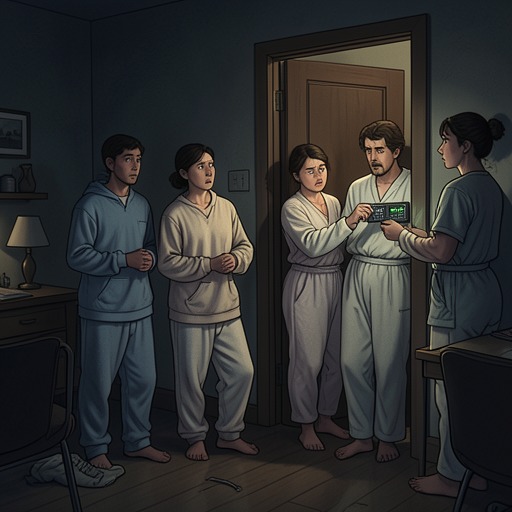
Ben and Jessica arrive expecting couples counselling, not a drug-assisted session. Jessica protests that they paid for counselling and that the experience so far has been pointless. Masha answers that the treatment will have a profound impact on their marriage, assuring them they will remain together through the experience. She points them toward a cluster of cushions and discloses that their smoothies contained a different formula from everyone else’s. The formulation, she explains, was selected after studying research on MDMA.
Heather immediately names the drug ecstasy and objects to the risks, invoking the deaths of young people after taking ecstasy tablets. Her alarm is sharpened by the fact that the intervention is taking place at the retreat, not in a clinical environment. Masha, however, does not stop to address Heather’s objection. The contrast between the couple’s expectation of counselling and the undisclosed contents of their smoothies makes consent central to the scene: Masha speaks of therapeutic purpose after the drug has already been given.
Masha’s therapeutic rationale
Masha distinguishes her treatment from recreational use at a club. She describes MDMA as an empathogen that produces feelings of empathy and openness, and argues that, in a controlled environment, it is safe. She cites trials of prescription psychotherapy for PTSD, social anxiety, and couples therapy, claiming that clinically administered doses have produced no deaths or adverse reactions. Her defence rests on research and controlled clinical use; Heather’s reply is that this retreat is not a clinical setting. The disagreement therefore concerns not only what MDMA can do, but whether evidence about clinical administration justifies using it here.
Masha frames the intended effect in relational terms. She expects Ben and Jessica to become more sensitive to each other’s feelings and more accepting of each other’s views, enabling a form of communication they may never have experienced before. Lars, already under the drug’s influence, calls it a very nice experience. Masha rebukes that recreational-sounding response by insisting that the session is guided therapy, not a night of dancing. In her account, the drug is an instrument for crossing barriers quickly, with the counsellor directing the process rather than leaving the couple to the effects alone.
The session between Ben and Jessica
During the session, Ben and Jessica sit cross-legged on cushions facing one another. They grip each other’s forearms as if balancing on a narrow beam, a posture that gives their exchange a visible sense of mutual effort and precariousness. Masha guides them only when necessary. From her perspective, the MDMA is doing what it is meant to do: dissolving barriers and bringing the couple to a point that might otherwise have taken months of therapy.
Ben speaks directly from his heart while Jessica listens, transfixed. He says that he misses her face, calls it beautiful, and tells her he no longer recognizes her, their relationship, or their life. He also grieves their old flat, the job he misses, and the friends they lost after their lives changed. His repeated focus on Jessica’s face concentrates the marital estrangement into a personal absence: he is not merely describing dissatisfaction, but mourning the person and shared life he feels have disappeared. The scene supplies Masha with apparent evidence that the drug has opened an unusually direct channel between them.
Secrecy and the limits of chemical openness
That apparent breakthrough does not mean Jessica has told Ben everything. When he later points out that she did not mention the matter the previous night, while they were speaking from their hearts, Jessica recalls that she had already gone off the pill but had concealed it. She had understood the omission as a betrayal, even while the drug made her feel that she and Ben were two halves of one person. The session’s emotional intensity made that sense of unity feel like a beautiful truth; in retrospect, she sees it as a beautiful lie because the secret remained.
Jessica remembers that, as they kissed, the thought that they were okay had flashed through her mind repeatedly. But the reassurance did not survive the session. She concludes that what she felt the night before was not real and that drugs had lied to her. The novel thus sets MDMA’s capacity to loosen inhibition against its inability to guarantee honesty: a person may feel extraordinarily close while withholding exactly the information the relationship needs. The drug can alter access to feeling, but, in Jessica’s experience, it cannot make a concealed decision disappear or turn temporary certainty into durable trust.
Significance
MDMA is presented through competing claims rather than a simple verdict. Masha treats it as a research-supported shortcut to empathy and communication; Heather challenges the transfer of clinical claims to an unapproved, nonclinical setting; and Jessica’s later recollection exposes the gap between felt openness and actual disclosure. Ben and Jessica do experience an intense exchange, but the emotional access Masha celebrates does not erase Jessica’s secrecy or settle the couple’s underlying crisis.
The episode’s decisive contradiction is that MDMA can make closeness feel immediate while leaving the conditions of trust unresolved. Masha calls the session guided therapy, yet the couple only learn that their smoothies contained a different formula after drinking them. The same intervention that appears to dissolve barriers therefore raises a prior barrier of its own: the participants were not told what they were being given before the experience began. Its promise of transformation cannot be separated from the question of who chose that transformation, and from Jessica’s recognition that feeling united under the drug did not mean that she and Ben were okay.