Masha's unresolved grief over her son
Nine Perfect StrangersMasha's unresolved grief over her son begins with an ordinary delay that became irreversible: she finished what she was doing before opening his bedroom door and finding him dead. He had strangled himself on the long white cord of a window blind. The loss persists as guilt, estrangement, and sensory recurrence; even years later, warning tags on blind cords command her attention, and her baby’s voice and image break through her certainty about what is real. Her grief is not simply a memory of the child she lost, but a life she believes she was denied and a past she continues to judge herself against.
The accident and the accusation against herself
Masha had called to her son that she needed five more minutes. The task took less than five, perhaps four. When she opened his bedroom door, she found that he was already dead. The stark interval between her promise to return and the discovery gives the memory its devastating shape: a small delay becomes, in retrospect, the moment she cannot undo. Her son had strangled himself while playing with the long white cord from the window blind, an accident Masha later learned was not uncommon. Other women had also found their babies and untangled them with trembling fingers.
The knowledge that the death was accidental does not release Masha from blame. At the hospital, her husband told her there was nothing to forgive and that it had been an accident. She refused that absolution. Her son had called for her, and she had not gone to him; in her judgment, that failure was unacceptable. The gulf between her husband’s attempt to comfort her and her own uncompromising verdict becomes central to the grief: reassurance cannot change what she remembers doing, or believes she failed to do.
The loss also fixes itself to visible reminders. Masha sees warning tags on blind cords whenever she enters a room, even from far away. The cord is no longer merely part of a window covering: the warning label makes an ordinary domestic object carry the continuing force of the accident. Her attention returns to the precise means of her son’s death, as if vigilance could now answer the helplessness of that earlier moment.
Marriage, separation, and the life that continued
Her husband’s response could not bridge the distance between them. Masha refused his forgiveness, and she let him go, insisting that he find another life. Their son’s death had made the sight of her husband unbearable because his face so resembled their beautiful child; when the marriage ended, she felt relief at no longer having to see that resemblance. The separation is thus both a consequence of grief and an effort to escape one of its daily reminders.
Masha later learned by chance that her former husband was healthy and happy. He had remarried, had three sons, and built a family life in Australia. She hoped that he still sang while cooking, as she remembered him doing. This knowledge sits uneasily beside her own conclusion that she was a complex, unhappy woman while he had been simple and happy. His apparent return to happiness does not restore what they lost together, and her hope for him coexists with the distance she chose and maintained.
Her former husband did not stop hoping for contact. Years after giving up on communicating with Masha, he emailed again when their first grandchild was born, attaching photographs and offering her the possibility of becoming a grandmother even though she had chosen not to be a mother. She did not reply. The birth created a new opening toward family, but it did not dissolve the refusal that had followed the death. The continuing silence shows how the old rupture persists even as life around it expands into another generation.
Motherhood refused and the family she could not enter
The depth of Masha’s separation from motherhood becomes clear in the memory of her second son’s birth. He was born only three months after the loss of her first child. Masha would not look at the baby. She told her husband that the child was his, not hers, and discharged herself from hospital, saying she would return to work that very day and send money so that he could care for the newborn. Her decision was expressed calmly, as though it were a business arrangement; she lost her composure only when her husband fell to his knees and begged her to let them be a family again.
Then she screamed that she was not a mother. Her repetition made the declaration sound less like a settled identity than an absolute boundary she needed her husband to recognize. She would provide financially, and as her career became more successful she sent more money each year, but she would not take up the maternal role he was asking her to resume. The distinction between supporting the child and claiming him as her own allowed her to continue living without entering a relationship that, after the first loss, she could not bear.
Her former husband sent photographs of their son, but Masha never acknowledged them. She may not even have looked at them. He eventually remarried, and his son called his Australian wife Mummy; together they raised a family in a life Masha had refused. The story preserves both the permanence of that refusal and its complexity: Masha is described as strong enough to move mountains and as weak as a child. Neither image cancels the other. Her separation from the family is an exercise of will, but also a condition born of overwhelming grief.
The dead child’s return
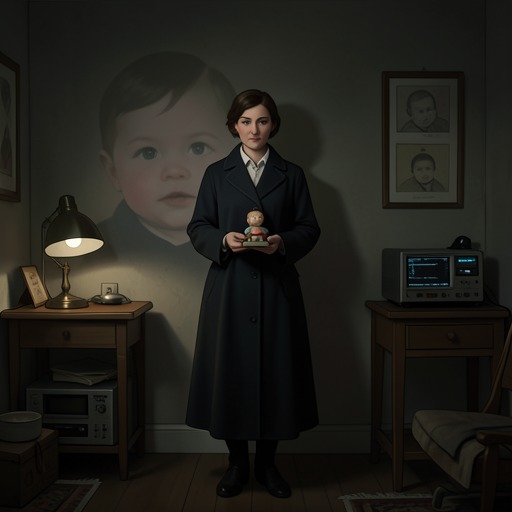
Masha’s grief returns not only through objects and remembered decisions but through a sensory presence. During her crisis, she hears her baby calling. She knows that the voice is not real, closes her eyes, and tries to distinguish the hallucination from reality. Yet when she opens them, she sees him crawling across her office floor, babbling. She closes her eyes again, insisting to herself that he is not real. The sequence makes her clear awareness and her involuntary vision coexist: recognizing the image as unreal does not prevent it from appearing.
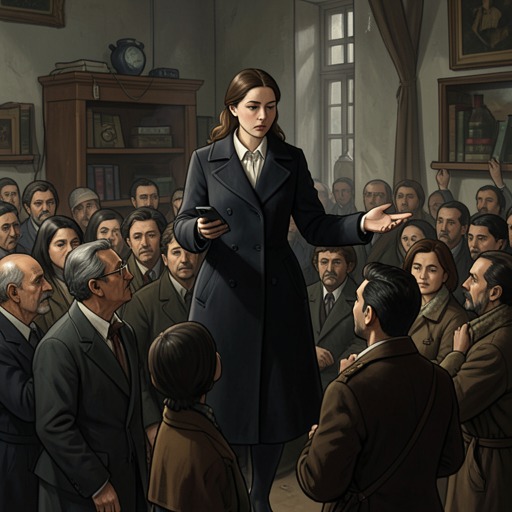
The vision breaches the controlled professional setting in which Masha monitors her guests. Her son appears not in a distant recollection but on the floor of her office, in the present tense of an experience she must actively resist. The return makes visible what her composure conceals: the loss remains intimate and immediate, despite the years that have passed and the authority she exercises over the retreat.
The remembered child is also held in a future that never arrived. Masha thinks he would have been twenty-eight that August. She imagines that they might have had a difficult relationship and fought as she once fought with her own mother. But that possible conflict is itself part of the loss: she has no adult son with whom to argue, reconcile, or discover what their relationship might have become. Instead, he remains her singing, chuckling baby and the beautiful young man she pictures walking toward her through a lake of colour. She thinks she should have been allowed to stay with him.
Private grief and public stories of suicide
Masha’s loss exists alongside the Marconi family’s grief over Zach’s suicide, but the two histories are distinct. At Tranquillum House, Zoe explains that her family cannot bear to be at home in January, where her brother hung himself, and that the family has stopped telling people how he died because of concerns about suicide contagion. The disclosure unsettles Masha: hearing the details of another family’s bereavement briefly breaks through the controlled composure she had maintained even while speaking of her own father.
The retreat’s conversations also place private grief beside claims about suicide and its prevention. Napoleon tells a group of newly bereaved parents that research suggests some teenage suicide attempts follow only a short period of suicidal thought, and that interruption or removal of the means can matter. His account emphasizes the possibility of chance and intervention, but he withholds other findings he fears would burden the parents. These discussions do not explain Masha’s son’s accidental death; rather, they show the retreat’s wider effort to give language to families whose lives have been reorganized by a child’s death.
Masha’s own response to bereavement remains personal and embodied. The white blind cord, the refusal of forgiveness, the child’s imagined voice, and the adult life she cannot know all return to the same unresolved point: she was away for a few minutes, and her son died before she reached him. Her grief persists not because she lacks an explanation, but because the explanation that he died accidentally cannot reconcile her with the fact that he called and she did not go.