Monkey brain
Nine Perfect Strangers“Monkey brain” is the retreat’s image for a mind moving rapidly from one thought to another, like a monkey swinging between branches. At Tranquillum House, the metaphor supports the promise that five days of silence will settle the mind, body, and soul; as the guests’ attention is detached from their devices and later altered by drugs, the phrase also becomes a lens on how thought and connection are shaped by the retreat’s rules and practices.
Definition and Introduction
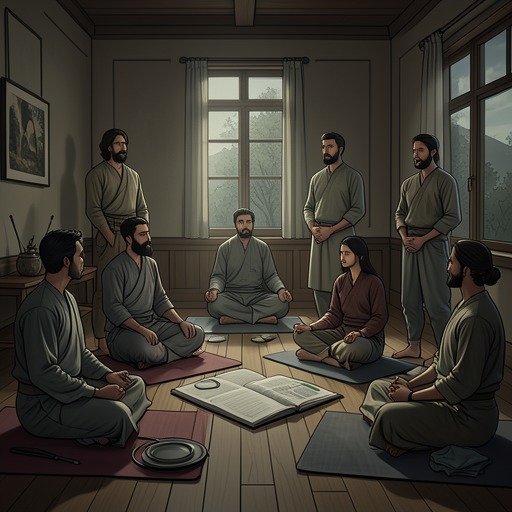
Ben Chandler reads the metaphor aloud from the retreat’s welcome letter to Jessica Chandler. The letter says that it takes at least twenty-four hours to quiet the monkey brain, then presents “noble silence” as a period of reflection intended to bring calm. The silence is more than an instruction not to talk: it also bars touching, reading, writing, and eye contact with other guests and even with one’s companions. Jessica notes that the restrictions apply even when she and Ben are alone together in their room.
Ben illustrates the metaphor physically, making a monkey-like sound and scratching under his arm as he explains the mind’s movement from thought to thought. His comic demonstration briefly draws a smile from Jessica. The lightness of the exchange sits beside the restrictions in the letter: the metaphor makes restless thinking sound ordinary and almost playful, while the retreat’s proposed answer is a strict, five-day withdrawal from ordinary communication.
Silence, Devices, and Attention
The retreat’s effort to quiet mental activity is paired with the removal of the guests’ electronic devices. Frances Welty switches off her phone and hands it to Yao, experiencing the handover as a shift into subservience. The loss is not abstract: Jessica later lies awake missing her phone, which she normally uses to scroll through Instagram and Pinterest when she cannot sleep. Without it, she cannot fall back on the familiar routine of looking at a screen until she becomes tired.
The metaphor therefore operates within an environment whose rules regulate not only speech but also access to information and communication. The guests are told that going off the grid will be an enjoyable part of the retreat, yet their phones remain in the retreat’s care. Later, when Ben finds the phones, the guests reconnect with the outside world and discover that relatively little has changed in the intervening week. The contrast gives the promised stillness a practical dimension: attention has been redirected partly by removing the tools through which the guests ordinarily follow their thoughts and social lives.
Altered Thought and Experience
The retreat’s language about mental quiet takes on a different context when the guests learn that they have been given micro-doses of LSD. Masha describes the doses as roughly one-tenth of a normal dose and attributes benefits such as increased focus and creativity to the practice. The claim that the substances are safe and the promise of a more settled or capable mind thus appear together, even as Frances responds with uncertainty on learning that LSD is involved.
Lars’s psychedelic experience includes a moment in which he thinks of Ray’s open, hopeful face and understands that Ray wants his love, not anything from him. For a moment, the thought seems to answer every question; then his mind breaks into a vivid image of purple petals. The sequence does not simply show thought being silenced. It presents a brief, emotionally clarifying insight followed by a striking mental transformation, making the language of focus and calm sit uneasily beside the unpredictable flow of the guests’ altered consciousness.
Frances later remembers her experience as an unusually vivid dream, lasting subjectively for a long time and moving through images of her deceased friend Gillian, her father, and her former husbands. She recalls being in space and being an ant, while Yao, Delilah, and Masha sometimes interrupted to question her or guide her; she ignored their attempts and continued with the experience. Her account places the retreat’s ambition to direct thought beside the guests’ own vivid, shifting experiences, which do not necessarily follow the direction its staff intends.
Meaning and Limits
The monkey-brain image offers a simple account of why silence might help: if thought keeps swinging from one subject to another, removing ordinary stimuli and conversation may appear to promise quiet. Yet the events around the metaphor complicate that promise. Jessica’s habitual phone use is interrupted, the guests are subject to rules limiting contact, and their psychedelic experiences produce not a uniform stillness but divergent memories, images, and emotional discoveries.
The metaphor consequently belongs to the retreat’s persuasive vocabulary as well as to its account of the mind. Its accessible, humorous image makes the goal of silence easy to grasp, while the actual experience shows that attention is also governed by the retreat’s control of devices, restrictions on interaction, and drug regimen. Rather than resolving what restless thought means, the phrase helps expose the gap between a neat promise of mental quiet and the complex experiences the guests undergo.