Napoleon Marconi and Zach Marconi
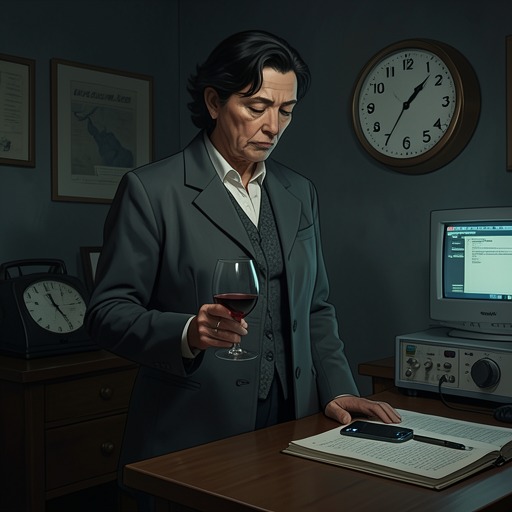
Nine Perfect StrangersNapoleon Marconi and Zach Marconi’s father-son relationship is recast by Zach’s suicide as an enduring struggle between love and self-blame. Napoleon remembers their ordinary closeness in the days before Zach died, but repeatedly fixates on one small decision—the snooze button he pressed on the morning Zach died—as if a different choice could have preserved his son and his family. His eventual movement toward understanding Zach’s despair does not erase his grief; it changes the terms on which he remembers and addresses his son.
Identity and Background
Before Zach’s death, Napoleon understands himself as a father who knows how to guide boys. He teaches young people, keeps letters from former students and their parents, and takes seriously the praise that he has helped boys through difficult moments. In his family, he sees himself as responsible for education and conversation, while Heather handles health decisions. This division later becomes painful: Napoleon believes that if he had known about a potential risk associated with Zach’s asthma medication, he would have read its information leaflet and warned his son to watch for changes in mood.
His memories preserve the mundane texture of their relationship rather than a single defining farewell. Three years before the events at Tranquillum House, he and Heather had been together the previous night. The next morning, Napoleon went paddling while Zach was at home, shirtless and eating breakfast; Zach said there was no milk because he had drunk it all, and mentioned that he might join his father for a paddle the following day. Later, father and son discussed Zach’s friend Chris’s specific career plans, watched tennis, played table tennis, and watched The Royal Tenenbaums. Napoleon remembers that they laughed and stayed up late. The ordinary happiness of this evening, and the casual plan for another outing, become inseparable from what followed.
The Missed Morning and Its Aftermath
Napoleon attributes his failure to get up on time to staying awake late and pressing snooze on his phone. He replays the motion of his hand and thumb, imagining an alternative version of that morning in which he turns off the alarm, gets out of bed, and asks Zach to come paddling. To Napoleon, the decision becomes the point at which one possible family future separated from the one he endured. He is certain that if he had risen as planned, Zach might have lived; this is his grief-driven counterfactual, not something the events can establish.
Heather found Zach. Napoleon remembers hearing her scream and running upstairs, and he learns that Zach had used the new brown leather belt Heather gave him for Christmas. The remembered details make the loss feel painfully particular: Napoleon had remarked on the belt’s price, and Zach had admired it. His recollection of the day before is similarly exact, as though reviewing evidence in an investigation might disclose an answer. Yet after a year of speaking with Zach’s friends, teammates, teachers, and coaches, Napoleon finds no further explanation. The search has limits, but his mind continues to return to the decision he believes he should have made.
In the first week after the funeral, Napoleon decides that he must not break. He resolves to keep functioning for Heather and their daughter, Zoe, while continuing to grieve. He studies suicide, reads books, listens to podcasts, and searches for research. He attends a Tuesday-night support group for people bereaved by suicide, eventually runs it, listens to other grieving parents, gives talks to parent groups and schools, takes part in radio interviews, edits an online newsletter, and helps with fundraising. He tells newly bereaved parents that teenage suicide can follow an impulsive decision and that sometimes there are no warning signs. He withholds other research he believes might make those parents feel that a phone call, interruption, or other stroke of luck could have prevented the death. His public work is therefore both care for others and a difficult management of what his own experience has taught him.
Fatherhood, Knowledge, and Responsibility
Napoleon’s certainty about the snooze button is bound up with the father he thought he was. He remembers telling Zach to think carefully and believes he was meant to understand boys. The cards and letters from former students seem to confirm his ability to help young people, making his sense that he failed his own son especially stark. He imagines a different present in which Heather is not broken, Zoe still sings in the shower, and Zach is approaching his twenty-first birthday. These imagined outcomes express the scale of his regret, but they cannot prove that a morning paddle would have changed what happened.
At Tranquillum House, Heather reveals that Zach’s asthma medication could have depression and suicidal thoughts among its side effects. She recalls that a specialist wanted to prescribe it and that Napoleon had asked whether there were side effects; she had said no. The confession gives Napoleon a possible explanation he has sought for years, but also creates a new source of anger: Heather knew of the risk, or could have known it, and did not tell him. He believes that he would have read the leaflet, monitored Zach, and warned him to report a change in his mood. He also believes that the information should be reported to the relevant authorities so that other families can be made aware of the possible risk.
The new knowledge does not settle causation. Napoleon recognizes that he cannot remember the medication conversation, even as he imagines what he would have said if he had known. He considers whether medication, adolescence, or both might have contributed to Zach’s state. His conviction that Heather’s disclosure matters coexists with uncertainty about what caused Zach’s suicide and whether any intervention would have prevented it. The distinction is central to their relationship: a possible risk supplies information and public responsibility, but it cannot turn the past into a recoverable certainty.
Grief, Memory, and Recognition
Napoleon’s grief returns in repeated fragments: his hand reaching for the phone, the remembered scene of Zach at breakfast, and the words of love he associates with his lost son. The recurrence gives his mourning the shape of an investigation, but also reveals its emotional purpose. He wants to find a decision that makes the death intelligible and a different decision that might have saved Zach. The more he studies the day, the more firmly the imagined alternative takes hold, even though the people he questions cannot provide the missing answer.
During the retreat, Napoleon begins to imagine what Zach may have felt. Sitting in darkness and listening as Carmel sings while Lars yields the melody to her, he recognizes that the numbness weighing on him might resemble his son’s experience. He considers the possibility of an inner grey fog in which ordinary outward appearances conceal a sense that nothing has purpose. He still calls Zach’s decision wrong, but for the first time he can imagine that Zach experienced it not as one choice among many but as the only escape he could see. This recognition is not approval; it is a change in Napoleon’s capacity to understand the son whose state he could not see in time.
That altered understanding takes the form of an imagined act of comfort. Napoleon pictures taking Zach onto his lap as he once did when Zach was a little boy and telling him that he is not in trouble, that he is sorry for yelling, and that he understands. The imagined words answer the older pattern of a father who told his son to think and who now wishes he had recognized how much Zach might have needed understanding. Their force comes from what Napoleon cannot change: the reassurance is offered in memory, after the possibility of offering it to Zach has passed.
Continuing Consequences
Napoleon’s grief also affects his marriage and his relationship with Zoe. He overhears Heather refer to his support-group work as his new hobby. He experiences the phrase as both a malicious distortion and an uncomfortable truth: the work has become a substantial part of his life, but it is not simply a pastime. Although he can imagine resentment toward Heather, he believes that a happy marriage depends on not searching for reasons to hate one another. The medication disclosure complicates that effort without making their shared bereavement disappear.
Zoe’s account of Zach adds a different perspective to the family’s mourning. She explains that she and Zach were twins but were not close, and that the family avoids being at home in January because that is where he died. She also says that she and her parents stopped explaining the method of his death because they feared suicide contagion. Napoleon’s grief is thus part of a family in which each survivor has a distinct relation to Zach and to the circumstances of his death; his own public explanations cannot substitute for theirs.
Six weeks after the retreat, Napoleon is still teaching, cooking, talking with Heather and Zoe, and running his support group, yet he describes himself as merely surviving. He has waited six weeks for an appointment with a psychiatrist referred by his general practitioner. His senses feel muted, the sky seems drained of colour, and everyday effort is exhausting. He has written to authorities and to the pharmaceutical company to put on the public record that Zach died by suicide after being prescribed the medication. Heather points out that, after the retreat, they have never properly talked again about the medication. The letters have documented the issue, but documentation has not replaced the intimate conversation between husband and wife—or resolved Napoleon’s grief for his son.