Psilocybin
Nine Perfect StrangersPsilocybin enters the guests’ retreat not as a substance they knowingly choose, but as part of a concealed intervention that turns the promised wellness program into an intense, shared altered state. In the resulting visions, memory, imagined presence, and emotional recognition blur: the experience can feel more vivid than ordinary life without settling whether the dead have truly returned.
Introduction and Administration
At Tranquillum House, the guests are told that the retreat’s next stage is a new protocol, and that they are the first nine people to undergo it. Their final smoothie contains both LSD and liquid psilocybin, which Masha identifies as a naturally occurring substance found in certain mushrooms. Tony’s disgusted response, calling them magic mushrooms, and Frances’s uncertain question about whether the guests have been taking LSD expose the gap between the retreat’s reassuring presentation and the guests’ understanding of what they have consumed.
The disclosure is especially charged for Napoleon, who recognizes the substance through a previous bad trip he associates with magic mushrooms. Masha promises that the staff will prevent a recurrence, describes them as trained medical professionals who will guide the guests, and assures them that the drugs have been tested for purity. Those assurances address the anticipated experience and the product’s quality, but the scene also makes clear that the guests are learning only after the fact what their final smoothie contained.
The Promised Experience and Its Effects
Masha frames the session as guided psychedelic therapy: as the ego dissolves, she says, the guests will reach a higher level of consciousness and see the world differently. The drug’s immediate atmosphere is not uniformly frightening. Lars feels a spreading sense of well-being and thinks the retreat is innovative; Frances later recalls the smoothie as delicious and her drug-induced dream as extraordinarily beautiful and vivid. Her recollection ranges across Gillian, her father, and her former husbands, and includes the striking images of being in space and being an ant.
The experience also has a sharply nonlinear quality. Frances remembers staff members, including Yao, sometimes Delilah, and sometimes Masha, interrupting her dream with questions and attempts to steer it. She ignored them because she was absorbed in the experience, and sensed that eventually they stopped trying. Her account therefore places the private intensity of the vision alongside the staff’s effort to guide it, without reducing what she experienced to either a fully directed exercise or an entirely solitary one.
Memory, Grief, and Family
For Lars, the altered state briefly clarifies his love for Ray. He thinks of Ray’s earnest, open, hopeful face and understands that Ray wants his love, not anything from him. The thought seems to answer every question, but then his mind breaks apart into what he experiences as a billion purple petals. The sequence gives the session both emotional lucidity and perceptual disintegration: a simple recognition arrives with overwhelming force, then dissolves into a visual image.
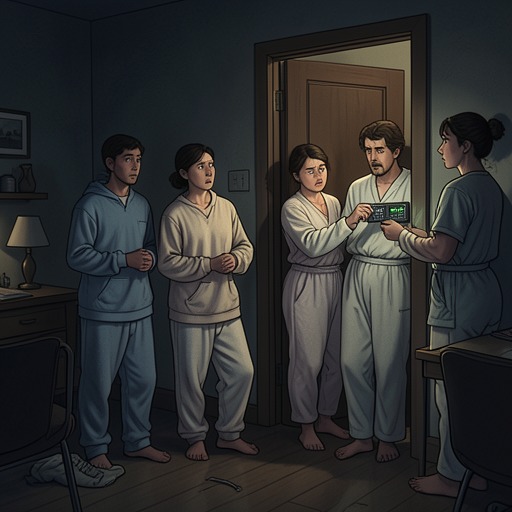
The session also reaches the grief of the Marconi family. Zoe says that Zach would have found it hilarious to see the family getting high together; Napoleon answers that Zach is present and addresses his son. He then sees Zach sitting before him, bare-chested and dressed in shorts, and experiences the scene as an ordinary family moment, as if the four of them were together as they used to be. The ease of that imagined reunion contrasts with the family’s actual loss and gives the psychedelic session a form in which absence temporarily seems reversible.
Afterward, Zoe describes feeling that she and Zach talked again. She explains that her anger had made her feel he had died on purpose to make her feel guilty forever, and that she had been unable to forgive him; in the session, she felt a renewed conversation. Frances responds by describing her own vivid encounters with Gillian, who died the previous year, and with her father. When Zoe asks whether they might really have seen the people they encountered, Frances does not claim certainty. Psilocybin’s narrative significance rests partly in this unresolved space: the experiences are presented as emotionally consequential and more vivid than dreams, while their status as literal contact remains a question rather than a confirmed fact.