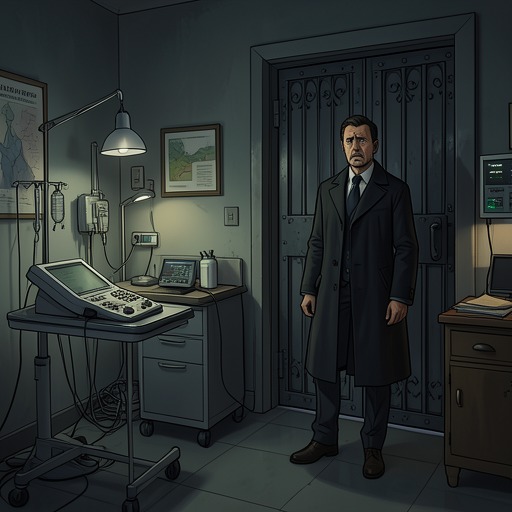
Psychedelic-assisted therapy
Nine Perfect StrangersPsychedelic-assisted therapy is the experimental centerpiece of Masha’s Tranquillum House program: she presents measured LSD doses as a route to heightened awareness and personal change, while the guests encounter intense visions and newly accessible feelings. Yet the therapy’s significance rests on a contradiction. The experiences may feel profound to those undergoing them, but the guests are not told what the smoothies contain, and Masha’s pursuit of transformation overrides their ability to choose. The novel therefore treats the protocol not simply as a therapeutic idea, but as a test of the boundary between insight and manipulation.
Design and promises
Masha describes the drug regimen as micro-dosing, calling it safe and attributing to it greater creativity, focus, spiritual awareness, and improved relationships. She says the amount is about one tenth of a normal LSD dose. Her presentation gives the protocol the language of measured research and practical self-improvement: guests are meant to function a little better, not to understand themselves as taking a powerful psychedelic. Frances later recognizes that she might have agreed to try LSD if asked openly, especially after hearing assurances about research and Yao’s paramedic background. That hypothetical willingness does not make the actual administration consensual; it underscores how different a freely chosen experience would have been from an undisclosed ingredient in a smoothie.
The protocol is embedded in a retreat that already regulates ordinary habits. Guests receive a warning bell before meals or smoothies, are expected to come promptly to the dining room, and are told that room service is unavailable during fasting periods. Masha also imposes an opening period of silence, believing it will establish the right tone and give guests clarity. These routines create a tightly managed setting in which food, conversation, and access to substances are controlled by the retreat. The psychedelic sessions consequently do not occur in a neutral therapeutic space: they are part of a program whose conditions and interpretation are set by Masha.
Experiences and interpretations
The guests’ reactions are not uniform. During one psychedelic experience, Lars has a moment of apparent certainty about Ray: he thinks of Ray’s love as uncomplicated and sufficient, and the thought seems to answer every question before his consciousness breaks into a vivid image of purple petals. The sequence joins an intimate realization to a striking alteration in perception, without establishing that the vision itself proves the insight true. Its force lies in how briefly the thought becomes complete before the experience changes form.
Zoe interprets her experience through the family’s grief over Zach. She says that she had been angry with her brother and felt that his death had left her unable to forgive him; during the session, it felt as if they had spoken again. Frances, too, recalls an experience that felt more vivid than an ordinary dream, involving her dead friend Gillian, her father, and her former husbands. She remembers being in space and becoming an ant, while also recalling that Yao, Delilah, and Masha sometimes interrupted her and tried to guide the experience. Frances had ignored their questions because she was absorbed in what she was experiencing. These accounts show how the sessions bring personal memories and relationships into altered perception, but the narrative leaves room between the felt reality of a vision and a claim that it constitutes literal contact or verified therapeutic progress.
The retreat’s threshold rituals make the contrast between structure and consent especially visible. At the end of the five-day noble silence, Masha celebrates the guests’ completion of it and invites them to reintroduce conversation and eye contact, speaking in turn about their reasons for coming, what they have found challenging, or whatever facts they wish to share. Later, she insists that the guests must struggle to escape a locked room as if passing through a birth canal, calling the ordeal essential to their rebirth. These episodes belong to the wider transformation program rather than to the drug’s pharmacology, but they clarify the framework in which Masha interprets psychedelic experience: discomfort and fear are treated as instruments she may direct toward a promised new self.
Control, risk, and consent
The protocol’s ethical failure becomes clearer as Masha’s confidence in it hardens into unilateral control. When Yao loses confidence in the plan, she gives him a sedative that staff had prepared for a guest who became dangerously agitated after a smoothie. Yao had taught Masha and Delilah how to administer it in an emergency; Masha instead uses it to remove him temporarily from strategic decisions, reasoning that his doubts have become a liability. The distinction between emergency preparation and management of dissent reveals how the retreat’s therapeutic authority can be turned against the very people responsible for care.
Masha rationalizes the sessions as demanding but worthwhile. She believes the guests need to experience real fear, regards their skepticism as disrespectful, and has invested in the drugs and the work of getting each guest’s dosage right. She also imagines the protocol as a career pivot: a foundation for a book, public speaking, and renewed recognition beyond Tranquillum House. Her personal ambitions do not erase her stated belief that the program will help, but they complicate the claim that its risks are being taken solely for guests’ benefit. The language of transformation and research serves both a therapeutic promise and Masha’s plans for a public return.
Yao’s own judgment is compromised by his commitment to Masha and the program. When he finds her altered after she has taken a smoothie herself, she tells him that it was delicious and that she has had remarkable insights. He recognizes that, given her medical history, she should not have taken it and thinks she should be resting while he guides the experience. Even as concern rises, he turns his attention back to the nine guests. His divided response reflects the protocol’s unstable safeguards: he understands that a dose may be inappropriate, yet the system he helped build continues to command his loyalty and attention.
Aftermath and significance
The consequences extend beyond the retreat. Yao pleads guilty for his part in events at Tranquillum House and receives a fourteen-month suspended jail sentence. Masha insists to police that she alone should take responsibility, saying she mixed the smoothies; the account notes that Yao was present, checking and rechecking the doses. His parents are angry, and he himself struggles to understand why the decisions had seemed reasonable at the time. The prestigious researchers and journal papers that helped lend the project authority cannot undo the legal and personal consequences of administering the protocol without proper consent.
Masha later writes a book about a ten-day personal-development program combining psychedelic drugs, confinement with strangers, fear-facing exercises, and riddles. In this public account, the protocol becomes a package that can be described and promoted as an innovative form of therapy. That afterlife sharpens the novel’s critique of the wellness industry: a compelling story of transformation can turn ethically compromised practices into a marketable method, even when the participants’ experiences cannot certify either the method’s safety or its legitimacy.
The psychedelic episodes are therefore neither dismissed as meaningless nor accepted as proof that Masha’s system works. They give characters emotionally resonant ways to encounter grief, attachment, and memory; at the same time, the drug’s undisclosed presence and Masha’s control over the setting prevent those experiences from serving as uncomplicated evidence of healing. The novel keeps phenomenological intensity separate from ethical authorization. Feeling changed is not the same as having freely chosen the means, and an apparent insight cannot by itself justify the conditions imposed to produce it.