Russian Doll
Nine Perfect StrangersThe Russian Doll is a small hand-painted nesting doll whose empty final compartment frustrates the guests’ search for a security code. Its significance shifts from an apparent container for a practical clue to the centerpiece of Masha’s koan: she argues that the guests can be released only by surrendering the demand for a solution. The object gives that abstract paradox a tangible form, while its missing message leaves the immediate problem unresolved.
Appearance and Discovery
Zoe unwraps the object from bubble wrap, which recalls opening a birthday present at a party where attention had been fixed on her and Zach. The timing makes the doll part of a charged moment: the next day would have been their twenty-first birthday, and Zoe is beginning to imagine reclaiming the celebration by asking her parents to take her to La Fattoria for pizza. She knows it would not be the same without Zach, but thinks some of the activities they stopped after his death might again be possible. The doll appears as that possibility begins to take shape, an unexpected object inside a parcel that carries the feel of a gift.
The outer figure is a little girl, hand-painted with a scarf around her head, an apron at her waist, red circles on her cheeks, and eyebrows angled as if she were asking a question. Zoe first turns it upside down. Her mother identifies it as a Russian Doll, and Zoe twists its two halves apart to uncover a smaller figure. The opening is an action that invites repetition: she hands the separated halves to her mother, then opens the next doll herself.
The Empty Compartment
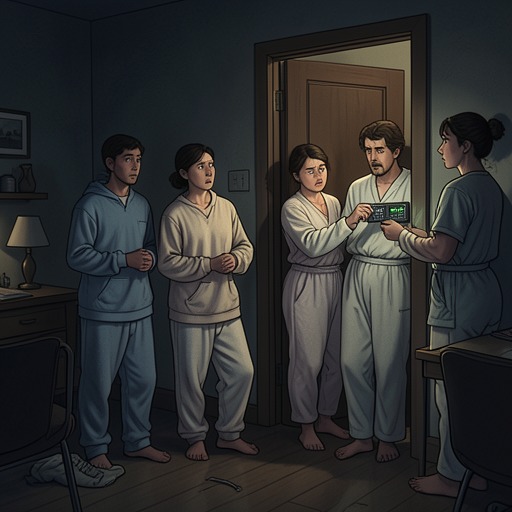
Within moments, five dolls of progressively smaller sizes lie in a row on the floor between the people gathered around them. The diminishing figures turn the search into a visible sequence of expectation: each opening reveals another container, and each smaller container seems to promise that the answer may be further inside. Carmel asks whether the last doll has been reached and observes that ordinarily there is a tiny final doll that cannot be opened. Here, the smallest figure is empty.
The guests had expected a message. Frances voices the specific hope that the security code would be inside the last doll, and Ben asks what its absence is supposed to mean. The discrepancy matters because the object had been assigned a practical role in the plan: the code was meant to be placed inside it. When Yao sees the screen, his relief fades; he turns to Masha and reminds her that putting the security code in the doll had been the plan. Masha, holding the tiny final figure between her fingertips above her keyboard, acknowledges that this had indeed been the original plan. The empty doll is therefore not simply a clue the guests overlooked: it marks a departure from what Masha and Yao expected to happen.
Zoe’s response is not to solve the discrepancy. She tries to suppress a yawn and becomes suddenly exhausted, longing for her own bed, her phone, pizza, and an end to the ordeal. That mundane list sits beside the guests’ urgent demand for the code: the doll has produced no practical instruction, only another unanswered question, while Zoe’s attention returns to ordinary comforts and to the possibility of celebrating her birthday again.
Masha’s Koan
Masha supplies an explanation that changes the doll’s function without filling its empty space. She describes a koan as a paradox that leads to enlightenment and says it demonstrates the inadequacy of logical thinking. Her account makes the guests’ search itself part of the problem: if they keep treating the doll as a container that must yield a code, they remain caught in the expectation that a further piece of information will resolve their difficulty.
Masha states the intended release directly: once the guests surrender and accept that there is no solution, they will be free. The solution, in her formulation, is no solution. Yao repeats the phrase, but his earlier question about why the code is missing shows that the practical plan and the philosophical explanation remain in tension. Masha recognizes that the code was originally supposed to be there; her appeal to the koan does not undo that admission, but reframes the absence as an exercise in relinquishing the demand for a logical answer.
To explain the koan, Masha recounts a story about a hermit living on a mountain. A man asks the hermit for the way, but the hermit answers by remarking on the mountain’s beauty. When the man objects that he did not ask about the mountain but about the way, the hermit replies that so long as the man cannot go beyond the mountain, he cannot reach the way. The story parallels the doll’s predicament: the guests seek a route out through a definite answer, while Masha insists that their attachment to the question obstructs the way they want to find.
Narrative Significance
The doll moves through three distinct meanings. First, it is an intimate, brightly painted object encountered amid Zoe’s tentative return to a birthday custom. Then it becomes an expected hiding place for a security code, with its nested structure encouraging the belief that the answer must lie one layer further in. Finally, its last compartment is empty, and Masha makes that absence the occasion for a lesson about surrendering the expectation of an answer. The shift from gift-like object to failed container to philosophical example is carried by the same physical detail: a tiny doll that can be held between two fingertips but yields no message.
That resolution remains deliberately uneasy within the scene. The guests’ search was based on an agreed plan, and Masha confirms the code was meant to be placed inside the doll; her explanation therefore asks them to accept not only the paradox but the failure of an anticipated practical arrangement. The object does not disclose what the code is or why it is absent. Instead, it concentrates the conflict between concrete expectation and Masha’s doctrine: for the guests, an empty compartment is a missing answer; for Masha, accepting its emptiness is supposed to become the answer.