Set and setting
Nine Perfect StrangersSet and setting is the principle Masha invokes to explain why a psychedelic experience should take place in a controlled environment with a particular mindset. At Tranquillum House, she presents the retreat’s surroundings and its guides as conditions for safety and transformation. The guests’ experiences lend emotional force to that claim, but also expose its limits: the drugs have been administered without their consent, and the meaning of what they experience cannot be managed as neatly as Masha’s program suggests.
Masha’s explanation
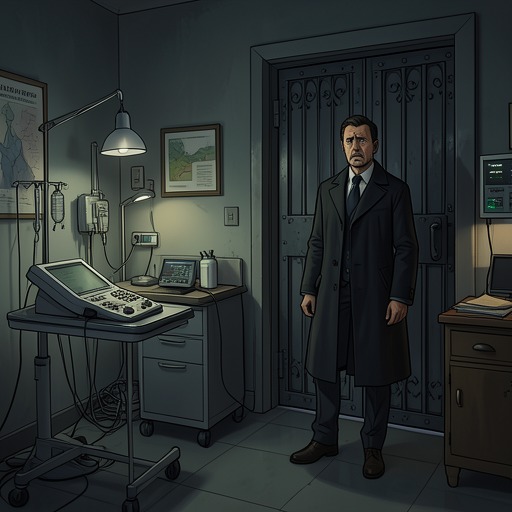
When Napoleon says he lost his mind and disliked the experience, Masha answers that he lacked a safe, secure environment. She names the experts’ term, “set and setting,” and gestures around the room as evidence that the group now has the right conditions. She identifies herself, Yao, and Delilah as guides who are there to keep the guests safe. Her explanation casts the experience not as a drug effect alone, but as something shaped by the participant’s mindset and the surrounding environment.
Masha’s claim is also an exercise of authority. The guests have not knowingly agreed to take LSD; when Frances realizes what has been given to them, she asks whether they have been taking it. Yet Masha presents controlled conditions as an answer to the distress that follows, and promises Napoleon a transcendent experience. The contrast matters: an environment may be organized by the people running the session, but that organization does not itself establish that participants are safe or have consented.
The retreat as a designed environment
Tranquillum House’s routine makes the setting concrete. Guests are told to come promptly to the dining room after a five-minute warning bell, including during fasting periods when smoothies replace meals. Their morning and late-evening smoothies are delivered to their rooms, but room service is unavailable. Masha’s program also begins with a period of silence, which she expects to unsettle some guests and believes will establish the tone of the retreat. These rules structure ordinary bodily needs and social contact before the psychedelic sessions begin.
Masha’s earlier experience running the resort has made her wary of guests evading its restrictions. After a family-sized meatlovers pizza was delivered over the back fence, she introduced security cameras, monitoring, and bag checks, describing the precautions as being for guests’ own good. The retreat’s controlled setting is therefore not simply a therapeutic room prepared for a session; it is a wider system of schedules, surveillance, food rules, and managed behavior. Its order may provide predictability, but it also demonstrates how completely Masha’s staff control the conditions in which guests participate.
Experiences and competing meanings
The guests’ altered states do not produce one uniform response. Frances remembers drinking a smoothie containing hallucinogenic drugs and experiencing a vivid, beautiful dream involving her dead friend Gillian, her father, and her former husbands. She recalls being in space and being an ant; Yao, Delilah, and Masha sometimes interrupted with questions and attempts to steer her, but she ignored them because she was enjoying the experience. The same session that Masha intends to guide thus includes a participant resisting the guides’ efforts and following her own experience.
Other moments connect the altered state to grief and family. Zoe says it felt as if she had spoken with her dead twin, Zach, and that she had been able to talk to him again after years of anger. Frances describes her own encounters with Gillian and her father as more vivid than an ordinary dream. During the session, Napoleon sees Zach and experiences the family together as it once seemed to be. These reports establish what the experience means to the guests, without proving that the people they see are literally present; the novel keeps felt reality and external fact distinct.
The sessions can also make an insight feel momentarily complete without making it permanent. Lars has a sudden thought about Ray: Ray does not want to take anything from him, but wants his love. For a moment, the realization seems to answer every question, before his mind breaks into an image of purple petals. The episode gives set and setting a narrative dimension beyond Masha’s assurances: surroundings and altered perception can open a powerful emotional understanding, while the experience remains fleeting and cannot guarantee lasting change.
Limits and significance
Masha treats set and setting as a basis for safety, but the novel places that therapeutic language against coercion and confinement. When Yao and Delilah begin to suggest letting the guests out or giving them a clue, Masha insists that they must find their way through the ordeal as part of being reborn, likening it to a baby squeezing through a birth canal. Her interpretation of distress as an essential trial shows how the person controlling the setting can also define what counts as necessary, even when others question the method.
The principle is therefore both an explanation of how environment can shape a psychedelic experience and a contested justification for Masha’s methods. The retreat’s routines and guides may create a deliberately controlled atmosphere, and guests may find grief, affection, or new perspectives within it. But control of the room is not control of the experience, and a guide’s confidence in the setting cannot substitute for informed consent. The guests’ return to ordinary social life comes not as a clinical measure of transformation but in a communal release: they find contraband wine and phones, share food, dance, and cry. The contrast leaves the novel’s central question about Masha’s principle unresolved: a powerful experience may be shaped by its surroundings, but its emotional force does not by itself make the conditions ethical or the promised transformation assured.