The no-solution koan
Nine Perfect StrangersThe no-solution koan is Masha’s deliberately imposed rule for the nine guests confined in the studio: they will be free only when they stop searching for a code and accept that there is no solution. It turns a missing security code and a locked door into an exercise in surrender, with Masha treating the guests’ frustration as the mechanism of transformation rather than a problem she should resolve for them.
The missing code and the changed plan
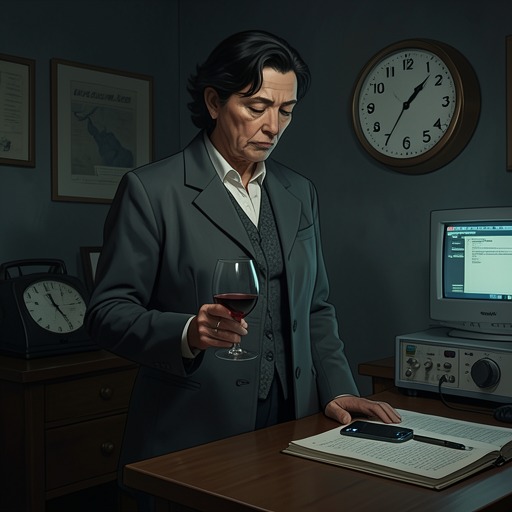
The rule emerges when Yao notices that the security code is not in the Russian doll, where the original plan was to hide it. Masha confirms that this had been the plan, lifting the last tiny doll from her keyboard and holding it between her fingertips. The physical absence of the code is not an oversight in her revised design: she tells Yao that, while meditating, she had an epiphany about what the guests needed after their psychedelic experiences.
Masha describes what is happening to the nine people as a koan in practice. In her account, a koan is a paradox that leads to enlightenment by demonstrating the limits of logical thought. Instead of giving the guests a clue to decipher, she has made the absence of a solution itself the challenge. The change in plan therefore shifts the doll from a container for the answer to evidence that the expected answer is not there.
The rule of surrender
Masha states the koan’s governing condition plainly: once the guests surrender and accept that there is no solution, they will be free. She condenses the paradox into the phrase, “The solution is no solution.” Yao repeats it, but his repetition does not establish that he shares her confidence in the plan; his earlier questions show that he is trying to understand why the code was withheld at all.
To explain the koan, Masha recalls a story about a hermit on a mountain. Asked for the way, the hermit answers by drawing attention to the mountain; when the questioner insists that he is asking about the way rather than the mountain, the hermit says that the way cannot be reached while the man cannot go beyond the mountain. The tale models Masha’s distinction between demanding a logical answer and relinquishing the demand that the answer take that form. In the studio, the keypad becomes the mountain: the guests keep entering combinations, while Masha expects their release to come through abandoning the search for a combination that will work.
The door and its intended consequence
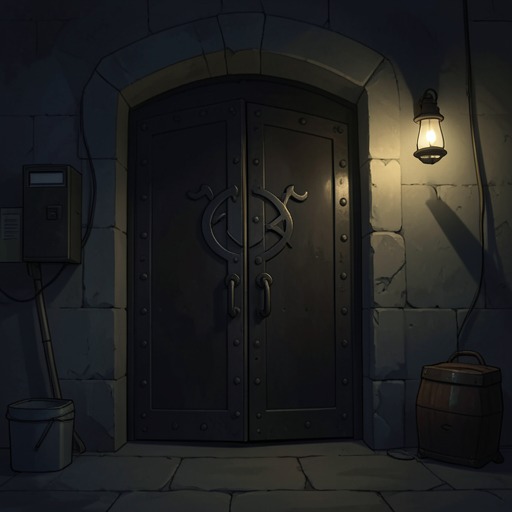
The rule becomes a direct choice about control when Yao watches some of the guests take turns punching number combinations into the studio door. Lars strikes it with his fist. Seeing their attempts, Yao says he thinks he should let them out. Masha answers that they must open the door themselves, making their own act of release part of the exercise rather than permitting the staff to end their confinement for them.
Yao objects that they cannot do it; Masha insists that they can. That disagreement exposes the practical and ethical tension within her rule. To Masha, the guests’ apparent inability is part of the paradox and an opportunity to stop relying on ordinary problem-solving. To Yao, the locked door is a real barrier and the guests’ failed attempts are grounds to intervene. The koan thus functions not only as a puzzle imposed on the guests but also as a contested instruction about whether their distress should be relieved by someone else.
Function within the retreat
Masha presents the koan as the means by which the guests might achieve true transformation after their psychedelic experiences. Its logic depends on withholding the expected solution and interpreting that frustration as a lesson in the inadequacy of purely logical thinking. The rule makes the guests’ confinement, their repeated attempts at the keypad, and the absent code parts of one designed test; it does not establish that the guests understand or accept Masha’s interpretation.
The scene also marks a consequential departure from the original plan. A security code concealed in the doll would have offered a conventional route out; Masha’s change instead makes freedom contingent on accepting that the anticipated route does not exist. Her insistence that the guests must open the door themselves leaves the outcome unresolved in this exchange, while making clear the principle she is prepared to enforce: release is meant to follow surrender, not an answer supplied from outside.