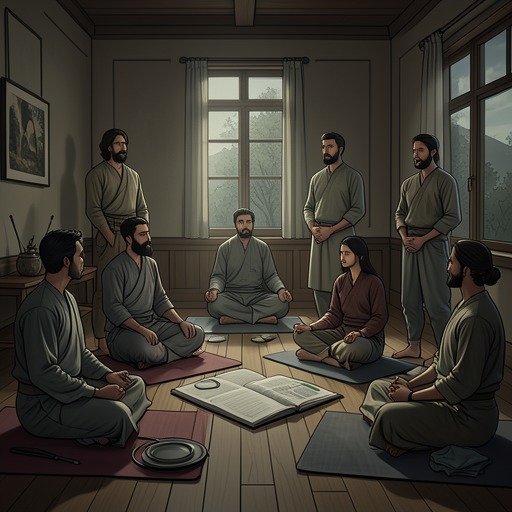
The start of the noble silence at Tranquillum House
Nine Perfect StrangersThe start of the noble silence at Tranquillum House is a deliberately staged threshold in the retreat: at the sound of three bells, guests enter five days of restricted communication and prescribed mindfulness, beginning a passage away from their familiar routines and toward the program’s promised clarity. The silence is not simply an individual practice. Masha establishes it, the retreat’s rules define its limits, and the bells make the transition audible across the property.
Announcement and Rules
The guests learn of the silence through written instructions rather than a gradual discussion. Ben reads that it will last five days and prohibit talking except in counselling sessions, touching, reading, writing, and eye contact, including between companions. Jessica objects that the condition was not mentioned on the website. The letter then sets out what participants are meant to do instead: walk slowly and mindfully, heel to toe, around the property; avoid conversation and eye contact; and use reception and a laminated blue card if they must communicate with staff. Guided walking and sitting meditations will take place throughout each day, with bells providing the cues.
The restrictions reach beyond formal meditation. The guests are expected to eat with strangers in silence, and the stated rules also bar conversation between companions. Ben privately considers whether he and Jessica should talk in their room, where no one would know, making the difference between public compliance and private choice visible from the outset. The instructions thus frame silence both as a shared ritual and as a rule whose boundaries can be tested.
The Bells and the Threshold
The beginning is marked in stages. While Frances is receiving a treatment, one bell rings, followed by a second that interrupts her sentence, then a third. Their sequence cuts across ordinary conversation and makes the retreat’s schedule harder to ignore. Frances has just been warning Jan that, after her experience with a scammer, she is wary of unorthodox methods; the bell interrupts her as she searches for the familiar phrase that would finish her thought. The moment places personal caution beside the authority of the retreat’s timetable.
Heather experiences the final bell as a decisive change in the atmosphere. She has come out of the bathroom and had been considering whether to follow what she regards as an absurd requirement. The bells’ religious quality changes her response: ignoring the silence now seems disrespectful, even in the privacy of her room. Napoleon, seated on an antique sofa, signals for quiet with a finger to his lips. Heather resists his gesture internally, but understands that he is observing the rules, including the ban on eye contact. His respect for regulations, which he associates with courtesy and social order, contrasts with her suspicion that such restrictions between a married couple can serve little purpose.
Masha’s Purpose and Control
For Masha, this is the first retreat she has opened with a period of silence, but she believes the practice will give the guests clarity and set the right tone for what follows. She expects fear and resistance, as well as deliberate or accidental breaches. Couples may whisper in bed, she thinks, and men who become friends may be tempted to disregard the rules. These anticipated exceptions do not lead her to abandon the plan; she regards the silence as a structure that can expose how guests respond to limits.
Her approach is informed by earlier experiences running Tranquillum House. In the resort’s early days, she discovered guests arranging for a large meat-lovers pizza to be delivered through the back fence. She now relies on security cameras, regular monitoring, and bag checks, describing such precautions as being for the guests’ own good. The silence belongs to this broader system of managed retreat life: it asks participants to relinquish familiar choices while the institution watches and directs their activities.
Daily Rhythm and Reintegration
The silence is embedded in a tightly signalled daily routine. A five-minute warning bell precedes meals or, during fasting periods, smoothies; guests are expected to go promptly to the dining room. Morning and late-evening smoothies will be brought to their rooms, but there is no room service. This schedule makes the practice more than an absence of speech: bells, meals, fasting, and guided meditation organize the day in place of ordinary conversation and individual arrangements.
After the five days, Masha declares the noble silence over and celebrates the guests’ completion of it. She asks them to reintroduce conversation and eye contact gradually, taking turns to say why they came, what they have enjoyed, and what they have found difficult, or simply to share basic personal information. The transition back is communal and deliberate, just as the start was. Later, the guests’ release into ordinary sociability takes a more exuberant form: they recover phones, reconnect with the outside world, share food and wine, and dance and cry together. The contrast makes the silence one stage in a larger retreat passage rather than an end in itself.
Significance
The five-day silence promises clarity through a temporary removal of familiar habits, but the rules also make the question of control unavoidable. Participants are told what they cannot do, how to walk, how to request staff help, and when to gather; Masha anticipates resistance and maintains surveillance beyond the silence itself. At the same time, the guests encounter the restriction differently: Jessica worries about its unexpected demands, Frances is interrupted while voicing caution, and Heather regards the rule as an intrusion into ordinary intimacy even as the bells prompt her to comply.
The ending offers a measure of reintegration rather than proof that the practice has transformed everyone. Masha marks the silence as completed, invites the guests to speak again, and opens space for them to describe their experiences in their own terms. The later return to phones, food, music, and conversation places the retreat’s controlled quiet against the social life it had temporarily suspended.