Tranquillum House
Nine Perfect StrangersTranquillum House is a rural boutique health and wellness resort whose promise of transformation steadily gives way to the realities of restriction, surveillance, and danger. Set in a restored historic mansion, it is at once a retreat for guests seeking change, a workplace shaped by Masha Dmitrichenko’s ambitions, and the enclosed stage on which the novel tests what happens when personal growth is treated as a program that can be engineered for others.
Setting and First Impressions
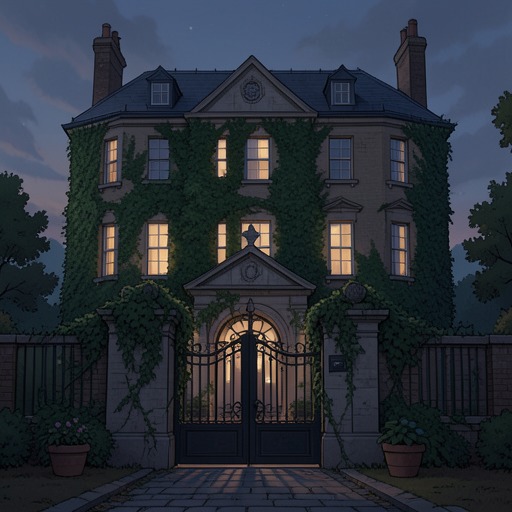
For Frances Welty, the resort is a place her friend Ellen recommends after a lunch of cocktails, telling her that she needs to heal. The approach initially challenges the language of healing: Frances reaches an extremely locked gate, an intercom, and a barbed-wire fence extending in both directions. A recorded welcome directs visitors to enter a security code, turning arrival into a passage through controlled access rather than an open invitation.
Beyond the gate, the setting changes. The sealed road runs through greener, softer bushland toward a three-storey sandstone Victorian mansion with a red corrugated-iron roof and a princess tower. Frances feels transported to the late nineteenth century, though a yellow Lamborghini following her punctures the historical picture. Two uniformed staff members greet arriving guests from the broad veranda; among them is Yao, whose polished, youthful appearance contributes to the resort’s carefully composed atmosphere.
The contrast between picturesque estate and secured perimeter defines the location from the outset. The house advertises welcome and renewal, but its locked entrance also establishes that access—and, later, movement within the retreat—is managed by the institution. The resort’s charm does not erase its boundaries; it makes them easier to approach.
Founding and the Retreat’s Promise
Tranquillum House grows out of Masha’s change of direction after a near-death experience. Yao, intrigued by what she experienced, keeps in sporadic contact with her over the years. Masha tells him that after recovering from heart surgery she left a highly successful corporate career, sold her company shares, and bought a famous historic country house. She first planned to restore it, add a swimming pool, and establish an exclusive bed and breakfast. As her interest in health developed, she abandoned that plan in favour of a wellness resort.
Yao’s own transition brings the project into being. His parents visit separately and urge him to return to Sydney and get his life back on track, but within six months of his arrival he and Masha open Tranquillum House to its first guests. The business succeeds, and Yao finds the work more enjoyable than being a paramedic. What begins as a few days at the estate becomes five years. Delilah joins the staff four years before the events of the retreat, and the three colleagues continue refining their programs. Masha pays generously, making the resort a desirable workplace as well as a business.
The institutional story has a less elevated side. Delilah’s supposed wellness journey is, in practice, a move by train from Central Station to Jarribong after she leaves her job as an executive assistant at an insurance company. Her experience as an assistant—agreeing, smiling, arranging matters behind the scenes, and not asking unnecessary questions—transfers readily to wellness consulting. She has a savings goal and intends to travel for a year. Masha’s language of transformation therefore sits beside a staff structure in which the appearance of conviction can itself be part of the work.
Daily Life, Rules, and Surveillance
Guests encounter an intensive schedule from their first full day. Frances’s begins before dawn, with a firm knock at her bedroom door. The retreat promises that no one goes home early and that participants are about to have a transformative experience. The assurance turns the resort’s program into a commitment: leaving is presented not as an ordinary choice but as something that does not happen there.
Masha has learned the habits of her guests and responds by tightening oversight. Security cameras cover the property, staff monitor regularly, and bags are checked. She understands these precautions as being for the guests’ own good, but the measures also make the resort’s authority concrete. Tranquillum House does not merely offer advice about change; it tracks, screens, and organizes the people expected to undergo it.
The grounds include a meditation room and a yoga and meditation studio, spaces associated with quiet and reflection that also become sites of conflict. During the noble silence, guests are expected to refrain from speaking. When Zoe Marconi and Frances leave the meditation room and have not returned, the silence is broken; Tony Hogburn demands his money back and threatens to report the resort to the Department of Consumer Affairs. The other guests watch with curiosity or concern. The scene makes the rule’s fragility visible: a practice promoted as inward discipline can become a source of dispute when guests’ needs and the institution’s expectations diverge.
The retreat’s group exercises similarly reveal how its methods have been adapted from corporate practice. Masha devises a code-breaker puzzle meant to take no more than an hour and to help the guests bond. Its model comes from a team-building retreat she attended in her corporate years, where participants had laughed and high-fived after a similar exercise. At Tranquillum House, the inherited exercise belongs to a more consequential program: group cohesion is treated as one element in a wider plan for personal transformation.
Escalation and the Limits of the Program
The resort’s methods become increasingly difficult to reconcile with its reassuring presentation. Lars Lee, who has experience with health resorts and recreational drugs, finds one of Tranquillum House’s practices unprecedented. The irony is pointed: reducing recreational drug use was one of the side benefits he had hoped to gain by coming. Later, the guests’ experiences in the studio are bound up with the anniversary of Zach Marconi’s death. The site of retreat and reflection is therefore also a setting for grief and emotionally charged memories, not simply a neutral wellness environment.
As the crisis develops, the resort’s staff watch the guests through live CCTV from Masha’s office. Delilah, Masha, and Yao follow events in the meditation room on camera, a striking reversal of the resort’s language of inward awareness: staff observe the guests from elsewhere in the house while the guests remain under the program’s control. When the guests are still in the studio close to twenty-four hours later, Napoleon Marconi checks the time on the only watch among them; it is approaching two in the afternoon, and they have heard nothing from staff. The prolonged separation turns the retreat’s managed environment into a situation of uncertainty.
Masha’s motives are not limited to her belief in personal growth. The new protocol is also intended to relaunch her public career. She misses the recognition she enjoyed in corporate life—business-magazine profiles and keynote invitations—and hopes to publish articles, speak at conferences, and secure a book deal. A publisher has expressed interest in the enduring market for personal transformation. She anticipates waiting lists and higher prices after news of the program’s success spreads, and resents what she sees as guests complaining about an experience offered at a bargain price. The resort’s therapeutic promise and commercial ambition become inseparable: its guests’ responses matter both as human consequences and as proof on which Masha’s projected future depends.
Crisis, Closure, and Legacy
After the crisis, Yao acknowledges that some of the previous night’s activities may have seemed unusual, while continuing to frame them as designed for the guests’ personal growth. Masha appears in the dining-room doorway in an outdated, oversized red pantsuit and announces that she is going back to work. The declaration revives the professional identity that helped shape the retreat, even as the events at the estate have exposed the risks of her program.
The police response brings outside authority onto the property. Gus, the boyfriend of massage therapist Jan, does not charge Frances with Masha’s murder, because Masha is alive. After a few terrifying moments, Masha sits up, touches the back of her head, and tells Frances that she is fired, effective immediately. More officers arrive; when Gus and his colleagues discover large quantities of illegal drugs on the premises, another group follows, less interested in the surrounding details. The resort’s internal account of its methods can no longer contain the consequences: the drugs draw a wider law-enforcement response.
The guests are ultimately permitted to remain at Tranquillum House because there is no longer an active crime scene, no one has died, and the drugs are gone. Gus works through the legalities before agreeing. Jan gives everyone a ten-minute mini-massage to ease tension and suggests that they might be checked at the local hospital, but no one wants to go—particularly with Masha having been taken there. Tony says his shoulder is fine. Even after the retreat’s authority has been interrupted, its guests remain physically and emotionally situated in the aftermath of what happened at the house.
Tranquillum House persists beyond the crisis as a story Masha turns into a book. Its subject is a ten-day personal development program combining psychedelic drugs, confinement in a room with strangers, fear-facing exercises, and riddles. That later account recasts the estate as both a business and an argument about transformation: the same controlled setting that promises renewal can become the machinery of an experiment whose participants do not share equal control over its terms. The house’s defining tension is thus architectural as well as ethical—the welcoming mansion stands behind a locked gate, and the promise of a new self is delivered inside a place designed to monitor and direct its guests.