Yoga and meditation studio
Nine Perfect StrangersThe Yoga and meditation studio at Tranquillum House is the retreat’s central room for enforced quiet, guided psychedelic experiences, and, eventually, confinement. Its meaning changes with the guests’ passage through the program: a space presented as a tool for clarity becomes the setting for an unauthorized drug experience and an apparent locked-door crisis, before the group’s return to ordinary social life exposes the gap between Masha’s language of transformation and the guests’ autonomy.
A room governed by the retreat
The studio belongs to a program that regulates ordinary comforts as well as formal practice. Guests are asked to come promptly to the dining room at a five-minute warning bell, and during fast periods smoothies replace meals; there is no room service, though morning and late-evening smoothies are delivered to their rooms. The retreat’s structure therefore extends from food schedules into the shared spaces where guests assemble and follow Masha’s instructions.
The first retreat Masha began with a period of silence, which she believed would give guests clarity and establish the right tone. She expected some to resist and some to break the rule, and regarded the silence as a way to prevent Tranquillum House from becoming a kind of summer camp, with guests chatting excitedly and treating one another as mates. Her approach to managing the property had also hardened after an early guest arranged for a family-sized meatlovers pizza to be delivered over the back fence. She later relied on security cameras, regular monitoring, and bag checks, all in the name of protecting guests. The studio’s disciplined atmosphere thus sits within a wider system in which Masha controls both the retreat’s rituals and its boundaries.
Silence ends; altered experiences begin
When the five-day noble silence ends, Masha announces the change in the studio and asks the group to reintroduce conversation and eye contact gradually. Guests are invited to speak briefly about why they came, what they enjoy, what they find difficult, or simply basic facts about themselves. The shift is small but consequential: the room that had contained silence becomes a place where the group can acknowledge personal experience aloud.
The studio also becomes a setting for guided psychedelic sessions. During one session, Delilah places a mask over Lars’s eyes and headphones over his ears, then tells him to look for the stars as classical music plays. In the altered state, Lars thinks of Ray’s attentive, loving nature; the thought briefly seems to answer every question before his mind breaks into an image of a billion purple petals. The scene pairs an intentionally restricted physical environment—eyes covered, sound delivered through headphones—with an expansive private experience that Lars hopes to remember and share with Ray.
For the Marconi family, the session brings Zach into their shared imaginative space. Zoe remarks that Zach would find it hilarious if the family were all getting high together, and Napoleon responds as though his dead son is present, greeting him. Zach appears to him as the shirtless boy he remembers, and Napoleon feels, for a moment, the ordinary completeness of the family as it once was. The studio’s psychedelic setting does not erase grief, but it gives the family a vivid form through which to encounter it.
Frances’s experience takes a different shape. After drinking a smoothie containing hallucinogenic drugs, she recalls a beautiful, unusually vivid dream involving Gillian, her father, and her ex-husbands, filled with symbols and visual metaphors. Yao, Delilah, and Masha sometimes interrupt to ask questions or steer her, but Frances ignores them because she is enjoying the experience. She remembers being in space and being an ant. The episode makes plain that the staff’s guided process does not determine how a guest experiences or interprets the session.
From therapeutic room to locked enclosure
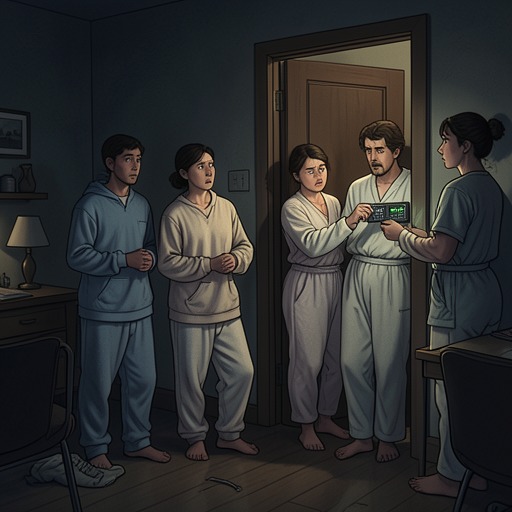
The studio’s role turns sharply when the guests realize they are locked inside. Napoleon tells the others that there seems to be no way out. By nearly two in the afternoon, according to his watch, they have heard nothing from the staff for close to twenty-four hours. They are exhausted and grimy; some have not eaten for almost forty-eight hours. Their only apparent access point is a heavy oak door at the bottom of the stairs, beside a new-looking gold security keypad. Repeated attempts to enter combinations fail.
The room’s physical enclosure gives concrete force to a conflict that had previously been framed as spiritual development. Masha believes the guests must fight their way out as a baby squeezes through the birth canal, describing confinement as essential to their rebirthing. Yao and Delilah begin to question whether they should release the group or offer a clue, but Masha insists the guests will work it out and dismisses their difficulty. The studio is no longer merely a controlled environment for meditation: the keypad and locked door make the limits on the guests’ freedom impossible to ignore.
Release, memory, and return
In the aftermath of the psychedelic experience, the studio is also where grief is spoken rather than contained within private visions. Zoe tells Frances that she had been angry with Zach and unable to forgive him, because his death had felt like an act that would leave her feeling bad forever. During the session, however, it had seemed to her that they talked again. Frances shares that she encountered Gillian and her father and that the experience felt more vivid than a dream, even more real than ordinary life. The two compare their experiences without establishing whether they literally saw the dead; what matters in the scene is that each can speak about the encounter and its emotional force.
The studio’s changing uses give the retreat’s central promise a complicated physical form. Silence is introduced as a route to clarity; psychedelic experience opens access to memory, love, and bereavement; confinement turns a symbolic rebirth into a situation imposed by the staff. Later, when the guests are back among the ordinary rooms and provisions of Tranquillum House, they find smuggled wine and old contraband, reconnect with their phones, cook steaks and pizza, and share food, dancing, and tears. Their convivial return contrasts with the studio’s controlled rituals: connection emerges not only from Masha’s program, but from the guests’ own choices and care for one another.