2+2=5
Nineteen Eighty-Four2+2=5 is the arithmetic emblem of Ingsoc, the single most concentrated expression of the Party's power to dictate reality in George Orwell's Nineteen Eighty-Four. It first appears as a complete statement in the white-tiled Ministry of Love, where Winston Smith, during his re-education, writes "TWO AND TWO MAKE FIVE" on a slate; it is the exact negation of the axiom he once set down in the diary he kept in secret: "Freedom is the freedom to say that two plus two make four. If that is granted, all else follows." Between those two inscriptions the novel measures the entire distance from private rebellion to public annihilation, and the slogan ends as the price of consciousness itself.
From Private Axiom to Official Slogan
Winston began his diary as a traitor to the official order of facts. The act was not illegal -- "nothing was illegal, since there were no longer any laws" -- but the book's detection would have meant death or twenty-five years in a forced-labour camp, and the pen he used had to be procured furtively as an archaic instrument. The axiom that justified the risk came later, when, with the feeling that he was speaking to O'Brien, he wrote: "Freedom is the freedom to say that two plus two make four. If that is granted, all else follows." That sentence made arithmetic the test case for every other truth; the Party's later counter-slogan, "TWO AND TWO MAKE FIVE," is therefore not a separate lie but the negation of the one freedom Winston had named.
The Arithmetic of Doublethink
The theoretical frame for the slogan is supplied by the outlawed compendium attributed to Emmanuel Goldstein, The Theory and Practice of Oligarchical Collectivism, known in Oceania only as "the book," whose existence is a matter of whispered rumour and whose author is the "primal traitor" of every Two Minutes Hate. The book defines doublethink as a mental discipline whose goal is to believe two contradictory truths at the same time. Winston had already discovered the same mechanism in his own skull during the morning exercises, recognizing the power "to hold simultaneously two opinions which cancelled out, knowing them to be contradictory and believing in both of them." The Party's everyday propaganda turns this mechanism into routine: the Ministry of Plenty could announce a 20 per cent rise in the standard of living and a rise in the chocolate ration to twenty grammes a week only twenty-four hours after the reduction to that figure had been announced, and Parsons swallowed it "with the stupidity of an animal," while even the most orthodox comrade processed it through doublethink. "2+2=5" makes the same procedure visible: an arithmetic statement cannot be argued with, only believed.
The Test in the Ministry of Love
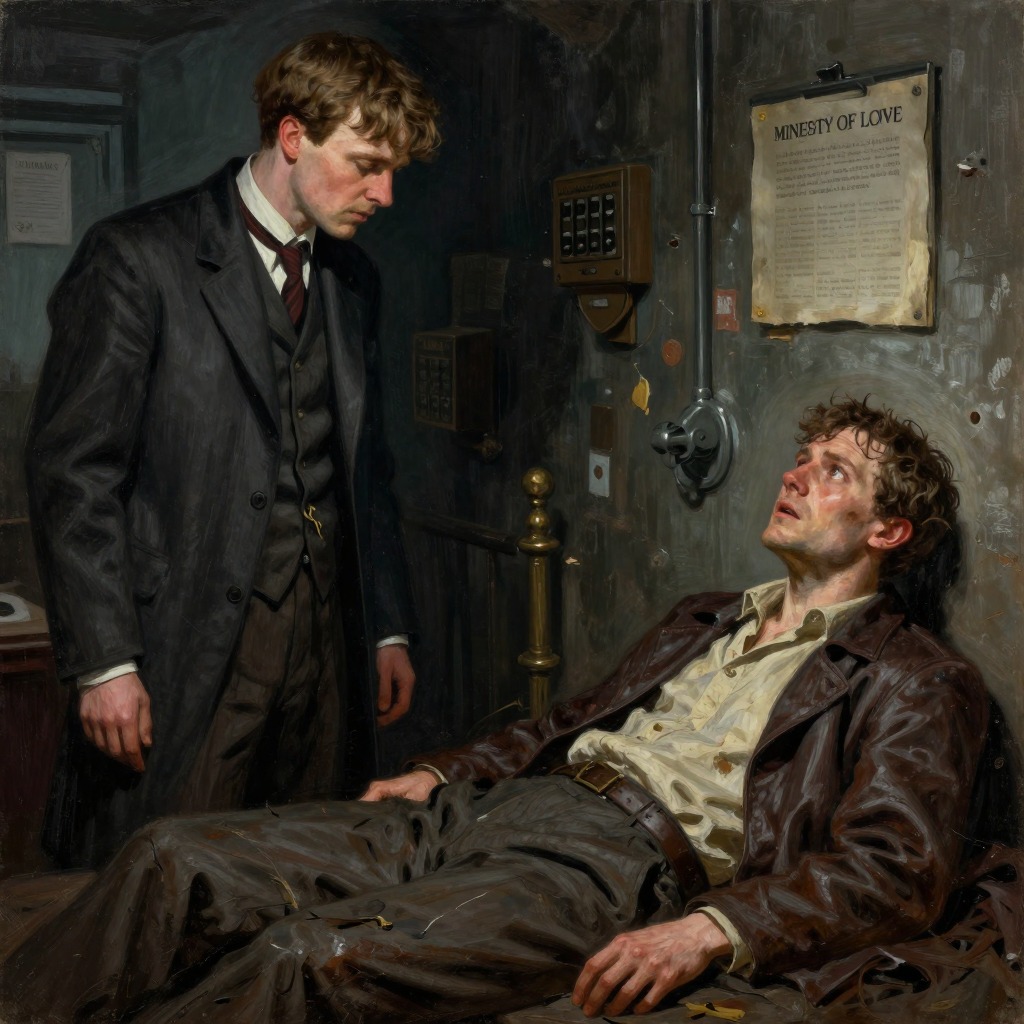
It is in the Ministry of Love that the slogan is tested against a living body. O'Brien, holding up four fingers, demands that Winston say how many he sees; the needle on the pain dial rises to fifty-five, then sixty, yet Winston insists on "Four." At last he screams "Five! Five! Five!" and O'Brien answers: "No, Winston, that is no use. You are lying. You still think there are four." The interrogation is not satisfied by speech, only by perception. O'Brien then states the full doctrine: "Sometimes, Winston. Sometimes they are five. Sometimes they are three. Sometimes they are all of them at once." The culmination of this lesson is the slate on which Winston, now "re-educated," writes the sequence "FREEDOM IS SLAVERY," "TWO AND TWO MAKE FIVE," "GOD IS POWER." The last inscription follows the first two with the automatic logic of an accepted catechism.
Linguistic and Scientific Erasure
The slogan belongs to a wider programme of making heretical thought literally impossible. Syme, the Newspeak philologist, explains that the language is being deliberately diminished, its vocabulary growing smaller every year, until thoughtcrime is "literally impossible." The world the Party has built is correspondingly impoverished: "scientific and technical progress depended on the empirical habit of thought, which could not survive in a strictly regimented society," and "the ravages of the atomic war of the nineteen-fifties have never been fully repaired." The enforcement of such a reality is total: a Party member lives from birth to death under the eye of the Thought Police and is required to have "not only the right opinions, but the right instincts." "2+2=5" is the arithmetical equivalent of this linguistic and scientific erasure -- the point at which the empirical habit, and the sanity that went with it, is abolished.
Dust-Traced in the Chestnut Tree
After his release, the old arithmetic survives only as a phantom gesture. In the Chestnut Tree Café, among the chessboard and the endless gin, Winston traces "2 + 2 = 5" in the dust on the table and cannot fix his mind on any subject for more than a few moments. The memory of Julia's resistance -- "They can't get inside you" -- meets O'Brien's verdict: "But they could get inside you... What happens to you here is for ever." The expression is now a reflex, emptied of conviction, and when the trumpet-call announces the African victory Winston enters "a blissful dream" in which he sees himself confessing in the public dock and walking down the white-tiled corridor toward the bullet. Looking up at the enormous face on the wall, he understands at last the smile beneath the moustache: "He loved Big Brother." The arithmetic lie, which began as the test of his freedom, has become the ground of his peace.