2050
Nineteen Eighty-Four2050 is the date inscribed at the far end of the Party's linguistic project in Nineteen Eighty-Four: the year by which Newspeak was intended to abolish the possibility of unorthodox thought. It matters not as a technological prophecy but as a linguistic one, a horizon where language, memory and history were all to be remade. The date marks the boundary of the Party's ambition, the point at which thoughtcrime would become not merely punishable but impossible.
The Date of a Completed Language
The appendix to the novel states that in 1984 no one yet used Newspeak as a sole means of communication, and that Newspeak was expected to supersede Oldspeak, or Standard English, by about 2050. The version spoken in 1984, recorded in the Ninth and Tenth Editions of the Newspeak Dictionary, was explicitly provisional, containing superfluous words and archaic formations due to be suppressed. The final, perfected version belonged to the Eleventh Edition, and the appendix records that the final adoption of Newspeak was deliberately fixed as late as 2050 in order to allow time for the preliminary work of translation. The date was therefore not an accident of arithmetic but a planning decision: the Party needed years to translate, or rather transform, the literature of the past before the last link with it could be severed.
Syme's Conversation of the Future
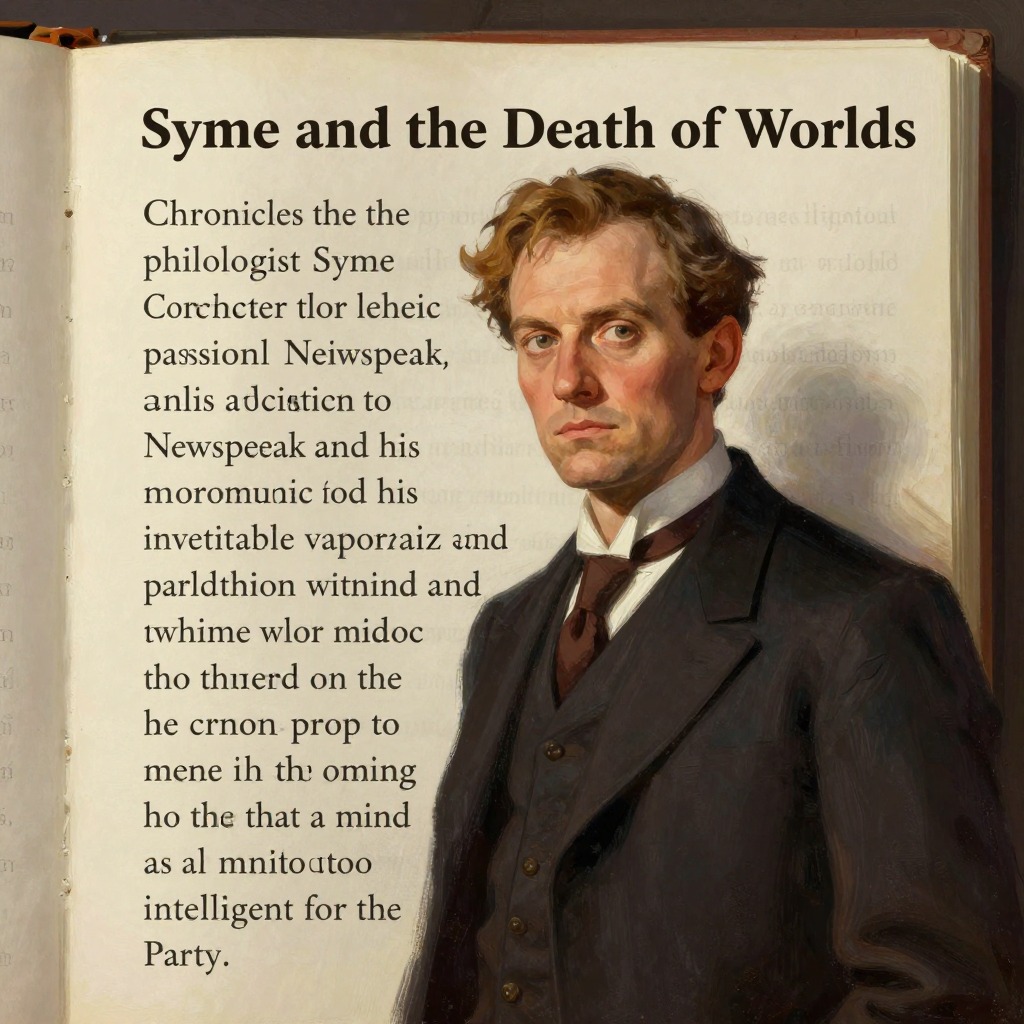
The most vivid use of the date occurs in the canteen, where Syme, the Newspeak philologist working on the Eleventh Edition, tells Winston Smith that by 2050, at the very latest, not a single human being would be alive who could understand the conversation they were then having. Syme's boast rests on the claim that Newspeak was the only language whose vocabulary grew smaller every year; he insists that the Eleventh Edition would contain no word that would become obsolete before 2050. In his vision all real knowledge of Oldspeak would have disappeared, and the whole literature of the past, from Chaucer and Shakespeare to Milton and Byron, would survive only in Newspeak versions altered into something contradictory of what they had been. The date is therefore the moment when thought itself was to be narrowed past the point of return. Winston listens with a different certainty: one of these days, he thinks, Syme will be vaporized. The man who announces 2050 is himself too intelligent, sees too clearly and speaks too plainly to be allowed to reach it.
2050 and the Appendix's Retrospective
The appended essay 'The Principles of Newspeak' is written from a vantage point after 1984, and entirely in pre-Newspeak English. Its grammar is the quiet subversion of the Party's timetable: the language that was supposed to be universal by 2050 is here used to describe Newspeak as a finished historical object, and the essay's past tense implies that the projected completion did not in fact hold. The novel thus sets 2050 as the intended end of standard English, while the appendix speaks across that date in the very tongue the Party meant to destroy.
A Horizon That Fails to Arrive
The force of 2050 lies in the gap between the Party's plan and the novel's form. Within the story, the date is offered as the point at which Newspeak would make heretical thought literally inexpressible. Outside the story, the appendix's continued existence in standard English suggests that the ancient habits of thought the language carries were not so easily extinguished. The year is the Party's chosen threshold for the abolition of the human past, and the thing that most clearly survives beyond it, in the novel's closing pages, is the ordinary English in which the warning is written.