Aaronson
Nineteen Eighty-FourAaronson is one of the three last surviving original leaders of the Revolution, the companion of Jones and Rutherford whose career of arrest, public confession, pardon, re-arrest and execution shows how the Party annihilates its own founders. He never speaks in Nineteen Eighty-Four, and he is physically present in the story only twice: once sitting silent in the Chestnut Tree Café, once standing in a decade-old newspaper photograph. Even so, the photograph in which he appears is the only concrete, documentary evidence Winston Smith ever holds of the falsification of history, and his fate, re-narrated in the Ministry of Love by O'Brien, becomes the measure of how completely the Party can remake not only the record of the past but memory itself.
The Last Survivors of the Founding Generation
The great purges of the middle 'sixties wiped out the original leaders of the Revolution once and for all; by 1970 none were left except Big Brother. Emmanuel Goldstein, who had once stood almost on a level with Big Brother himself, had been condemned to death and had mysteriously escaped and disappeared; of the others, a few simply vanished while the majority were executed after spectacular public trials at which they made confession of their crimes. Around the fugitive leader gathered rumours of an underground network, the Brotherhood, and of a terrible book of all heresies of which Goldstein was the author, but these were not subjects any ordinary Party member would mention if he could avoid it. Among the last survivors of the founding generation were three men named Jones, Aaronson and Rutherford. They were arrested in 1965, vanished for a year or more so that no one knew whether they were alive or dead, and then were suddenly brought forth to incriminate themselves in the usual way. Their confessions covered the whole Party catalogue: intelligence with the enemy, which at that date meant Eurasia; embezzlement of public funds; the murder of various trusted Party members; intrigues against the leadership of Big Brother which had started long before the Revolution; and acts of sabotage causing the death of hundreds of thousands of people. After confessing, they were pardoned, reinstated in the Party and given posts which were in fact sinecures but sounded important, and all three wrote long, abject articles in the Times, analysing the reasons for their defection and promising to make amends.
Ghosts of the Heroic Age
Some time after their release Winston saw all three in the Chestnut Tree Café and remembered the terrified fascination with which he watched them out of the corner of his eye. They were relics of the ancient world, almost the last great figures left over from the heroic early days of the Party, and the glamour of the underground struggle and the civil war still faintly clung to them; Winston had known their names years before he had known that of Big Brother. But they were also outlaws, enemies, untouchables, doomed with absolute certainty to extinction within a year or two — corpses waiting to be sent back to the grave, since no one who had once fallen into the hands of the Thought Police ever escaped in the end. The place that waited for them was the windowless Ministry of Love, which no one entered except on official business, through barbed-wire entanglements, steel doors and hidden machine-gun nests, past black-uniformed guards armed with jointed truncheons. At the lonely hour of fifteen the café was almost empty, and the three sat in their corner almost motionless, never speaking, while an uncommanded waiter brought fresh glasses of the clove-flavoured gin that was the café's speciality and a chessboard stood beside them with the pieces set out but no game started. Then the telescreens changed their tune; a peculiar, cracked, braying, jeering note, which Winston privately called a yellow note, came into the music, and a voice sang 'I sold you and you sold me.' The three men never stirred, but Rutherford's ruinous face filled with tears, and Winston noticed for the first time, shuddering without knowing at what, that both Aaronson and Rutherford had broken noses — the only visible trace the narrative records of what the Party had already done to them.
Re-arrest and Execution
A little later all three were re-arrested. It appeared that they had engaged in fresh conspiracies from the very moment of their release. At their second trial they confessed to all their old crimes over again, with a whole string of new ones; they were executed, and their fate was recorded in the Party histories as a warning to posterity. The pattern they followed was the one reserved for the regime's great show-pieces, in which traitors and thought-criminals made abject confession of their crimes and were afterwards executed — spectacles that occurred no oftener than once in a couple of years, while the more common fate of those who incurred the Party's displeasure was to disappear without trace.
The Photograph
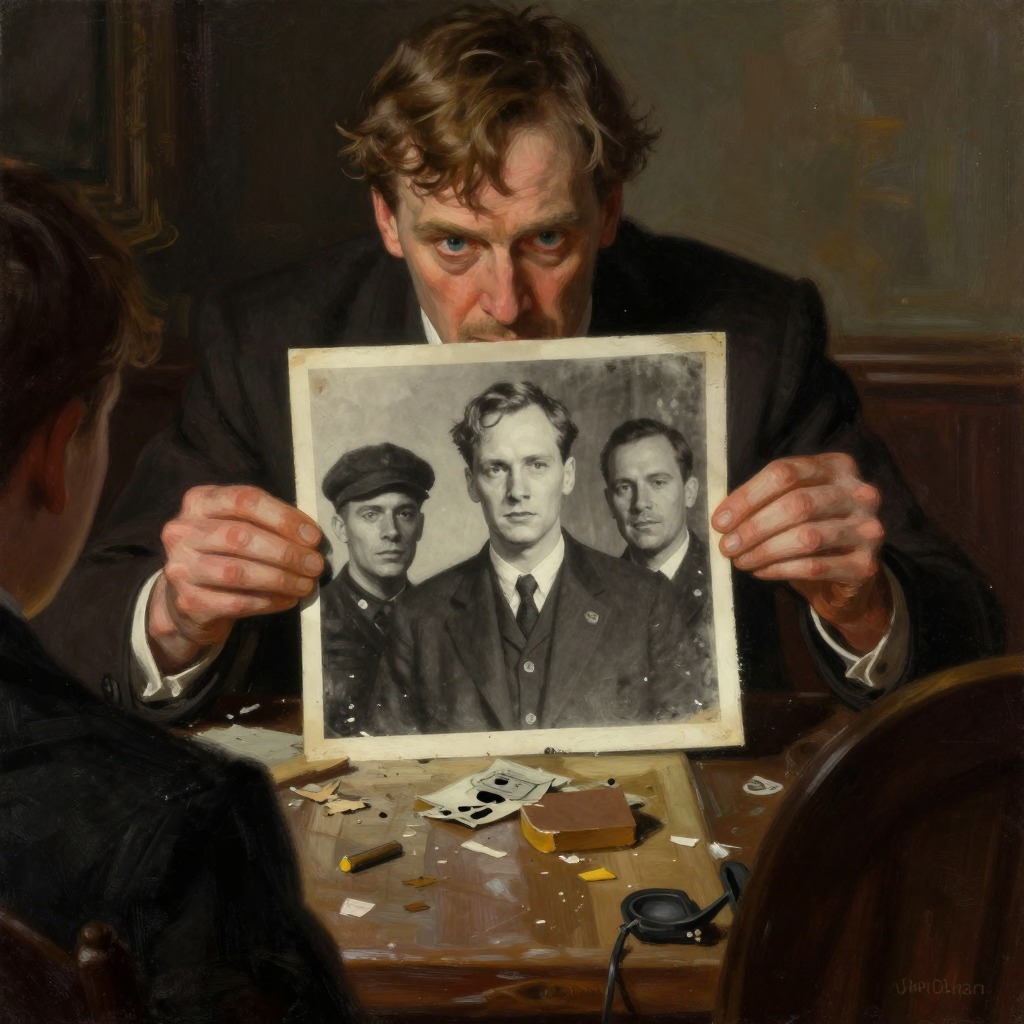
About five years after the executions, in 1973, Winston was unrolling a wad of documents that had flopped out of the pneumatic tube onto his desk when he came on a fragment of paper which had evidently been slipped in among the others and then forgotten. It was a half-page torn out of the Times of about ten years earlier — the top half of the page, so that it included the date — and it contained a photograph of the delegates at some Party function in New York. Prominent in the middle of the group were Jones, Aaronson and Rutherford; there was no mistaking them, and their names were in the caption at the bottom. The instant he had flattened it out, Winston saw its significance. At both trials the three men had confessed that on that very date they had been on Eurasian soil, flown from a secret airfield in Canada to a rendezvous somewhere in Siberia, where they had conferred with members of the Eurasian General Staff and betrayed important military secrets; the date had stuck in his memory because it chanced to be midsummer day. There was only one possible conclusion: the confessions were lies. This was not in itself a discovery, since Winston had never imagined that the people wiped out in the purges had actually committed the crimes they were accused of, but it was concrete evidence — a fragment of the abolished past, like a fossil bone which turns up in the wrong stratum and destroys a geological theory. It was the single occasion in his whole life on which he had held in his hands unmistakable documentary proof of the falsification of a historical fact.
The evidence demanded its price. Luck had been with him so far: when he unrolled it, the photograph had been upside-down from the point of view of the telescreen. He covered it with another sheet of paper and sat for what he judged to be ten minutes, tormented by the fear that some accident — a sudden draught blowing across his desk — would betray him, since the telescreen was delicate enough to pick up the beating of his heart. Then, without uncovering it again, he dropped the photograph into the memory hole along with some other waste papers, and within another minute it would have crumbled into ashes. The fact of having held it in his fingers seemed to him, eleven years later, to make a difference, even though the photograph itself and the event it recorded were only memory. But even that difference was fragile. Already at the time of his discovery Oceania was no longer at war with Eurasia, and it must have been to the agents of Eastasia that the three dead men had betrayed their country; since then there had been other charges, two or three, and very likely the confessions had been re-written and re-written until the original facts and dates no longer had the smallest significance. The past not only changed but changed continuously, and what afflicted Winston most was that he never understood why the huge imposture was undertaken. 'I understand HOW: I do not understand WHY,' he wrote in the diary.
"It Does Not Exist. It Never Existed."
In the Ministry of Love, O'Brien summons the photograph back from the ashes. He tells Winston that Winston believed three one-time Party members named Jones, Aaronson and Rutherford — 'men who were executed for treachery and sabotage after making the fullest possible confession' — to be innocent of the crimes they were charged with, and that the documentary evidence Winston thought he had seen was a hallucination. An oblong slip of newspaper appears between O'Brien's fingers; for perhaps five seconds it is within the angle of Winston's vision, and there is no question of its identity: it is another copy of the photograph from the Party function in New York. When Winston cries out that it exists, O'Brien carries it to a memory hole in the opposite wall, lifts the grating, and lets the frail slip of paper be whirled away on the current of warm air, vanishing in a flash of flame. 'Ashes,' he says. 'Not even identifiable ashes. Dust. It does not exist. It never existed.' To Winston's protest that it exists in memory and that O'Brien remembers it too, O'Brien answers, 'I do not remember it.' Winston's heart sank: that was doublethink, and it was perfectly possible that O'Brien had really forgotten, that he had already forgotten his denial of remembering, and forgotten the act of forgetting. Perhaps that lunatic dislocation in the mind could really happen, and that was the thought that defeated him.
O'Brien then claims the three men as his own work. 'Even those three miserable traitors in whose innocence you once believed – Jones, Aaronson and Rutherford – in the end we broke them down,' he tells Winston. He says he took part in their interrogation himself and saw them gradually worn down, whimpering, grovelling, weeping; in the end it was not pain or fear but penitence, and nothing was left in them except sorrow for what they had done and love of Big Brother. They begged to be shot quickly, so that they could die while their minds were still clean. Winston watches the exaltation in O'Brien's face and understands that he is not pretending and not a hypocrite; he believes every word he says. The story of the three old leaders is thus revealed as the dress rehearsal for Winston's own re-education: conversion before execution, the inner mind captured and remade before the body is destroyed. In his final capitulation Winston accepts that Jones, Aaronson and Rutherford were guilty of the crimes they were charged with, that he had never seen the photograph that disproved their guilt, that it had never existed and he had invented it. The only solid evidence the book ever grants him is reclassified as a false memory, and his own story takes its place in the Party's rewritten history.
The One Fossil Bone
Aaronson's story condenses the novel's central argument about the mutability of the past into one human arc, and its ground is the mechanical falsification Winston performs every day. In the Records Department, statistics were made up out of his head, forecasts were 'rectified' to agree with outputs that had never occurred, and all history was a palimpsest, scraped clean and re-inscribed as often as necessary; the photograph of Aaronson, Jones and Rutherford is the single object that ever escaped that process, and its destruction, twice over, is the novel's most concrete demonstration of the Party's claim that the past survives only in written records and in human memories, both of which the Party controls. For the totalitarian mind, memory was the easiest thing of all to deal with: there was always some agency like the Ministry of Truth to deny the memories of others and rewrite the past. The 'sort of schizophrenic manner of thinking' that Orwell identified in his own time, in which words like 'democracy' could bear two irreconcilable meanings and concentration camps and mass deportations could be right and wrong simultaneously, is perfected here as doublethink, and the three broken leaders are its proof-text. Their story also looks forward to Winston's own: the re-education of the heretic until he loves his torturer, the confession made true by the machine that extracts it — an ordeal the novel's first readers would have recognized as the era's feared 'brainwashing,' conditioning human subjects into political reflexes useful to the State. 'We do not merely destroy our enemies, we change them,' O'Brien tells Winston, and the fate of Aaronson is what that sentence means; it is also what Orwell meant when he said that every line of serious work he had written since 1936 had been written against totalitarianism and for democratic socialism. The one fossil bone vanishes into the memory hole, and the last man who once held it is made to forget that he ever did.