Ampleforth
Nineteen Eighty-FourAmpleforth is one of the quiet casualties of the Ministry of Truth — a poet whose loyalty to a rhyme destroys him in a state that has abolished law and made the mere possibility of a future crime grounds for annihilation. A mild, ineffectual, dreamy worker in the Records Department, a few cubicles away from Winston Smith, he is arrested for allowing the word “God” to remain at the end of a line of Kipling’s verse, and is last seen being led away to Room 101. His fate condenses the novel’s central irony: the Party does not punish offences, it wipes out persons who might at some time in the future commit one.
A Poet in the Records Department
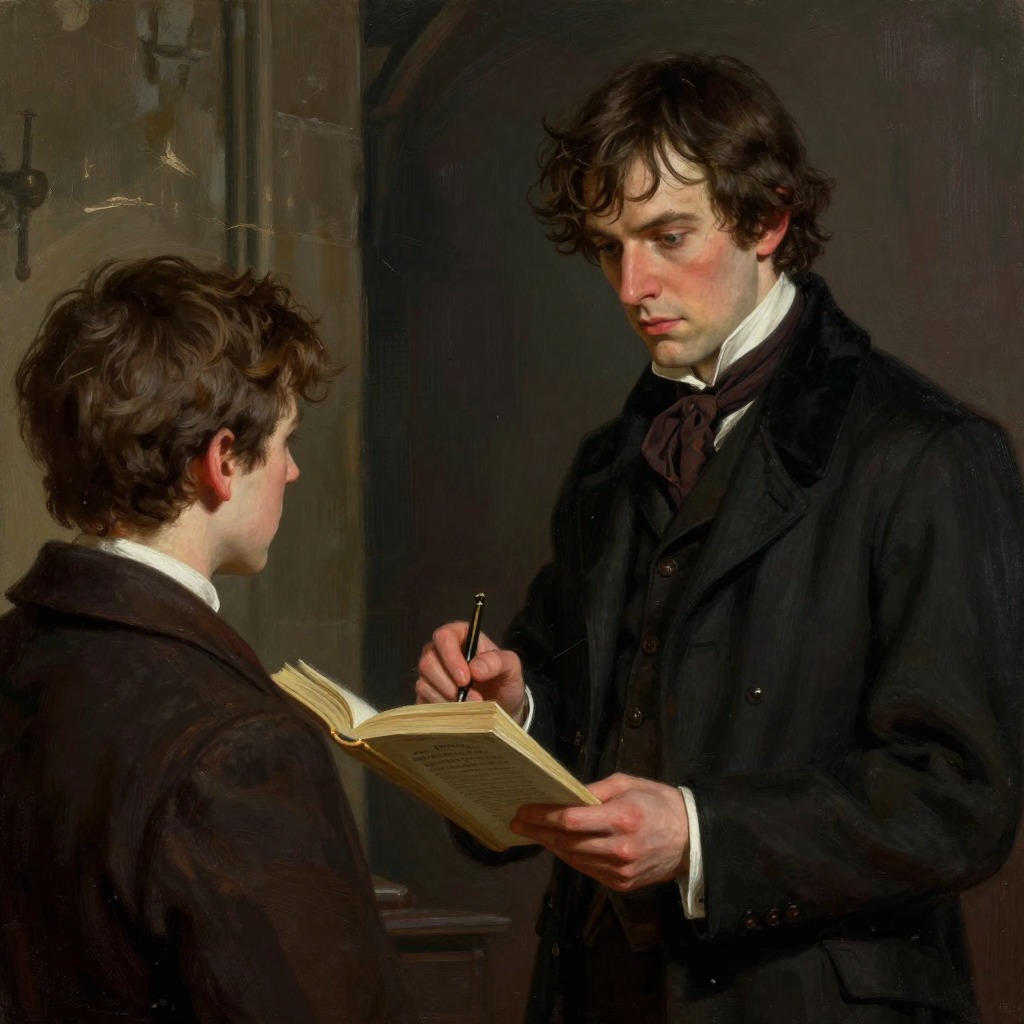
Ampleforth is introduced as part of the anonymous machinery of the long, windowless hall where Winston works, a place whose workers do not readily talk about their jobs. He is “a mild, ineffectual, dreamy creature” with very hairy ears and a surprising talent for juggling with rhymes and metres. His function is to produce garbled versions — “definitive texts”, they are called — of poems which have become ideologically offensive but which are still to be kept in the anthologies. He is thus the Party’s resident poet, an artist whose skill is valued only as an instrument of falsification. Like every Party member he lives under the unblinking scrutiny of the Thought Police; his friendships, his habits, even his characteristic movements are open to inspection, and no formulated law protects him, since in Oceania there is no law at all.
The Crime of a Rhyme
When Winston is imprisoned in the Ministry of Love, a young officer with a wax-mask face brings Ampleforth into his cell. The poet shambles in, shoeless, with dirty toes sticking through his socks and a scrubby beard, and at first does not notice Winston. Asked what he is in for, he answers that there is only one offence, and that apparently he has committed it. The offence, he explains, happened while he was producing a definitive edition of the poems of Kipling: “I allowed the word “God” to remain at the end of a line. I could not help it!” The rhyme, he insists, was the problem: “It was impossible to change the line. The rhyme was “rod”.” He adds, with the joy of a pedant who has discovered some useless fact, that there are only twelve rhymes to “rod” in the entire language, and asks Winston whether it has ever occurred to him that the whole history of English poetry has been determined by the fact that the English language lacks rhymes. In the cell, where night and day are indistinguishable and the lights are never turned out, this aesthetic scruple is his entire defence.
Taken to Room 101
Ampleforth’s ordeal never develops into a formal interrogation. The officer who brought him in returns later, indicates him with a brief movement of the hand, and says the words “Room 101”. Ampleforth marches clumsily out between the guards, his face vaguely perturbed but uncomprehending. He is one of the few prisoners who does not understand what is happening to him: a woman sent to the same room shrivels and changes colour at the sound of the words, and a starving man taken there flings himself on his knees and begs for any death — shooting, hanging, twenty-five years — rather than be led to that place. Ampleforth’s incomprehension is the measure of his innocence; he never knew that a loyalty to rhyme was a heresy capable of being punished.
Narrative Role
Winston’s relation to Ampleforth is brief but telling. In the canteen, during the week when he is trying to engineer a meeting with Julia, he spots Ampleforth wandering limply round the room with a tray, looking for a place to sit. In his vague way Ampleforth is attached to Winston, and would certainly sit down at his table if he caught sight of him; the threat of his company is what forces Winston to speak to Julia in the single available minute. Later, Ampleforth’s disappearance completes a pattern of destruction that also claims Syme, the Newspeak philologist who vanishes overnight and is erased from the Chess Committee list. But unlike Syme, Ampleforth is destroyed not by seeing too clearly but by caring too much about the wrong thing — the technical beauty of verse. He is the novel’s proof that the Party has no use for any private standard, however harmless, and that the artist who tries to serve it is consumed by it.