Community Centre
Nineteen Eighty-FourThe Community Centre is the institution through which the Party of Oceania colonises the spare time of its members, turning leisure into a checked and recorded duty. In Nineteen Eighty-Four it is the place a Party member is assumed to occupy whenever he is not working, eating or sleeping, and attendance is kept with the same care as any other official record. Winston Smith's second missed evening in three weeks is called a rash act precisely because "the number of your attendances at the Centre was carefully checked"; the taste for solitude that such an absence betrays falls under the Newspeak word Ownlife, meaning individualism and eccentricity. The Centre is therefore the soft engine of the system's war on private life, the daily point where boredom, surveillance and the fear of being noticed fuse into one experience.
The Compulsory Shape of Free Time
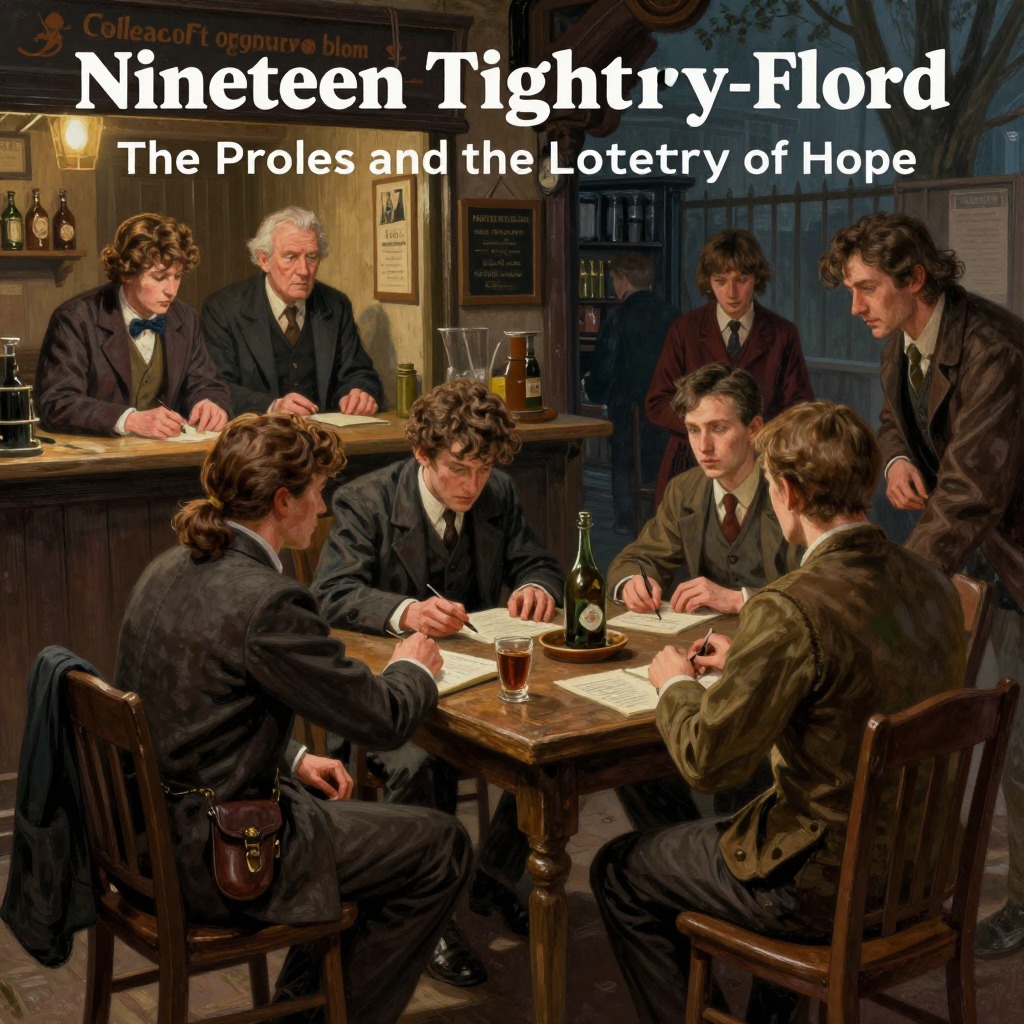
"In principle a Party member had no spare time, and was never alone except in bed," and the Community Centre is the concrete expression of that principle. It was assumed that when he was not working, eating or sleeping he would be taking part in some kind of communal recreation, while anything that suggested a taste for solitude — even going for a walk alone — was always slightly dangerous. What the Centre actually offers, in Winston's experience, is organised dullness: the solemn foolery of a discussion group, two games of table tennis, several glasses of gin, and a lecture on Ingsoc in relation to chess. The long, noisy evening at the Centre, with its boring, exhausting games and its creaking camaraderie oiled by gin, is described as intolerable precisely because it is compulsory. The boredom is not an accident of the institution but its method: the Centre absorbs attention that might otherwise turn inward, and its enforced cheerfulness is a form of discipline.
Parsons, the Perfect Regular
The Centre's model patron is Parsons. Winston's fellow-employee at the Ministry of Truth, a fattish but active man of paralysing stupidity and a mass of imbecile enthusiasms, Parsons would announce with quiet pride, between whiffs of his pipe, that he had put in an appearance at the Community Centre every evening for the past four years. His orthodoxy was not confined to attendance: he was a leading figure on the Sports Committee and on all the other committees engaged in organising community hikes, spontaneous demonstrations, savings campaigns and voluntary activities generally. The novel makes his zeal physically legible — an overpowering smell of sweat, an unconscious testimony to the strenuousness of his life, followed him about wherever he went and even remained behind him after he had gone. Parsons is the ideal subject because the Centre has nothing left to threaten: his conformity is so complete that it can be expressed as a number of evenings attended and as a smell left in a room.
Winston's Absences and the Alibi That Fails
For Winston the Centre works as an instrument of self-incrimination. The evening he yields to the mildness of the April air and wanders through the prole quarters is the second time in three weeks that he has missed the Centre, and he knows the omission may be counted against him because attendances are carefully checked. Later, after Julia's note has made him want to stay alive, he forces himself through the Centre's routines — the discussion group, the table tennis, the lecture, the gin — and his soul writhes with boredom, yet for once he has no impulse to shirk. When he imagines using the Centre as an alibi, hurrying to it and staying until it closed to establish a partial explanation for the evening, he recognises that even that refuge is impossible. The institution tracks him twice: as a recorded pattern of presence and absence, and as a place he can neither freely enter nor safely leave. Judging that his risky return to the junk-shop where he bought the diary was perhaps not more dangerous than shirking an evening at the Centre, he measures ordinary dissent in the currency of Centre attendance.
An Institution of the Totalitarian Everyday
The Community Centre belongs to the same system as the windowless Ministry of Love, though it presses on its subjects through boredom rather than pain. The Ministry of Love, reachable only through barbed-wire entanglements and hidden machine-gun nests, is the punitive terminus of the regime; the Centre is its everyday face, reminding members that even pleasure is owed to the collective. Orwell's stated aim in the years after Spain was to write every line of serious work against totalitarianism and for democratic socialism; the Centre is the institutional negation of that trust, an apparatus built on the assumption that every free hour must be policed. Orwell had diagnosed in the English Left "a sort of schizophrenic manner of thinking" in which words could bear two irreconcilable meanings, and the Centre daily enacts that split: everyone is present, nobody has chosen to come, and the checked record stands in for the missing enthusiasm. Like the falsified archives of the Ministry of Truth, the Centre converts the ordinary actions of an individual life into material for the Party's official version of reality; the smallest absence is already a fact in a file.