Eurasia
Nineteen Eighty-FourEurasia is one of the three super-states that divide the world of Nineteen Eighty-Four, and in 1984 it is Oceania's designated enemy. Covering the whole northern belt of the European and Asiatic land-mass, from Portugal to the Bering Strait, it is the largest of the three blocs; yet its boundaries, its alliances and even its existence as an enemy are continuously rewritten by the Party. More than a geographical rival, Eurasia is the novel's great test of memory and truth: the Party's claim that Oceania has always been at war with Eurasia is exactly the kind of lie that Winston Smith's diary sets out to resist.
Geography and Status
According to the forbidden book by Emmanuel Goldstein, The Theory and Practice of Oligarchical Collectivism, the division of the world into three super-states was foreseen before the middle of the twentieth century: with the absorption of Europe by Russia and of the British Empire by the United States, Eurasia and Oceania already effectively existed, while Eastasia emerged only after another decade of confused fighting. Eurasia covers the entire northern sweep of the European and Asiatic land-mass, stretching from Portugal to the Bering Strait. Its frontiers are in some places arbitrary and in others fluctuate with the fortunes of war, but in general they follow geographical lines; its defence rests on vast land spaces, just as Oceania is protected by the width of the Atlantic and the Pacific and Eastasia by the fertility and hard work of its inhabitants. In the inner-Party analysis that Winston reads and then reads aloud to Julia, Eurasia's philosophy is called Neo-Bolshevism, and it is barely distinguishable from Oceania's Ingsoc or Eastasia's Death-Worship—three versions of the same pyramidal structure, the same worship of a semi-divine leader and the same economy sustained by continuous warfare.
The Enemy as Spectacle
At the Two Minutes Hate, Eurasia appears not as a place but as a spectacle of menace. Emmanuel Goldstein, denouncing the Party and demanding peace with Eurasia, speaks against a screen image of endless columns of the Eurasian army—row after row of solid-looking men with expressionless Asiatic faces, their boots tramping in dull rhythm beneath his bleating voice. The image is designed to fuse the heretic and the foreign power into one object of automatic rage. The people of Eurasia are otherwise almost invisible; they are encountered only as enemies, in the officially announced hangings of Eurasian war criminals, or in the truckloads of prisoners that pass through Victory Square—small, sallow prisoners in shabby greenish uniforms, wearing leg-irons, their sad Mongolian faces utterly incurious. Even Winston, who pauses over the aged prisoner in the last truck, has no other vocabulary for them. The regime strips the Eurasian population of individuality so that hatred can be switched from one enemy to another like the flame of a blowlamp.
Origins in Wartime Geopolitics
Eurasia's fictional geography grew directly out of wartime realpolitik. As Thomas Pynchon notes in his introduction, Orwell projected the Allied occupation zones discussed at the Teheran Conference in 1943 onto the whole planet, turning the division of a defeated Germany and Poland into a division of a defeated world, and adding Eastasia even though China had not been part of the conference, because Orwell, who had served in the Far East, knew better than to ignore its weight. Traces of James Burnham's geopolitics appear in the arrangement: Burnham's victorious Japan becomes Eastasia, Russia as the pivotal heartland controls the Eurasian land-mass, and the Anglo-American alliance is transmogrified into Oceania. Orwell's own politics stood to the left of the official Left; he had gone to Spain in 1937 to fight fascism, and from 1936 onward every line of serious work he wrote was directed against totalitarianism and for democratic socialism. The Eurasia of the novel concentrates that menace—the will to power of a state that, in Orwell's diagnosis, the English Left had learned to accept as 'Socialist' while silently recognizing its alien spirit and practice, producing the 'schizophrenic manner of thinking' that became doublethink.
The Shifting Enemy and the Controlled Past
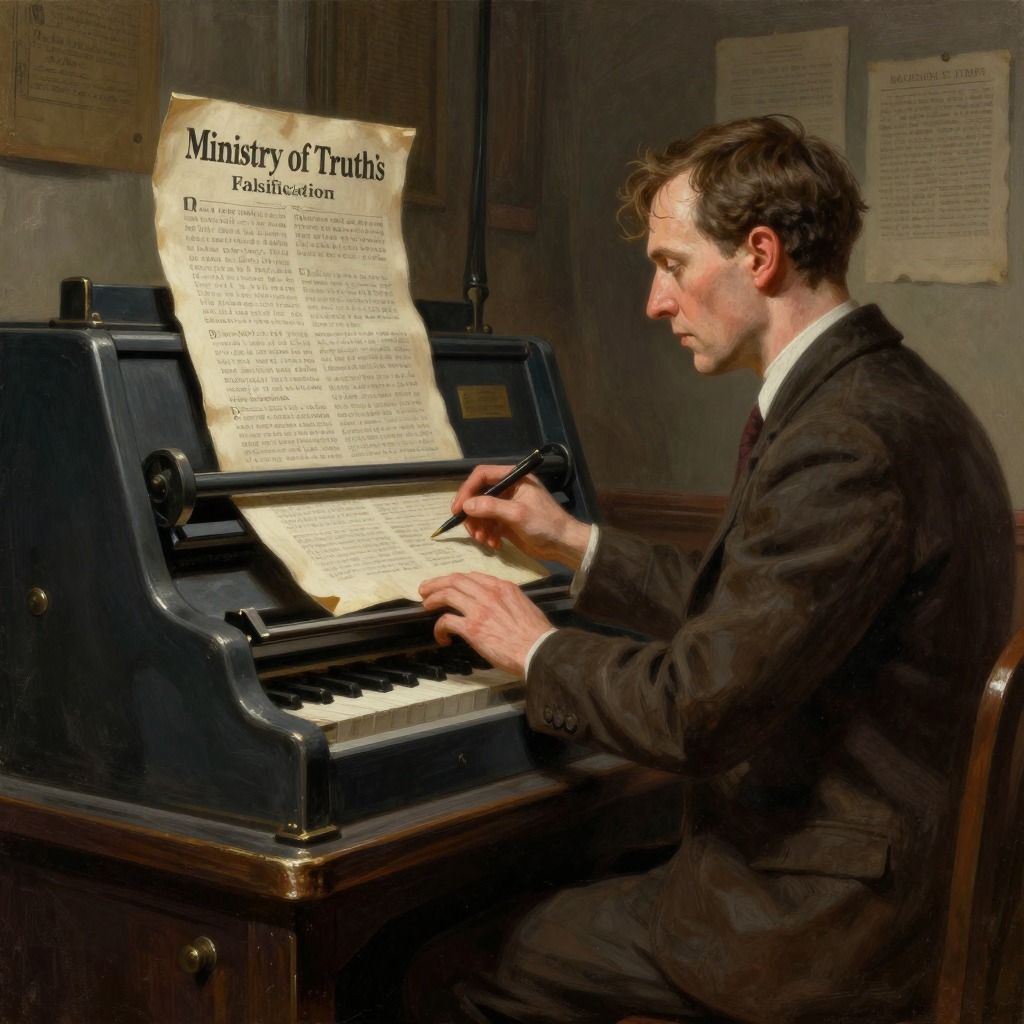
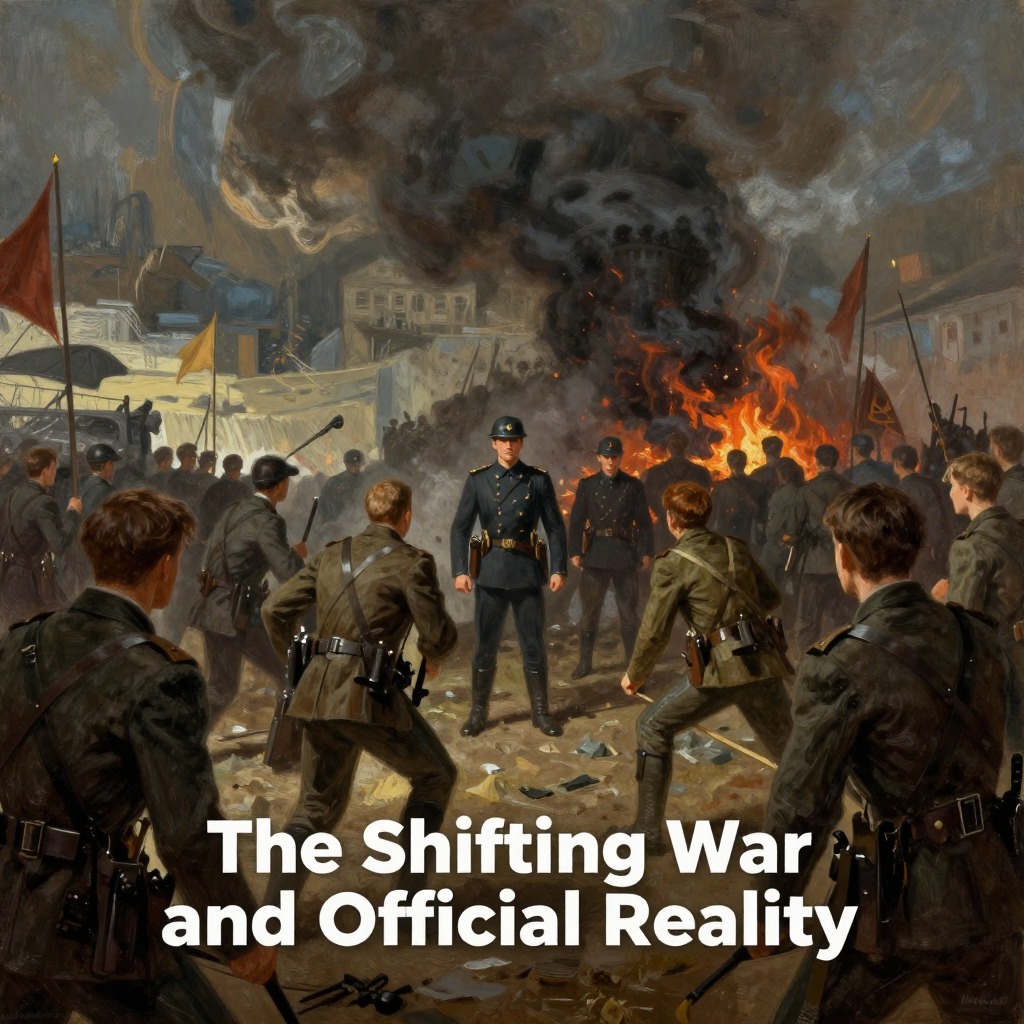
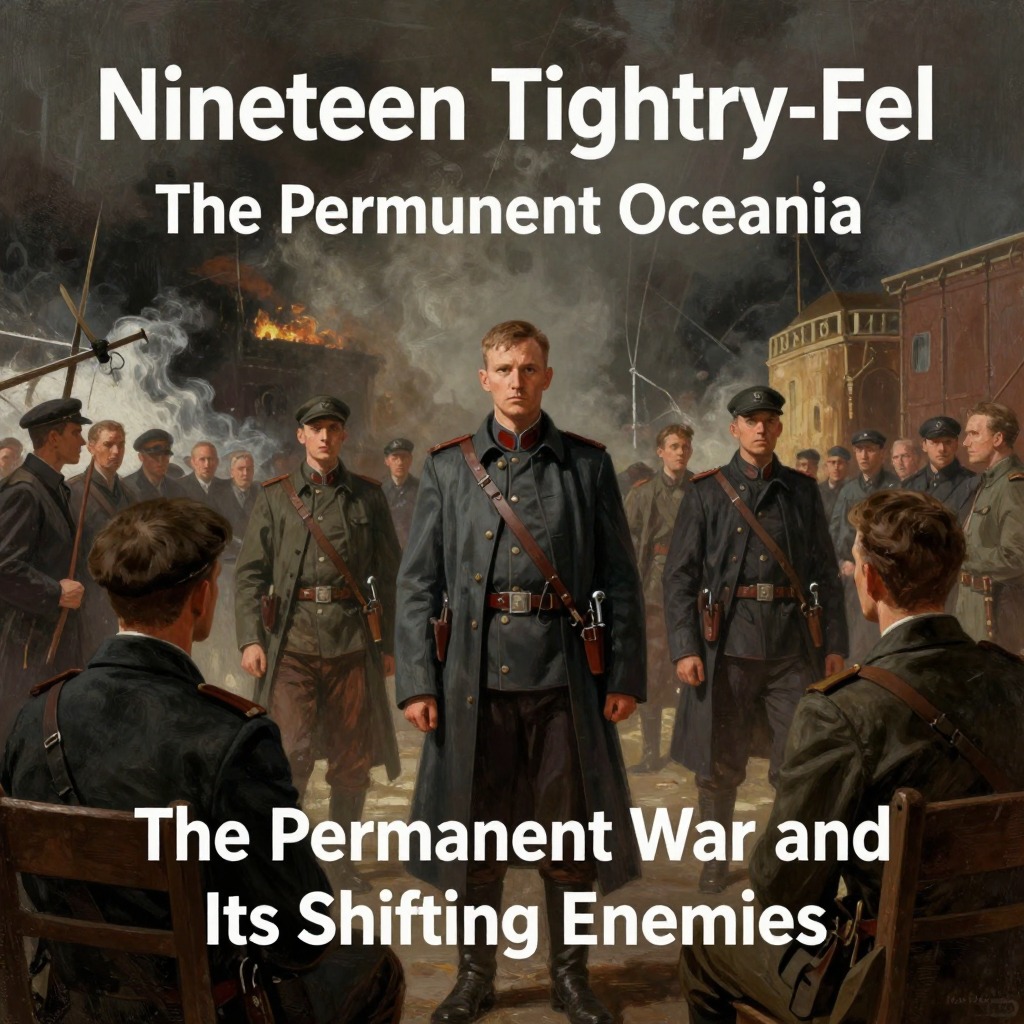
Within the plot, Eurasia's status is the clearest demonstration of the mutability of the past. On the day Winston begins his diary, Oceania is at war with Eurasia and allied with Eastasia; but Winston privately remembers that only four years earlier the alignment had been exactly reversed, and that no public or private utterance ever admitted it. During Hate Week the enemy is switched in mid-sentence: an orator denouncing Eurasia suddenly goes on denouncing Eastasia, without a pause or even a break in the syntax; banners and posters with the wrong faces are torn down as sabotage, and within a week the Records Department has worked eighteen-hour days to make it impossible to prove that the war with Eurasia ever happened. O'Brien later conducts the same operation inside Winston's mind, forcing him to repeat that Oceania has always been at war with Eastasia until he briefly sees five fingers.
Winston's own past is entangled with Eurasia in a more concrete way: the only documentary proof of falsification he ever held was a photograph of Jones, Aaronson and Rutherford, three men who had confessed to flying from a secret Canadian airfield to a rendezvous somewhere in Siberia and betraying secrets to the Eurasian General Staff—a confession the photograph showed to be a lie. By the end, in the Chestnut Tree Café, the war has reverted to its original shape: Oceania is at war with Eurasia again, a Eurasian army is moving south at terrifying speed, and Brazzaville and Leopoldville are said to be in danger. Eurasia thus ends the novel where it began, as the enemy of the moment, its perpetual reappearance the very meaning of the slogan War is Peace.