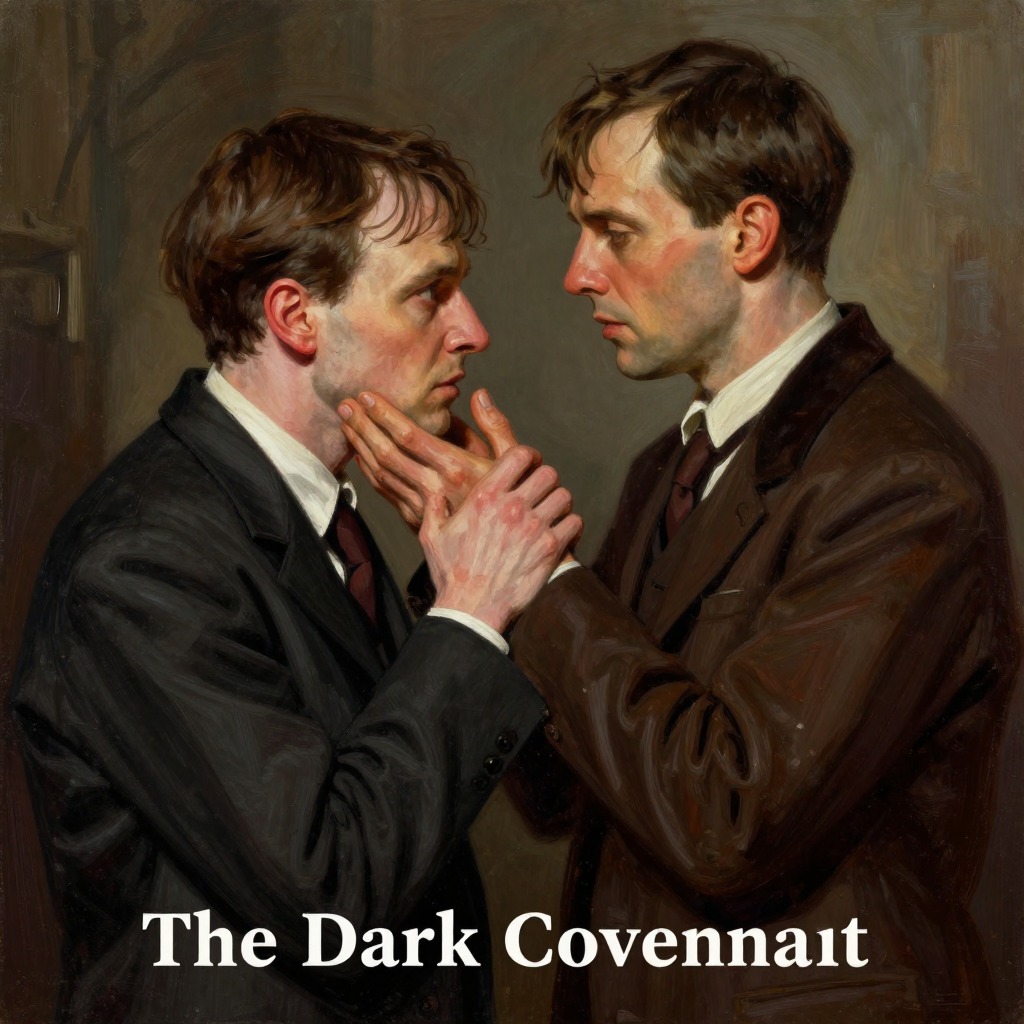
Eye Contact Between Winston and O'Brien
Nineteen Eighty-FourOne of the most consequential moments in Nineteen Eighty-Four is also one of the smallest. In the middle of the Two Minutes Hate, in the crowded Records Department of the Ministry of Truth, Winston Smith catches O'Brien's eye for a fraction of a second and is certain that a message has passed between them, a silent assurance that O'Brien is on his side. The narrative itself refuses to certify the event, closing the chapter with the hedge 'if, indeed, it did happen.' Yet this unverifiable glance becomes the seed of Winston's faith in a hidden conspiracy, the foundation of his trust in the man who will betray him, and the opening move of a seven-year surveillance that ends in the Ministry of Love.
The Hate and the Watchers
It is nearly eleven hundred, and the employees of the Records Department are dragging chairs from their cubicles and grouping them before the big telescreen for the daily Two Minutes Hate. Winston takes a place in the middle rows. O'Brien, an Inner Party member holding a post 'so important and remote' that Winston has only a dim idea of its nature, enters with the characteristic heaviness of his class: a 'large, burly man with a thick neck and a coarse, humorous, brutal face,' saved from menace by a trick of re-settling his spectacles on his nose, a gesture that recalls an eighteenth-century nobleman offering his snuff-box. Winston has seen him perhaps a dozen times in as many years and feels deeply drawn to him, not only by the contrast between urbane manner and prizefighter's physique but by a secretly held hope that O'Brien's orthodoxy is imperfect. O'Brien glances at his wristwatch, decides to stay until the Hate is over, and takes a chair in Winston's row, a couple of places away; the dark-haired girl from the Fiction Department, Julia, though Winston does not yet know her name, sits immediately behind them.
The Hate itself provides the emotional weather for the glance. As the face of Emmanuel Goldstein flashes onto the screen, O'Brien's heavy face flushes, his powerful chest swelling as though standing up to a wave; the dark-haired girl cries 'Swine! Swine! Swine!' and flings a heavy Newspeak dictionary at the screen; Winston finds himself shouting with the others and kicking his heel against the rung of his chair. The rage, he recognises, is abstract and undirected, an emotion which could be switched from one object to another like the flame of a blowlamp: at one instant his hatred turns not against Goldstein but against Big Brother, the Party and the Thought Police, and his heart goes out to the lonely, derided heretic on the screen; the next instant he is at one with the crowd. At the climax the face melts into that of a Eurasian soldier, then into the vast face of Big Brother, and the room breaks into the slow, savage rhythmical chant of B-B. Winston's entrails grow cold; he chants with the rest because it is impossible to do otherwise, and for a couple of seconds the expression in his eyes might conceivably betray him.
The Glance
At exactly this moment the significant thing happens. O'Brien has stood up; he takes off his spectacles and is in the act of re-settling them on his nose with his characteristic gesture when their eyes meet. For a fraction of a second Winston knows — yes, he knew! — that O'Brien is thinking the same thing he is. An unmistakable message passes, as though their two minds had opened and the thoughts were flowing from one into the other through their eyes. O'Brien seems to be saying that he knows all about Winston's contempt, his hatred, his disgust, and that Winston need not worry; he is on his side. Then the flash of intelligence is gone and O'Brien's face is as inscrutable as everybody else's.
That, the chapter insists, was all — and already Winston cannot be certain it happened. Such incidents, he reflects, never have any sequel; their only function is to keep alive the belief, or hope, that others besides himself are enemies of the Party. Perhaps the rumours of vast underground conspiracies are true and the Brotherhood really exists; but it is impossible, amid the endless arrests, confessions and executions, to be sure that the Brotherhood is not a myth. Some days he believes in it, some days not. There is no evidence: only snatches of overheard conversation, faint scribbles on lavatory walls, once a small movement of hands between two strangers that might have been a signal of recognition. He goes back to his cubicle without looking at O'Brien again; to follow up the contact would be inconceivably dangerous. Still, the two seconds of an equivocal glance are a memorable event in the locked loneliness in which one had to live.
From Glance to Trap
The glance acquires retrospective meaning almost at once. Later that day, still rubbing the sting of a catapult bullet on his neck, Winston finds himself thinking of O'Brien again and remembers a dream from seven years earlier: he was walking through a pitch-dark room and someone sitting to one side said, very quietly and almost casually, 'We shall meet in the place where there is no darkness.' Only later, by degrees, did the words take on significance, and at some point he identified the voice as O'Brien's. He could never be sure whether O'Brien was friend or enemy, but it did not even seem to matter greatly: there was a link of understanding between them more important than affection or partisanship, and Winston did not know what the phrase meant, only that in some way it would come true. The dream, and the glance that seemed to confirm it, eventually make O'Brien the imagined reader of the diary Winston has just begun: he writes it for O'Brien, to O'Brien, like an interminable letter no one will ever read but which takes its colour from being addressed to a particular person.
In Part II, the pattern completes itself. O'Brien approaches Winston in a Ministry corridor, praises his Newspeak article, and manages to let him know his address, scribbled beneath the telescreen where any watcher could read it. To Winston this is unmistakable: the conspiracy he has dreamed of did exist, and he had reached the outer edges of it. He knows he will obey the summons, and he understands the process that has brought him there — a first secret, involuntary thought; the opening of the diary; the move from thoughts to words and now to actions, with the last step waiting in the Ministry of Love. As he puts it, 'The end was contained in the beginning.'
In the Ministry of Love the meaning of the glance is finally, brutally disclosed. When O'Brien enters Winston's cell, Winston cries out, 'They've got you too!' and O'Brien answers with mild, regretful irony: 'They got me a long time ago.' He tells Winston that he has always known it. Later, during the long interrogation, a voice murmurs in Winston's ear, 'Don't worry, Winston; you are in my keeping. For seven years I have watched over you. Now the turning-point has come. I shall save you, I shall make you perfect.' Winston cannot be sure it is O'Brien's voice, but it is the same voice that spoke in the dream of the place where there is no darkness. O'Brien confirms the connection: 'I told you, that if we met again it would be here.' The glance that once seemed like an alliance is revealed as the beginning of a trap — or, in O'Brien's own account of his authorship of Goldstein's book, as part of a performance so total that the performer and the performance have become indistinguishable.
Doublethink and Dramatic Irony
The scene is built on doublethink before the word has even been defined in the diary. To know and not to know, to hold simultaneously two opinions which cancel out, to be conscious of complete truthfulness while telling carefully constructed lies — the definition Winston later works out during the Physical Jerks describes exactly his own condition at the moment of the glance. He knows a message has passed; he immediately doubts it. O'Brien, meanwhile, will prove to be the consummate embodiment of doublethink: in the words of this edition's introduction, he is 'Winston's seducer and betrayer, protector and destroyer,' believing with utter sincerity in the regime he serves while impersonating perfectly a devout revolutionary committed to its overthrow. The glance is the first perfect act of that impersonation.
The larger political irony is that the unverifiable look does exactly the work the Party requires. It converts hope into quasi-belief, drives Winston toward the Brotherhood, or toward whatever apparatus will catch him, and leads him into the lengthy, terrifying process of re-education that readers of the book, primed by the era's talk of Pavlovian brainwashing, could recognise as the nightmare core of the novel. Winston will end by loving what the glance seemed to oppose. The eye contact between Winston and O'Brien is thus both the novel's smallest event and one of its most powerful mechanisms: a moment of apparent solidarity that turns out to be the first link in the chain of obedience, betrayal and self-annihilation.