He loved Big Brother
Nineteen Eighty-FourThe final sentence of Nineteen Eighty-Four — "He loved Big Brother" — is the quietest and most devastating line in the book, the point at which the Party's power is shown to have achieved its real object. Spoken in the third person and in the past tense, it belongs to Winston Smith, the diarist who once filled half a page with "DOWN WITH BIG BROTHER", and it records not his death but his conversion: the rebel has won the only victory the regime recognizes, the victory over himself.
The Last Scene at the Chestnut Tree Café
The sentence falls at the end of a long, almost silent scene in the Chestnut Tree Café, the old haunt of painters and musicians where the discredited leaders of the Party had once gathered. Winston sits in his usual corner with an empty glass before him; the vast face on the opposite wall still carries the caption BIG BROTHER IS WATCHING YOU; an unbidden waiter brings the chessboard, the current issue of the Times turned down at the chess problem, and the bottle of Victory Gin flavoured with saccharine and cloves. A bulletin announces a great victory in Africa, and in that moment the "final, indispensable, healing change" that has never happened to Winston until now finally occurs.
The closing paragraph is a study in false consolation. Gazing up at the enormous face, Winston reflects that it has taken him forty years to learn what kind of smile was hidden beneath the dark moustache. "O cruel, needless misunderstanding! O stubborn, self-willed exile from the loving breast!" — the language of a prodigal's homecoming is poured out upon the Party's icon, and two gin-scented tears trickle down the sides of his nose. "But it was all right, everything was all right, the struggle was finished. He had won the victory over himself." The flat serenity of the prose is the horror: the man who had once dreamed of the "long-hoped-for bullet" entering his brain no longer needs it, because the release has come in another form.
The Road to the Final Line
The line is the terminus of an arc that began with the diary. Winston's first act of rebellion was to write "DOWN WITH BIG BROTHER" over and over again until it filled half a page; even then he knew that the Thought Police would get him just the same. In the Two Minutes Hate his emotions could be switched like the flame of a blowlamp: at one moment his heart went out to the heretic on the screen and his secret loathing of Big Brother changed into adoration, and the next instant he was at one with the crowd. He had written that "Freedom is the freedom to say that two plus two make four", and under torture in the Ministry of Love he had held out for four through the raising of O'Brien's fingers before at last screaming "Five! Five! Five!". He had once believed that "To die hating them, that was freedom".
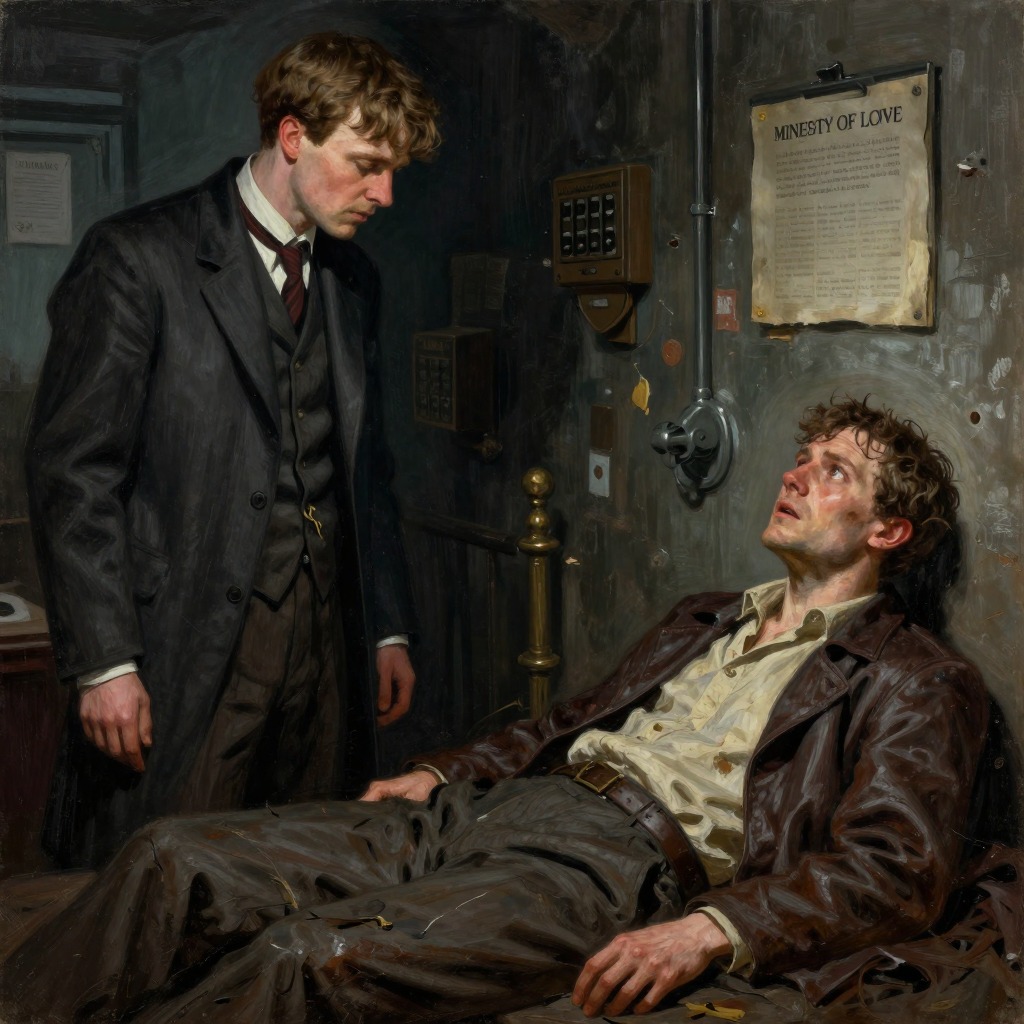
The conversion is managed by O'Brien. Asked for his true feelings, Winston answers, "I hate him." O'Brien's response is the hinge of the book: "Then the time has come for you to take the last step. You must love Big Brother. It is not enough to obey him: you must love him." Between that command and its fulfilment lie Room 101 and the wire cage of rats, and Winston's cry of "Do it to Julia! Do it to Julia! Not me!" — the moment in which he offers up the woman he loves to save himself. O'Brien had already explained the Party's aim: "We make him one of ourselves before we kill him." The final sentence of the novel proves the boast was not empty.
The Meaning of the Sentence
"He loved Big Brother" completes the novel's central act of doublethink: love and hatred, obedience and will, self and Party have become indistinguishable. Julia had promised that "They can't get inside you"; the final chapter recalls that promise and answers it — they could get inside you. O'Brien had told Winston that he was "the last man", that "your kind is extinct"; the sentence confirms the extinction by showing the last man loving the force that erased him. Even sanity has become statistical, a matter of learning to think as the Party thinks.
The larger pattern of the novel makes the line all the darker. The love story with Julia ends not in reunion but in a cold March meeting in the Park, where Julia, her body thickened and stiffened, says "I betrayed you" and Winston answers "I betrayed you"; what remains of his capacity for love is then transferred to the face on the wall. The same chapter sounds one last note from the abolished past as Winston remembers the Snakes and Ladders afternoon with his mother, a memory he at once dismisses as false. The chess problem set before him states the law of the world: "White always mates." "He loved Big Brother" is the checkmate — a happy ending, and the novel's own introduction calls it "as dark an ending as can be imagined".