If there is hope, it lies in the proles
Nineteen Eighty-FourWinston Smith writes the sentence 'If there is hope, it lies in the proles' in his diary during a moment of despair, after contemplating the impossibility of overthrowing the Party from within. The phrase becomes a recurring motif in his private reflections, representing his last anchor of faith in a world where every other avenue of resistance seems closed. The proles, who make up 85 percent of Oceania's population, are the only group the Party does not bother to indoctrinate systematically; they are left to live according to their own ancestral patterns, loyal to one another rather than to any ideology. Winston clings to this idea as a counterweight to the overwhelming power of the Thought Police and the endless falsification of history.
Origin and First Appearance
The sentence first appears in Chapter VII of Part I, when Winston, alone in his flat after a day of routine forgery at the Ministry of Truth, writes it as a stark declaration. He has just finished copying a passage from a children's history textbook that parodies the Party's official version of pre-Revolutionary life, and the contrast between the lies fed to the masses and the mute protest in his own bones drives him to seek hope in the one class the Party despises. The diary itself is an act of thoughtcrime punishable by death, and the sentence is written with the full knowledge that it may never be read by anyone else.
Meaning and Rationale
Winston's reasoning is that the Party cannot be overthrown from within because its enemies have no way of identifying one another or assembling. The proles, however, if they could become conscious of their own strength, would need only to rise up and shake themselves like a horse shaking off flies. He observes that the proles have remained human: they are not loyal to a party or a country or an idea, but to one another. They have held on to primitive emotions that Party members have lost, such as the ability to love without calculation. In contrast, Party members live under constant surveillance, their every action scrutinised, their instincts suppressed by sexual puritanism and ideological conditioning.
Development Through the Plot
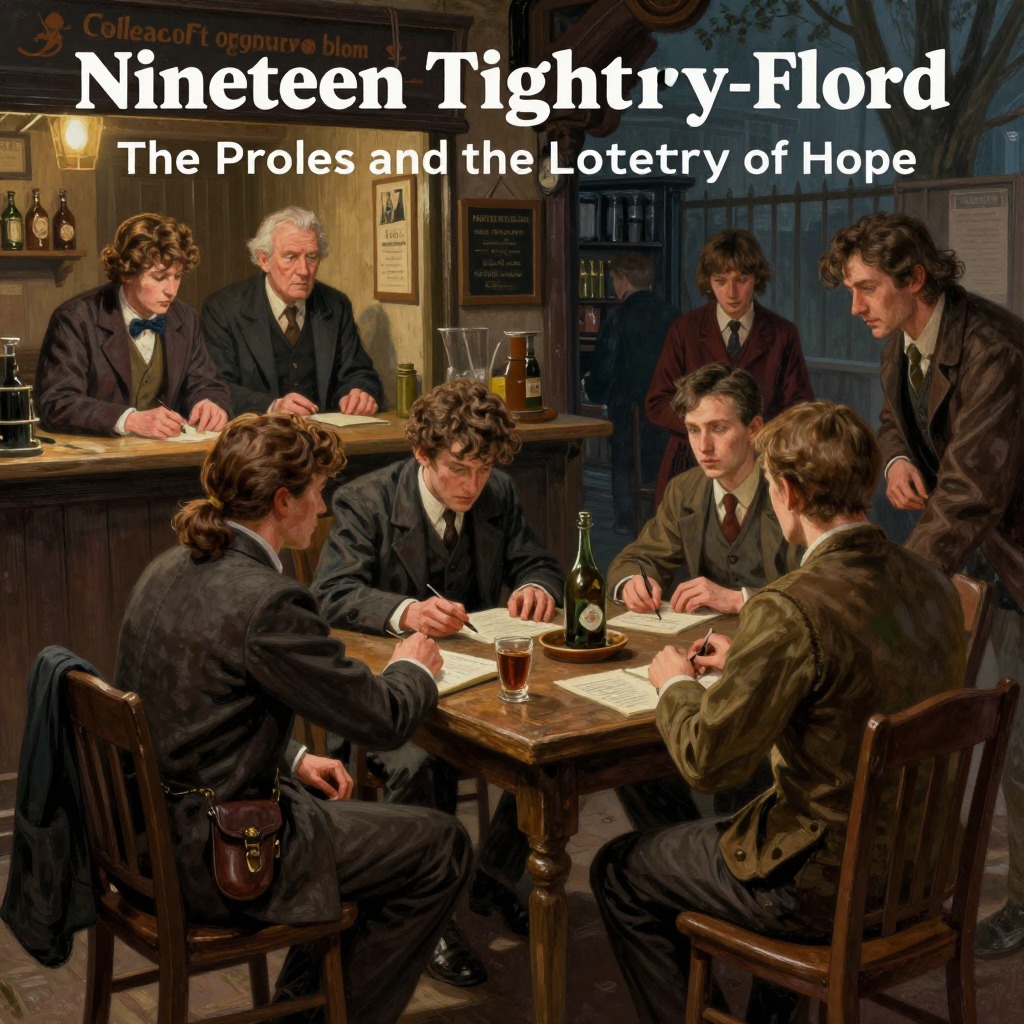
Throughout the novel, Winston tests his belief against the reality he encounters. He walks through prole neighbourhoods and sees a mob of women fighting over tin saucepans, a severed hand kicked into the gutter, and men arguing passionately about the Lottery—a state-run fraud. He tries to question an old man in a pub about life before the Revolution, but the old man's memory is a rubbish-heap of trivial details, incapable of providing the historical comparison Winston seeks. The proles, he realises, are not conscious of their oppression; they lack the intellectual framework to rebel. Yet he continues to repeat the sentence to himself, especially in moments of crisis, as when he and Julia are about to be arrested. Standing at the window of the room above Mr Charrington's shop, watching a prole woman singing while pegging out diapers, he feels a mystical reverence for her vitality and concludes that the future belongs to the proles.
Thematic Significance and Final Fate
The sentence embodies Winston's last hope, but the novel systematically undermines it. The Party's power is absolute: it controls all records, all memories, and even the language through Newspeak. The proles are kept in a state of perpetual ignorance, their minds filled with rubbishy entertainment and false news. Winston's faith is a form of wishful thinking, a desperate attempt to find meaning in a world where the Party has abolished history and truth. In the end, after torture in the Ministry of Love, Winston betrays Julia and learns to love Big Brother. The hope that lay in the proles is revealed as an illusion; the Party is immortal, and the proles will never revolt. The sentence thus becomes a tragic marker of Winston's doomed rebellion, a belief that the novel's conclusion shows to be both necessary and impossible.