Ingsoc
Nineteen Eighty-FourIngsoc, the Newspeak contraction of English Socialism, is the official ideology of the superstate Oceania in Nineteen Eighty-Four. It is not merely a party programme but a total system for manufacturing and abolishing facts, memories, desires and thoughts. The word first confronts the reader on a torn street poster that flaps in the wind, alternately covering and uncovering the single word INGSOC, while the face of Big Brother watches from every commanding corner. Above the Ministry of Truth stand the Party's three slogans, War is Peace, Freedom is Slavery and Ignorance is Strength, and Ingsoc is the doctrine those slogans serve. The novel's introduction sees Ingsoc as what results when a compromised official Left projects its will to power four decades into the future.
Definition and Origin
Ingsoc grows out of George Orwell's insistence, after fighting in the Spanish war, that every line of serious work he had written since 1936 was written against totalitarianism and for democratic socialism. Orwell was angered that nearly the whole of the English Left accepted the Russian regime as socialist while silently recognizing that its spirit and practice were alien to socialism, a condition he described as a schizophrenic manner of thinking in which words like democracy could bear two irreconcilable meanings and concentration camps and mass deportations could be right and wrong simultaneously. Ingsoc fictionalises that condition: English Socialism in name, oligarchical tyranny in substance. The introduction to the novel suggests that the British Labour Party's experience of power, projected four decades forward, could easily end up producing Ingsoc, Oceania and Big Brother.
Doctrine and Public Face
Ingsoc presents itself through an unbroken visual presence. The black-moustachio'd face of Big Brother gazes down from posters with the caption BIG BROTHER IS WATCHING YOU, while a smaller poster, torn at one corner, flaunts the word INGSOC. On the Ministry of Truth, the Party's three slogans are inscribed in elegant lettering: War is Peace, Freedom is Slavery, Ignorance is Strength. The entire apparatus of government is divided among four Ministries whose Newspeak names deliberately reverse their functions: the Ministry of Truth concerns itself with news, entertainment, education and the fine arts; the Ministry of Peace with war; the Ministry of Love with law and order; and the Ministry of Plenty with economic affairs. The Ministry of Love is the really frightening one, a windowless place guarded by barbed-wire entanglements, steel doors, hidden machine-gun nests and gorilla-faced guards in black uniforms.
Surveillance and Daily Discipline
Ingsoc operates through continuous surveillance. The telescreen receives and transmits simultaneously, so any sound above a low whisper is picked up and any movement within its field of vision is seen. There is no way of knowing whether one is being watched at any given moment, and citizens must live in the assumption that every sound is overheard and every movement scrutinised. The Thought Police can plug into any individual wire whenever they choose.
The disciplines of Ingsoc extend into the body and the calendar. A whistle at nought seven fifteen wakes office workers, and the Physical Jerks begin three minutes later under the barking of an instructress. A member of the Outer Party receives only three thousand clothing coupons annually, so that a suit of pyjamas costs a fifth of a year's clothing allowance. The condition is also lawless in a precise sense: nothing is illegal, because there are no longer any laws, yet opening a diary, if detected, is reasonably certain to be punished by death or at least twenty-five years in a forced-labour camp.
Language, Memory and Science
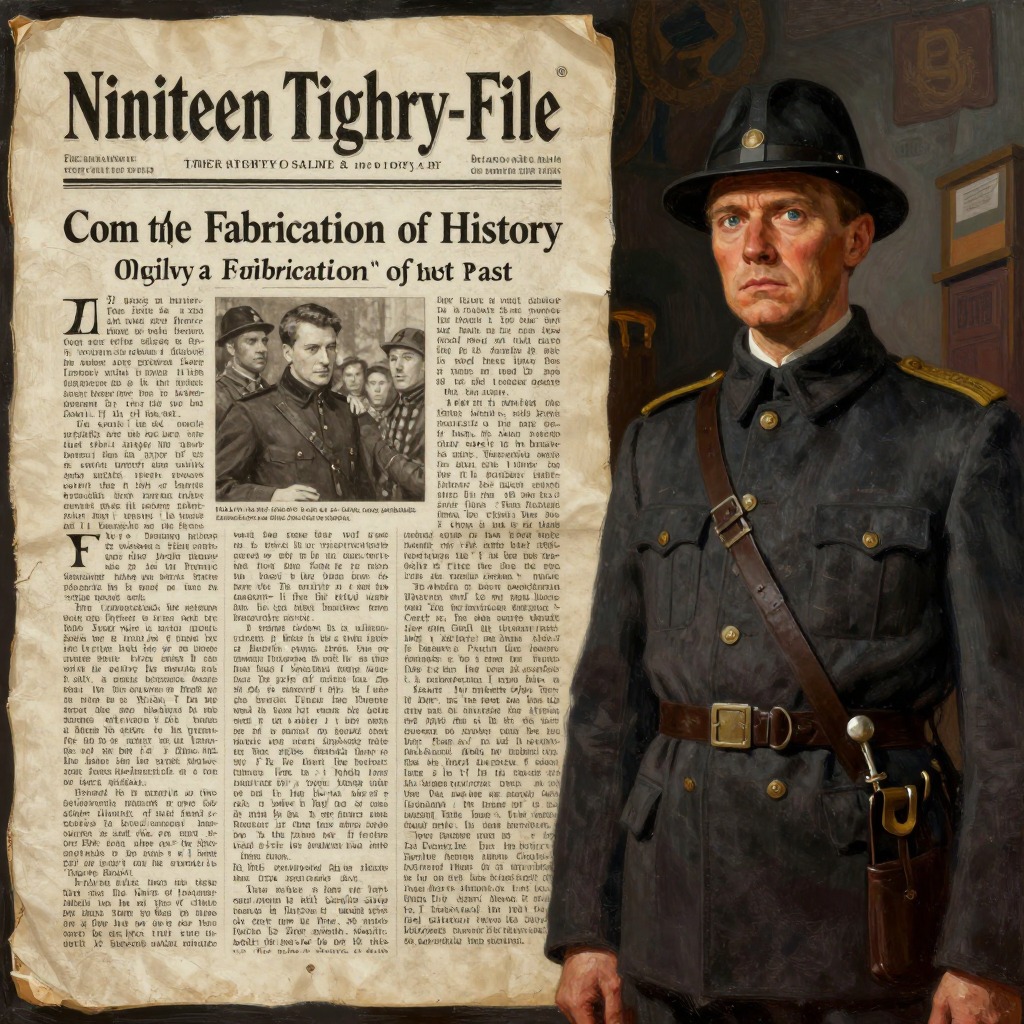
Ingsoc's most distinctive achievements are acts of forgetting. The schizophrenic mental habit Orwell identified in the English Left becomes the Party's central mental discipline, doublethink: the ability to hold two contradictory truths at once. The Ministry of Truth enforces this by rewriting the past, denying the memories of others and annihilating history on a daily basis, so that the lie becomes truth and the erasure is itself forgotten.
The same ideology strangles empirical thought. The glittering future of glass and steel that had seemed natural in the early twentieth century failed to arrive, in part because scientific and technical progress depended on the empirical habit of thought, which cannot survive in a strictly regimented society; as a whole the world of Oceania is more primitive than the world of fifty years earlier. The machine, which could have eliminated hunger, overwork, dirt, illiteracy and disease, is instead used to preserve inequality. Fields are cultivated with horse-ploughs while books are written by machinery, and scientific research survives mainly to discover what other people are thinking and to kill several hundred million people at short notice.
Significance
Ingsoc is the doctrine that makes plausible the novel's most chilling symmetries. The four Ministries bear names that are deliberate exercises in doublethink, and the Ministry of Love, which maintains law and order, is the place where Winston Smith is tortured into loving Big Brother. The torn poster that alternately reveals and hides the word INGSOC is an image of the ideology itself, which rewrites the past so that it never happened and then makes the denial of the denial disappear. As the introduction observes, projecting the will to power of the post-war Labour Party four decades forward could easily end up with Ingsoc, Oceania and Big Brother; the warning is that the tendency is already present, not that the outcome is fated.