Lottery
Nineteen Eighty-FourThe Lottery is the state lottery of Oceania, run by the Ministry of Plenty, and, in Winston Smith's observation, "the one public event to which the proles paid serious attention". Week by week it offers enormous prizes to the proles - the eighty-five per cent of Oceania's population who stand outside the Party - for whom, in Winston's estimation, it is "the principal if not the only reason for remaining alive". Yet its prizes are largely imaginary and its big winners are non-existent persons, and the whole apparatus runs on a fraud that every Party member knows. The Lottery is therefore at once the proles' chief consolation and the clearest everyday demonstration of how the Party manages the hopes of the ruled without ever letting them see the hand that manages them.
The proles' one serious passion
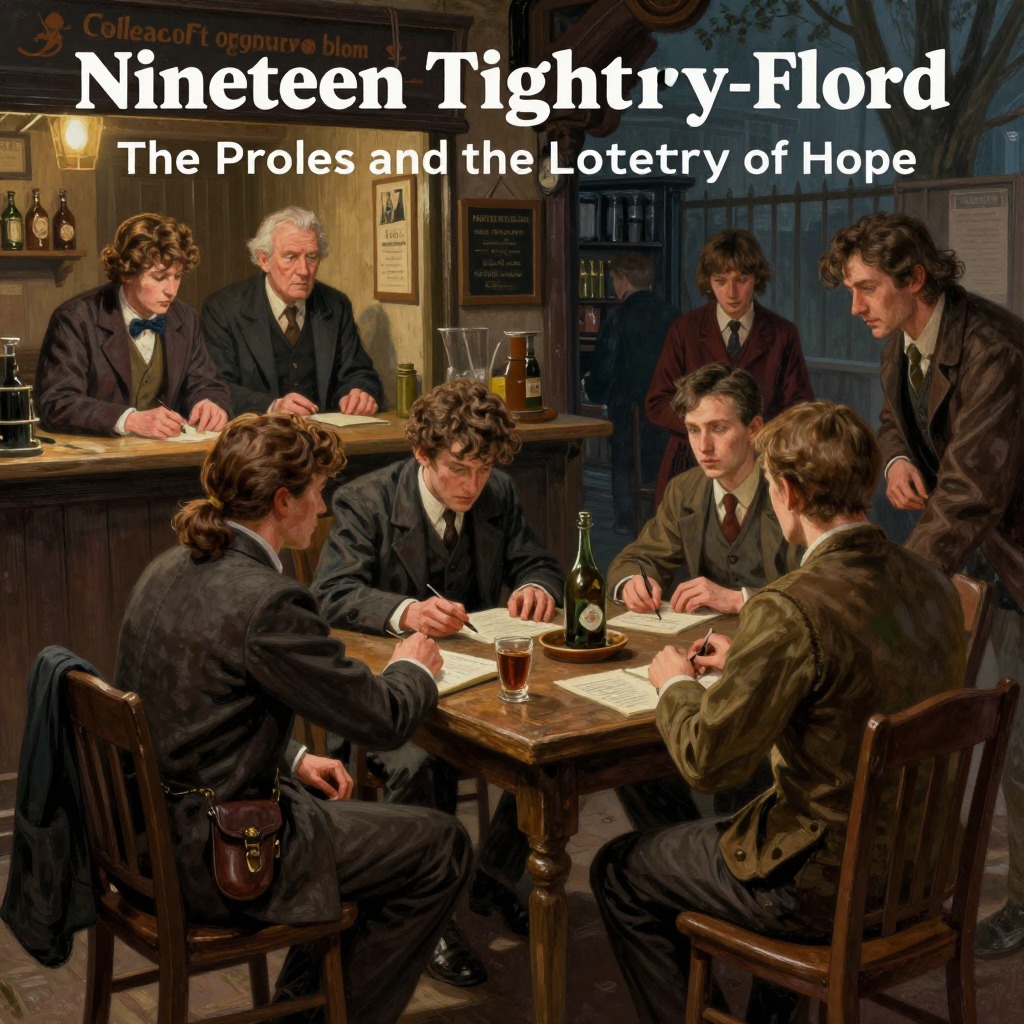
The Lottery towers over the inner life of the proles because nothing else does. In Winston's phrase it is "their delight, their folly, their anodyne, their intellectual stimulant", and some millions of proles treat the weekly draw as the thing that makes life worth enduring. The devotion it commands exceeds anything the Party obtains through its own propaganda: people who can barely read or write are capable of intricate calculations and staggering feats of memory where the Lottery is concerned, and a whole tribe of men makes a living simply by selling systems, forecasts and lucky amulets. In the drinking-shops of the poorer quarters the conversation turns to the draw as a matter of urgent personal business.
The imaginary prize
What the proles are actually playing for is largely a fiction. Only small sums are ever paid out; the winners of the big prizes are non-existent persons, invented names of the same administrative species as the Party's Unpersons, with the direction reversed - the Unperson is someone who existed and is erased from the record, while the Lottery's prizewinner never existed and is treated as real. The fraud is easy to maintain because there is no real intercommunication between one part of Oceania and another, so no winner can be checked and no prize verified. Winston has nothing to do with running the Lottery, but he knows this, and everyone in the Party knows it; the deception is one of the regime's open secrets, sustained not by concealment but by the absence of any standard of comparison among the people it cheats.
Passion in the street
The emotional reality of the Lottery is displayed in a chance scene Winston witnesses on his walk through the prole quarters. Three men stand close together reading a newspaper, and within moments two of them are in violent altercation, almost at blows. One insists that no number ending in seven "ain't won for over fourteen months"; the other swears a seven has won - "Four oh seven, it ended in", in the second week of February. Their faces are vivid and passionate, and the dispute plainly carries a weight out of all proportion to the facts at issue. Later, in the pub where Winston questions an old man about the pre-revolutionary past, the knot of men at the bar falls to talking about lottery tickets, and Winston's presence is forgotten in the absorbing business of the numbers.
The management of hope
The Lottery belongs to the same architecture of false promise as the Ministry of Plenty's "categorical pledge" that there would be no reduction of the chocolate ration during 1984 - issued, as Winston knows, at almost the very moment when the reduction from thirty grammes to twenty was being arranged. But the Lottery is more than a hoax: it is a machine for the management of hope itself. In O'Brien's account of the Party's philosophy, the Party "seeks power entirely for its own sake", and power lies in "tearing human minds to pieces and putting them together again in new shapes of your own choosing". The Lottery shows the gentle, everyday face of that project: a weekly ritual that gives millions a reason to live and a focus for their calculating energy, resting on prizes that do not exist. The same conquest of belief that the Lottery practises on the proles is finally enacted on Winston himself, who ends the novel loving Big Brother; the phantom prizewinner and the converted Winston are, in the end, products of the same power - the power to make the unreal seem the only reality.